86-15852949220      mt@alasmachinery.com
NANJING ALAS INTERNATIONAL CO., LTD
You are here: Home » Products » Press Brake Tooling » Press Brake V Die

Product Category

Contact Us

loading

Share to:
sharethis sharing button

Press Brake V Die

Made of premium 42CrMo (SCM440) steel with high strength and load capacity. Induction hardened to HRC 47±3 for durable V-opening wear resistance. CNC precision grinding ensures precise straightness, parallelism and consistent bending angles. Available in Single-V, Double-V, Multi-V and adjustable V-Die for various sheet thicknesses. Ideal for sheet metal bending in automotive, aerospace, appliance and steel fabrication.
Availability:
Quantity:

Achieving Micron Precision: CNC Grinding of Press Brake V Dies

Precision is the heart of every bend. In this video, we showcase the fine grinding process of our high-quality press brake bottom dies.
Straightness Control: Our surface grinding ensures absolute parallelism over the entire length (up to 6 meters).
Heat Management: High-flow coolant prevents thermal deformation, preserving the integrity of the 42CrMo steel.
The Result: Consistent bending angles and a flawless finish on your sheet metal parts.
Upgrade your bending accuracy with our precision-ground tooling!


Press Brake V Die Wear-resistant

In sheet metal fabrication, bend accuracy depends on your bottom tools. High-performance V dies help make precise bends and reduce marks on material. Choosing the right single‑V, double‑V, or multi‑V die is important for consistent production.

Why ALAS V Dies Improve Bending Accuracy

Strong Material: 42CrMo Steel

  • ALAS V dies use high-quality 42CrMo alloy steel.

  • They are heat-treated and precision-ground for extra strength.

  • Hardened to resist wear and stay stable under high pressure.

  • Hardness: HRC 45–50, so they do not break or deform easily.

  • Keeps V-groove shape accurate for long-term use.

Works for Many Bending Jobs

  • We offer custom V dies for different material thicknesses and machines.

  • CNC-ground to tight tolerances.

  • Compatible with European, American, and New Standard clamping systems.

  • Available in single-V and multi-V styles.

  • Works for thin sheet metal and heavy plate.

  • Reduces cracking and makes bending smoother.

Our V dies give you durability and precision for complex bending jobs. We provide standard parts and custom tooling. ALAS is your trusted partner for high-performance press brake V dies.

How Press Brake Dies Work

Upper Die

  • Mounted on the moving slider.

  • Applies downward pressure.

  • Shape decides the outside of the bent part.

Lower Die (V Die)

  • Fixed on the machine table.

  • Has a V-shaped groove.

  • V-width affects bending force, radius, and finish.

Working Principle

  1. Place sheet metal on the lower die.

  2. Upper die moves down and presses the sheet.

  3. Metal bends permanently to match the dies.

  4. Upper die returns; workpiece is removed.


Features of Press Brake Dies

  • Strong and wear-resistant

    Made of hardened alloy steel to handle high pressure and friction.

  • Customizable

    Punches and V-grooves can be made in different shapes and sizes.

  • Fits your machine

    Matches your press brake’s clamping, stroke, and tonnage.

  • Standard and custom options

    Standard dies fit most machines; special dies can be ordered.


Types of Press Brake Dies

By Shape

  • Standard straight-edge: For general bending.

  • Sharp-angle: For small angles and springback control.

  • Gooseneck: For U-shaped and deep parts (avoids interference).

  • Arc: For rounded bends.

  • Irregular: Custom-made for special parts.

By Use

  • Standard dies: For mild steel, galvanized steel.

  • High-strength dies: For stainless steel and tough materials.

  • Thin-material dies: Prevents marks and warping on thin sheets.


How to Choose the Right V Die

1. Match the material

  • Different metals bend and spring back differently.

  • Steel needs less compensation; stainless steel needs more.

  • Thickness affects die choice and bending results.

2. Follow the 8x rule

  • V-groove width = 8 × material thickness.

  • Thin material: use 6× thickness.

  • Thick material: use 10× to 12× thickness.

  • Prevents cracking and die damage.

3. Do not overload tonnage

  • Calculate required bending force.

  • Stay below the die’s maximum load.

  • Keep a 10–15% safety margin.

  • Use thick or segmented dies for heavy material.

4. Choose the right punch shape

  • Standard punch: general use.

  • Sharp-angle: small bends.

  • Gooseneck: deep channels.

  • Arc or custom: special shapes.

5. Check machine compatibility

  • Make sure the die fits your clamping system.

  • Die height must match machine stroke.

  • Ensure easy installation and accurate positioning.


Important Tips

  • Always consider material springback.

  • Follow the 8x rule for V-groove width.

  • Make sure the die fits your machine.

  • Avoid overloading to prevent breakage.

42CrMo International Standard Comparison Table (Essential for Selection)

Country/Standard Organization

Standard Code

Corresponding Grade

China (GB)

GB/T 3077

42CrMo or 42CrMo4

USA (AISI/ASTM)

ASTM A29

4140

International Organization for Standardization (ISO)

ISO 683-1

42CrMo4

Germany (DIN)

DIN EN 10083

1.7225 (or 42CrMo4)

Japan (JIS)

JIS G4105

SCM440

UK (BS)

BS 970

708M40 (EN19)

press-brake-v-die-factory-04press-brake-v-die-factory-03press-brake-v-die-factory-01


Press Brake V Die: Frequently Asked Questions

1. How to select the right V-opening width for material?

  • Standard air bending rule: V = 8T (V = opening width, T = material thickness).

  • Stainless steel: Use V = 10T to compensate for greater springback.

  • Plate over 12mm thick: Use V = 12T to lower press tonnage demand.

2. Single-V Die vs Multi-V Die – what’s the difference?

  • Single-V Die: For high-precision CNC bending, matched to specific material thicknesses.

  • Multi-V / 4-Way Die: Multiple V openings on one block; ideal for mixed sheet metal gauges, no frequent tool changes needed.

3. What material are your V-dies made of?

Main material: 42CrMo alloy steel.
It balances high tensile strength and toughness, avoiding die expansion or cracking under heavy bending pressure.

4. How to prevent wear on V-die shoulders?

Die contact shoulders are induction hardened 3–5mm deep, hardness 50–55 HRC.
This keeps edge radius and precision stable for long-term repeated use.

5. Can V-dies reduce marks on stainless steel & aluminum?

Yes.
  • Precision ground V-dies with large shoulder radii cut down friction marks.

  • Optional urethane inserts and bending tape available for mark-free bending on sensitive metals.

6. Do your V-dies fit my existing press brake?

Fits all mainstream global clamping systems: Amada European style, Trumpf Wila style, American standard.
Custom tangs can be made to match your machine’s bed structure.

7. What’s the maximum tonnage the V-die can withstand?

Each die has a per-meter tonnage limit, determined by V-opening size and material thickness.
We supply a standard tonnage chart to keep operation safe for tools and machines.

8. How to maintain V-dies for longer service life?

  • Keep V openings clean from oxide scale and debris.

  • Regularly check shoulder trenching and wear.

  • Professional re-grinding service is available to restore original die geometry and precision.


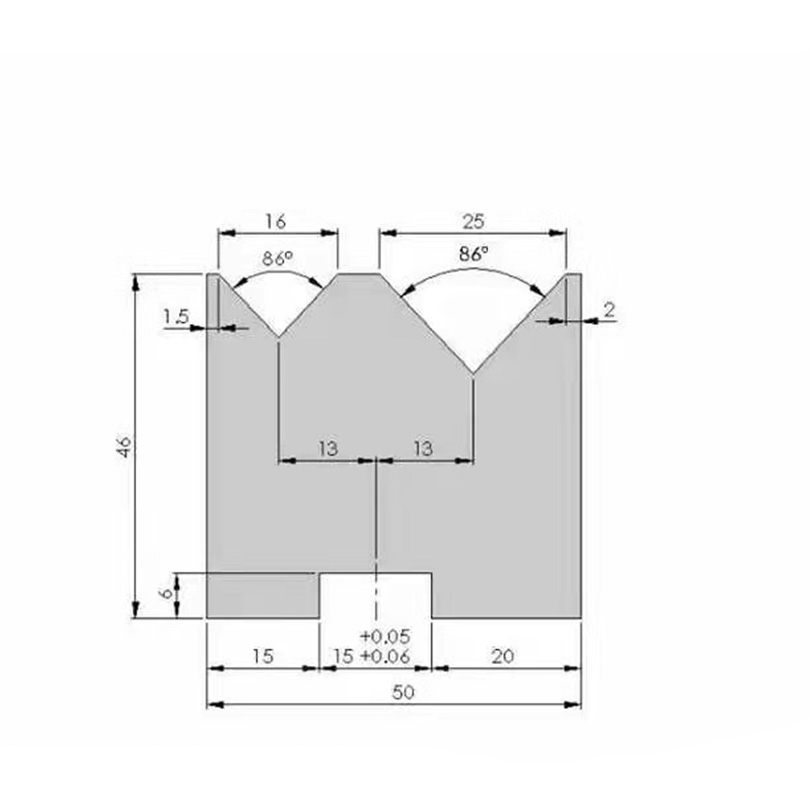
Press Brake v die drawing

press-brake-lower-die-01-press-brake-tooling-drawing-02press-brake-tooling-drawing-02bending-machine-mold-drawings-03

Engineering Support for Bespoke V-Dies.

For complex bending requirements, standard dies aren't always enough. We support Bespoke Tooling Development. If your drawing is incomplete, our team can assist in optimizing the V-opening angle and shoulder radius to prevent material marking and ensure bending accuracy. Submit your technical requirements today for a professional review.

Previous: 
Next: 
200
Phone:
86-15852949220
Address:
Jiangning District, Nanjing
About Us

Nanjing Alas International Co., Ltd. is a professional industrial tooling manufacturer focused on shear blades, bending dies, shredder blades, and custom wear parts. We offer full application engineering, material selection, setup guidance, and after-sales support to global customers.
Tell us your requirements, and our engineering team will provide professional solutions for blade specification, tool life optimization, and cost-effective production.

Subscribe
Sign up for our newsletter to receive the latest news.
​Copyright 2021 NANJING ALAS INTERNATIONAL CO., LTD            苏ICP备2021025144号