


Phone:
86-15852949220


 |


Strong Impact Toughness: Our A8 steel blades can absorb shock from knots and hidden debris without cracking.
Uniform HRC Hardness: Vacuum hardening stabilizes the steel’s molecular structure. Blades stay sharp much longer than induction-hardened ones.
Installed on a rotating cutter head
Common configurations: 4-6 blades, 8-12 blades, spiral blades
Good for large-diameter logs
Makes high-quality, clean wood chips
Most popular choice for paper mills
Fixed on a cylindrical cutter drum
Works well with different raw materials (bark, wood chips, small-diameter wood)
Suitable for small to medium processing plants and complex raw material needs
Wood chip uniformity is slightly worse than disc blades
A8: Best toughness and strong impact resistance
A8B: Improved A8 with better overall performance
D2: Highest wear resistance and hardness, longest service life, but weakest toughness
Type: High Toughness Cold Work Die Steel
Key strengths: Very high toughness, strong impact resistance
Hardness: HRC 58–62
Toughness: ★★★★★ (Best)
Wear resistance: ★★★☆☆ (Moderate)
High temperature resistance: Good
Corrosion resistance: Average
Type: A8 Optimized & Upgraded Steel
Key strengths: Good toughness + better wear resistance and high temperature resistance
Hardness: HRC 58–62 (more stable)
Toughness: ★★★★☆ (Better than A8)
Wear resistance: ★★★★☆ (Better than A8)
High temperature resistance: Excellent (not easy to anneal)
Corrosion resistance: Good
Type: High Carbon High Chromium Cold Work Die Steel
Key strengths: Top wear resistance, high hardness, long service life
Hardness: HRC 60–62
Toughness: ★★☆☆☆ (Weakest)
Wear resistance: ★★★★★ (Best)
High temperature resistance: Average (easy to soften at high temperature)
Corrosion resistance: Semi-stainless (better than A8/A8B)
Positioning: Focuses on high toughness and impact resistance. Low carbon content; chromium, molybdenum and vanadium alloy ratio emphasizes toughness.
Advantages: Not easy to chip or break when cutting hardwood, knotty wood or wet wood. Good for high-impact, complex working conditions. Our A8 blades use full-body vacuum heat treatment, so they absorb knot and debris shock without cracking.
Application: Small and medium chippers, branch shredders. Processes high-impact raw materials (logs, branches, mixed wood).
Positioning: Improved A8. Adjusted alloy composition and heat treatment boost wear resistance and high-temperature stability, while keeping A8’s high toughness.
Advantages: Toughness is similar to A8; wear resistance is much better. Doesn’t anneal easily during continuous high-temperature operation. Edge stays sharp longer. Best overall performance.
Application: Medium and large continuous production lines (papermaking, wood-based panels, pulping). Processes hardwood (rubber wood, eucalyptus) to balance efficiency and service life.
Positioning: High carbon, high chromium (≈12% Cr) cold work steel. Known as “semi-stainless steel” for extreme wear resistance, high hardness and long service life. We use high-quality D2 plus full-body vacuum heat treatment for uniform HRC hardness, making blades stay sharp longer than induction-hardened ones.
Advantages: Wear resistance is 2–3 times that of A8. Edge stays sharp longest; needs replacement least often. Better corrosion resistance than A8/A8B. With our precision CNC grinding, blades have a sharp edge, reducing heat and boosting output.
Disadvantages: Poor toughness, high brittleness. Easy to crack under high impact. Hard to process.
Application: Large, high-capacity continuous chippers. Processes high-wear, low-impact raw materials (softwood, bamboo, straw). Pursues long service life and low maintenance—matches our focus on long-lasting, factory-direct spares that cut downtime.
Mixed, high-impact raw materials (hardwood, knotty wood, wet wood): Choose our A8 blades. Prioritize toughness to avoid breakage. For best results, use our A8 blades with full-body vacuum heat treatment and precision sharpening.
Continuous production, mainly hardwood: Choose our A8B blades. Best overall performance.
Softwood/bamboo/straw, high capacity: Choose our D2 blades. Strongest wear resistance and longest service life. Use our factory-direct D2 spares for easy installation and less downtime.
The core difference between the three chipper blade materials A8, A8B, and D2 lies in the different ratios of alloy elements such as carbon (C), chromium (Cr), molybdenum (Mo), and vanadium (V), which directly determine toughness, wear resistance, hardness, and cost. The following is a comparison of their standard chemical compositions (mass percentage, wt%) and key functions.
Element | A8 | A8B (A8 Modified) | D2 | Key Functions |
Carbon (C) | 0.50–0.60% | 0.55–0.65% | 1.40–1.60% | Determines basic hardness and wear resistance; the higher the content, the harder and more brittle |
Chromium (Cr) | 4.75–5.50% | 5.20–6.00% | 11.0–13.0% | Improves hardenability and corrosion resistance; forms hard carbides (e.g., Cr₇C₃) |
Molybdenum (Mo) | 1.15–1.65% | 1.40–1.80% | 0.70–1.20% | Refines grains, improves toughness and high-temperature stability; inhibits temper brittleness |
Vanadium (V) | 0.80–1.40% | 1.00–1.50% | 0.50–1.10% | Forms extremely hard VC carbides, significantly improves wear resistance; prevents grain growth |
Tungsten (W) | 1.00–1.50% | 1.20–1.70% | — | Improves hot hardness and high-temperature wear resistance |
Manganese (Mn) | 0.20–0.50% | 0.30–0.60% | 0.10–0.60% | Deoxidation, improves hardenability |
Silicon (Si) | 0.20–0.80% | 0.50–1.00% | 0.10–0.60% | Deoxidation, improves strength and oxidation resistance |
Phosphorus (P) | ≤0.030% | ≤0.025% | ≤0.030% | Harmful impurity, reduces toughness |
Sulfur (S) | ≤0.030% | ≤0.025% | ≤0.030% | Harmful impurity, reduces toughness |
Low C, medium Cr, high Mo/W: Carbon content is only 0.5–0.6%, ensuring matrix toughness; chromium is about 5% to provide basic wear resistance; molybdenum and tungsten work together to strengthen, achieving impact resistance and not easy to break.
Positioning: Priority to impact resistance, suitable for high-impact working conditions such as hardwood, knotty wood, and wet wood.
Fine-tuned on the basis of A8: C, Cr, Mo, V, and W are all slightly increased, greatly improving wear resistance and high-temperature stability while retaining the high toughness of A8.
Positioning: Optimal comprehensive performance and highest cost performance, suitable for medium and large-scale chippers with continuous production.
High C, ultra-high Cr, appropriate Mo/V: Carbon content is as high as 1.4–1.6%, forming a large number of hard carbides; chromium is about 12%, known as "semi-stainless steel", with top-level wear resistance and corrosion resistance.
Cost: The worst toughness and highest brittleness, easy to crack under high impact; high price and high processing difficulty.
Positioning: Priority to wear resistance and longest service life, suitable for raw materials with high wear and low impact such as softwood, bamboo, and straw.
A8: Low C, medium Cr, high Mo/W → Strongest toughness
A8B: C/Cr/Mo/V/W are all higher than A8 → Toughness ≈ A8, significantly improved wear resistance
D2: High C, ultra-high Cr → Strongest wear resistance, weakest toughness
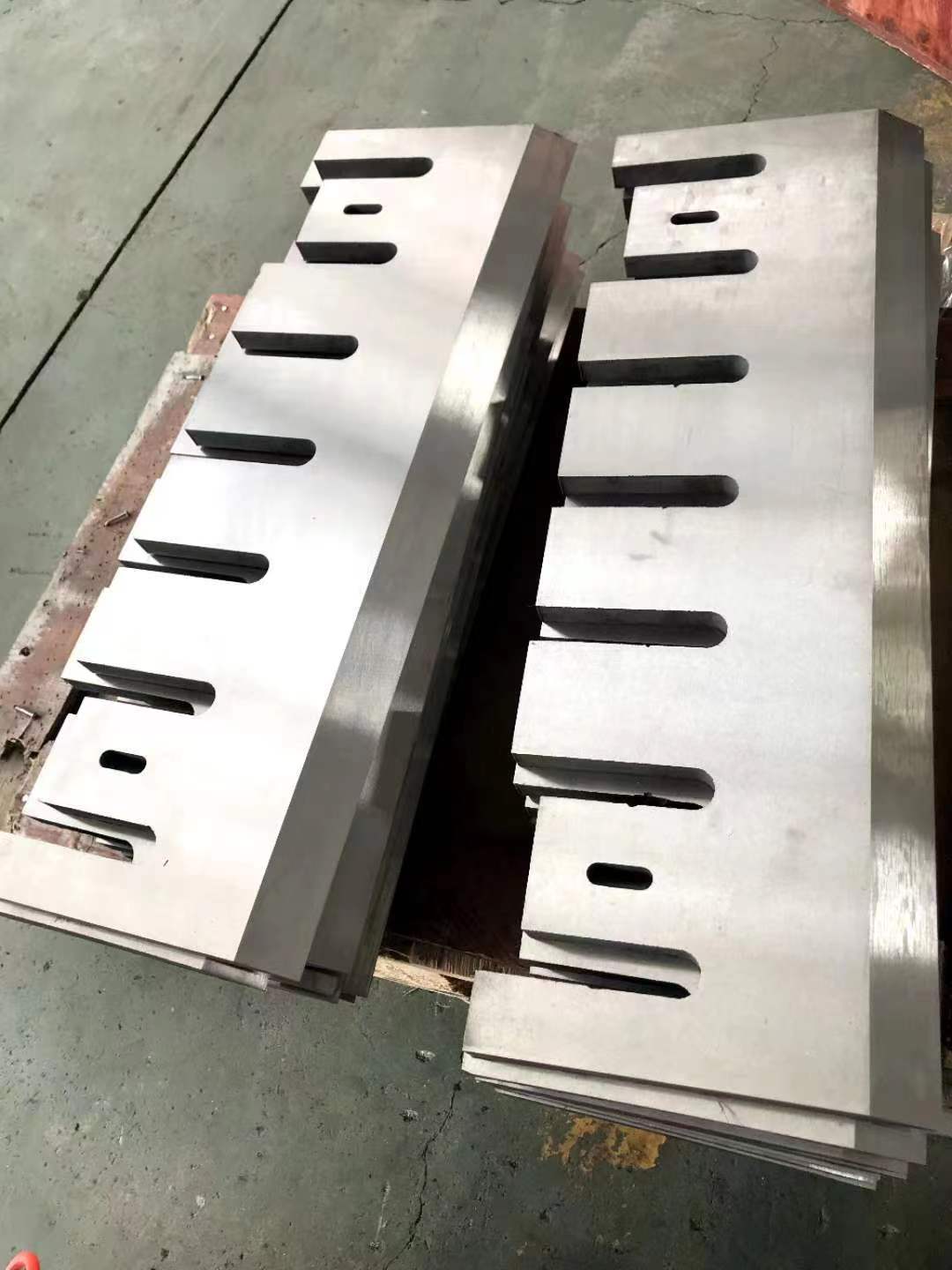
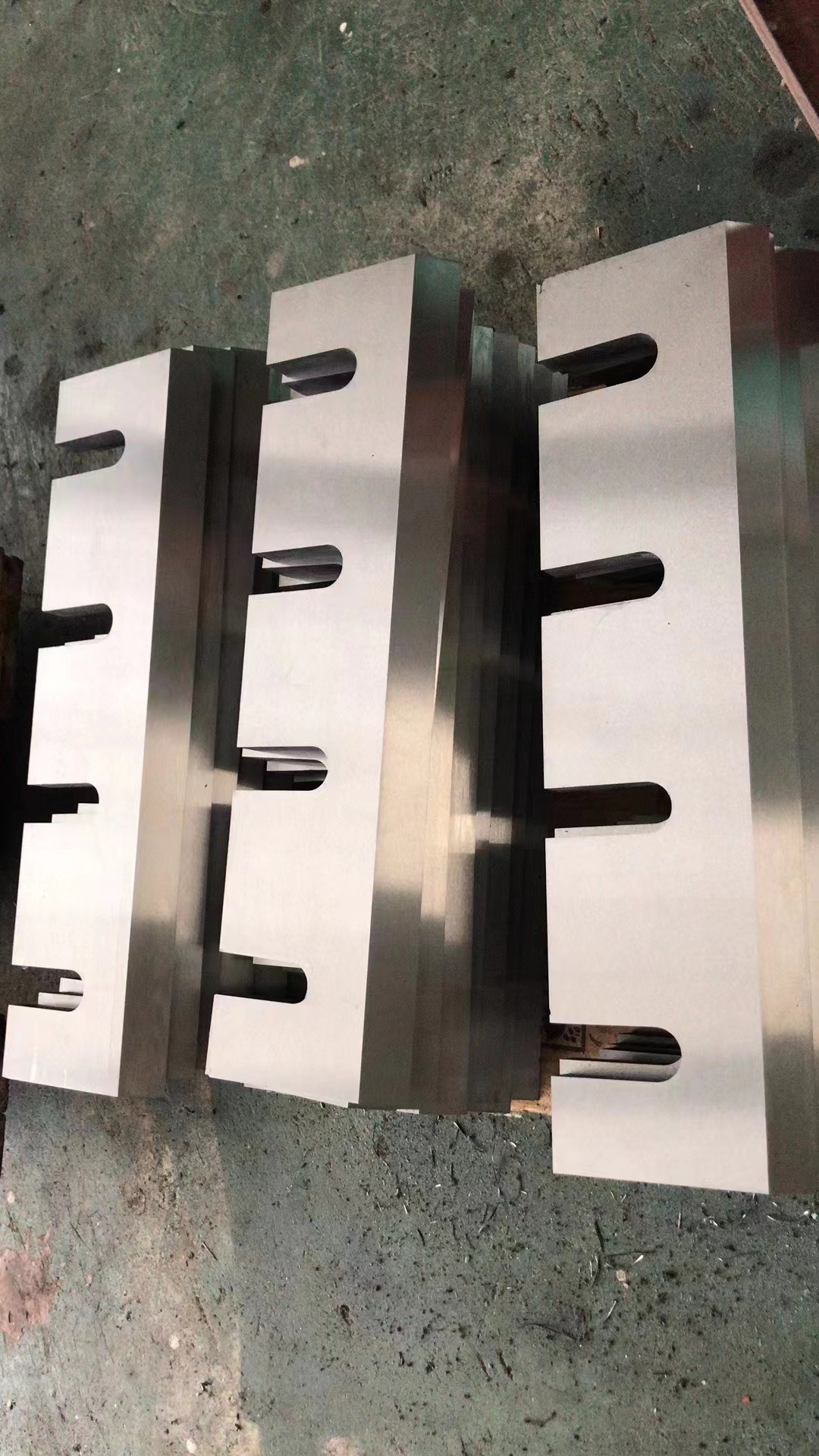
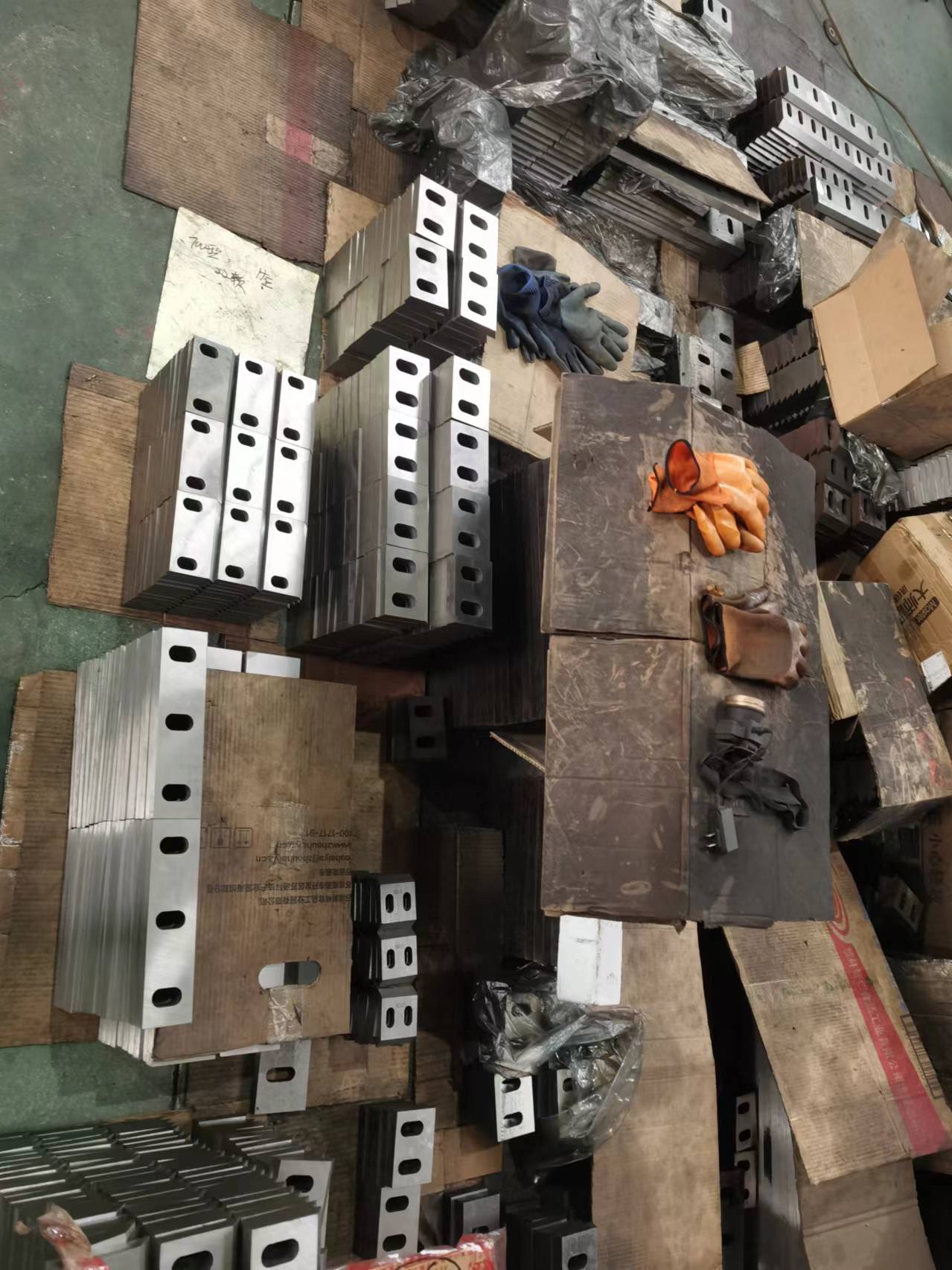
Nanjing Alas International Co., Ltd. is a professional industrial tooling manufacturer focused on shear blades, bending dies, shredder blades, and custom wear parts. We offer full application engineering, material selection, setup guidance, and after-sales support to global customers.
Tell us your requirements, and our engineering team will provide professional solutions for blade specification, tool life optimization, and cost-effective production.