

Phone:
86-15852949220


 |


ALAS
Nanjing, China
L/C, T/T, Paypal, Money Gram
10
| Quantity: | |
|---|---|
| Material | Hardness (HRC) | Toughness | Wear Resistance | Heat Resistance | Applicable Scenarios |
| H13 (4Cr5MoSiV1) | 50–55 | Excellent | Good | Superior | High-strength deformed bar, hot cutting, heavy-duty continuous cutting |
| Cr12MoV | 56–62 | Poor | Excellent | Average | Cold-drawn hard bar, small-diameter hard material (avoid heavy impact load) |
| 9CrSi | 50–55 | Good | Average | Average | Ordinary round bar, low-carbon rebar, medium & small construction projects |
H13 contains vanadium (V) and molybdenum (Mo) to refine internal grain structure, which maintains stable mechanical strength under high cutting temperature. Processed by professional vacuum heat treatment, the H13 bar cutter blade resists edge chipping under strong impact from 32mm deformed bars. By contrast, Cr12MoV blade has a high risk of brittle fracture under heavy impact working conditions.
Watch our industrial grade bar cutter blade in action inside a high velocity steel cropping station. This close up video demonstrates the flawless shearing performance and optimal cutting clearance control of the ALAS tool steel block. Notice how the upper and lower shearing knives cleanly slice high tensile deformed rebars without any rotational flexing or localized spark overheating. This operational precision ensures maximum edge longevity and eliminates jobsite equipment downtime.
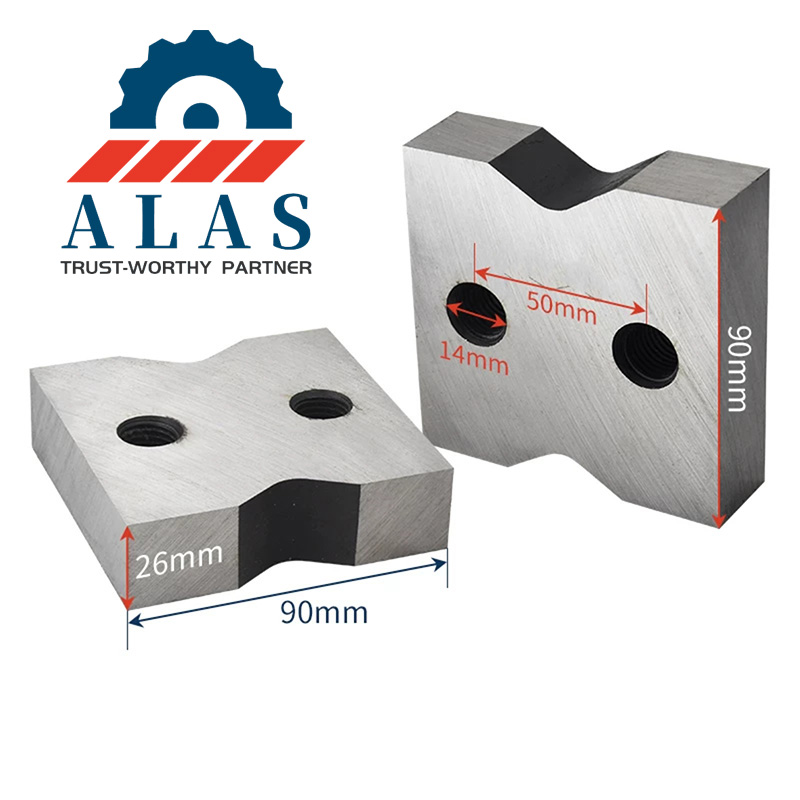
| Machine Model | Blade Thickness(mm) | Cutting Capacity(mm) | Mounting Holes | Standard Overall Dimension |
| GQ40 | 16-20 | 6–32 (Max 36-40mm for carbon steel bar) | Standard Middle Hole | 83x83x16 |
| GQ45 | 20-26 | 8–38 | Standard Middle Hole | 83x83x20 |
| GQ50 | 20-30 | 10–40 (Max 50mm for ordinary round bar) | Standard Dual/Middle Hole | 90x90x20 |
| GQ60 | 25-30 | 12–50 & above | Standard Dual Hole | 110x110x30 |
Over-thick blade: Cannot be installed into cutter seat, matched mounting bolts are not long enough
Over-thin blade: Excessive working clearance, burr cutting, blade shaking and edge chipping
Misaligned mounting hole: Poor centering effect, blade eccentric load and sudden fracture
Clean Cutter Seat: Remove iron filings and dust to avoid inaccurate clearance measurement.
Install Fixed Blade: Fasten fixed blade firstly, recommended torque: 250–300N·m for M20 bolt.
Measure gap between moving blade and fixed blade via feeler gauge.
Loosen moving blade bolt, add gaskets or use eccentric adjusting mechanism to adjust gap.
Adjust blade position and pre-tighten bolts temporarily.
Inspect Operation: Rotate cutter manually or jog the machine to check blade meshing, abnormal friction or resistance.
Final Fastening: Tighten bolts diagonally in 2-3 times to reach standard torque.
Clearance < 0.05mm: Severe metal friction, blade thermal annealing, rapid cutting edge dulling
Clearance > 0.5mm (for thin steel bar): Bar tearing instead of standard shearing, serrated cutting surface and edge chipping

| Fault Phenomenon | Root Cause | Solutions |
| Local edge chipping | Improper clearance; loose connecting bolt | Adjust clearance to 0.1–0.3mm; fasten bolts diagonally |
| Integral blade fracture | Hardness>58HRC; Cr12MoV blade for large diameter bar cutting | Adopt H13 blade (50–55HRC); reduce maximum cutting bar diameter |
| Fast edge abrasion | Hardness<48HRC; long-term high-strength bar cutting | Reheat treat or upgrade blade material; rotate blade edge regularly |
| Blade side wear | Uneven cutter seat flatness; insufficient bolt fastening | Repair cutter seat flatness; replace high-strength fastening bolts |
| Process Type | Hardness Uniformity | Internal Toughness | Deformation Rate | Production Cost |
| Traditional Box Furnace Quenching | Poor (±5HRC deviation) | Low, with internal soft spot | High | Low |
| Salt Bath Heat Treatment | Medium (±2HRC deviation) | Medium | Medium | Medium |
| Vacuum Heat Treatment + Cryogenic Treatment | Excellent (±1HRC deviation) | High, no decarburization layer | Minimal | Medium-High |
Avoid edge curling caused by partial insufficient hardness
Integral uniform toughness prevents crack expansion and sudden blade fracture under impact load
CNC precision grinding guarantees stable size for repeated regrinding and reuse

Check tightness of moving & fixed blade bolts to avoid operating looseness
Clean up iron filings inside cutter seat to prevent gap change caused by debris stacking
Visual inspection for edge chipping, passivated wear belt and blade damage
Test idle cutting to check flatness of cutting surface
Recalibrate blade working clearance with professional feeler gauge
Rotate 4-edge reversible bar cutter blade to balance edge abrasion evenly

Submit Demand: Provide original used blade or design drawing, mark bar grade and daily cutting volume.
Technical Confirmation: Confirm material, hardness, hole position and edge structure via 3D processing drawing.
Quotation & Delivery Confirm: Confirm custom mold cost and unit price, mold fee waived for bulk order.
Production & Full Inspection: Complete vacuum heat treatment and CNC grinding, test hardness, flatness and hole precision before delivery.
Pack & Delivery: Anti-rust packaging, matched high-strength mounting bolts delivered together.
Special countersunk mounting hole & eccentric hole customized blade
Thickened heavy-duty blade for extra-large diameter steel bar cutting
V-shaped anti-burr cutting edge blade for neat cutting surface
TiN golden wear-resistant coating / DLC low-friction coating treated blade
| Inspection Step | Genuine Blade Feature | Counterfeit Blade Feature |
| Visual Inspection | Uniform grinding texture, no oxide stain, unified edge chamfer | Obvious black/blue rust scale, rough irregular grinding trace |
| Hand Touch Check | Smooth cutting edge, flat blade body flatness<0.05mm | Micro edge notch, warped blade body flatness>0.1mm |
| Weight Check | Standard dimension & weight, error within ±2% | Reduced thickness & size, weight lighter over 5% |
| File Hardness Test | Moderate file resistance, slight cutting trace (50-55HRC standard) | Over-hard brittle or over-soft easy-to-wear blade |
Material Selection: 9CrSi for ordinary low-carbon round bar; H13 for HRB400/HRB500 high-strength deformed bar heavy-duty cutting.
Model Matching: Adopt site thickened standard blade, match exclusive size for GQ40/GQ45/GQ50/GQ60 cutter, mixed use forbidden.
Process Standard: Vacuum heat treatment + 50–55HRC hardness is the core standard for durable bar cutter blade.
Installation Standard: 0.1–0.3mm standard clearance, diagonal bolt fastening, weekly routine calibration.
Procurement Standard: Verify material and hardness test report, choose reliable manufacturer for standard & custom blade supply: Nanjing ALAS International.
| Base Grade | Steel Category | Chinese Standard GB/T 1299 | American Standard ASTM | German Standard DIN (W-Nr.) | Japanese Standard JIS |
| H13 | Hot Work Die Steel | 4Cr5MoSiV1 | H13 | 1.2344 | SKD61 |
Cr12MoV | Cold Work Die Steel | Cr12MoV | 1.2601 | SKD11 | |
9CrSi | Alloy Tool Steel (Cutting Tool Steel) | 9CrSi | 1.2108 |
Nanjing Alas International Co., Ltd. is a professional industrial tooling manufacturer focused on shear blades, bending dies, shredder blades, and custom wear parts. We offer full application engineering, material selection, setup guidance, and after-sales support to global customers.
Tell us your requirements, and our engineering team will provide professional solutions for blade specification, tool life optimization, and cost-effective production.