


Phone:
86-15852949220


 |


Punch (upper die)
Die (lower die)
Machinery manufacturing
Sheet metal fabrication
Hardware production
Cabinet and enclosure manufacturing
Place the sheet metal on the lower die.
The ram moves the upper die down, pressing the metal into the shape of both dies.
Once the right pressure and movement are reached, bending is done.
The upper die moves back up, and you can take out the finished part.
We use 42CrMo (42CrMo4) alloy steel — it balances toughness and durability well.
It can handle high pressure and friction without breaking or bending.
Our dies go through Full Induction Hardening, reaching HRC 48-52 hardness.
This hardening protects the V-groove from wear or damage under heavy pressure, reducing the need for frequent replacements.
Best for CNC machines with automatic clamping.
High precision and easy to change, saving setup time.
Great for high-volume, precise production.
Good for manual or hydraulic machines.
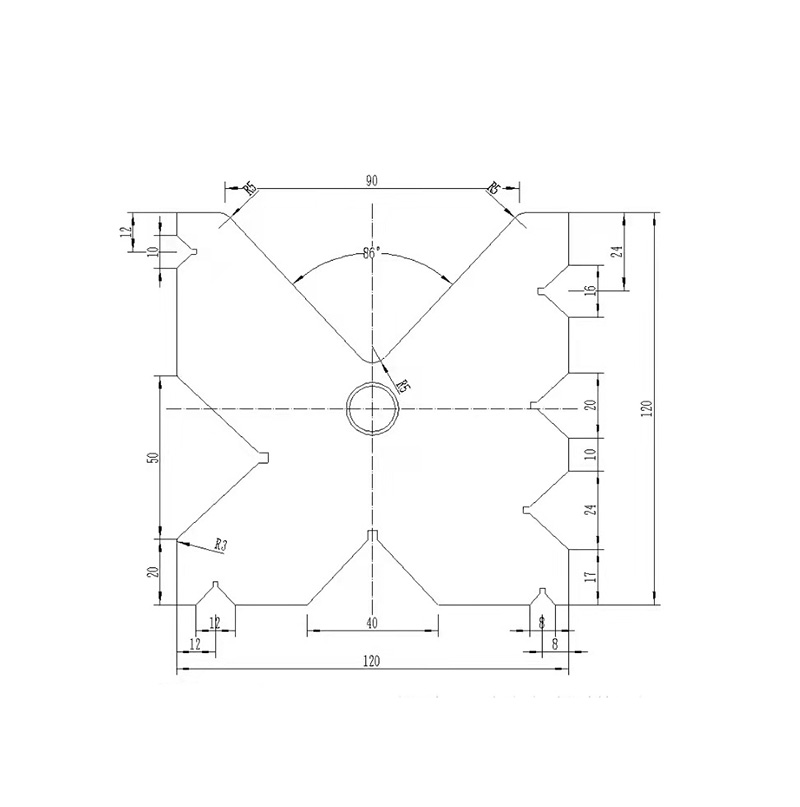
One block has multiple V-grooves of different widths.
No need to change tools often — perfect for small batches or mixed work.
Punches can be custom-made (rounded, gooseneck, irregular) to fit your needs.
Lower dies can have different V-groove widths (8mm, 16mm, 24mm) or special shapes.
Dies must fit your machine’s clamping system, ram movement, and pressure capacity to avoid installation issues.
Standard dies fit major machine brands (Amada, Trumpf, Wila) and can be bought and used right away.
Special dies can be custom-made for your specific needs.
Standard Straight Die: For regular straight bends (most common).
Sharp-Angle Die: For small angles or fixing springback (high precision).
Gooseneck Die: For U-shaped or deep parts (avoids hitting already bent edges).
Radius Die: For rounded bends (curved parts or smooth transitions).
Irregular Custom Die: Made for unique, non-standard shapes (from your drawings).
Standard Dies: For common metals (mild steel, galvanized steel) — good value.
High-Strength Steel Dies: Reinforced and hard — for stainless steel or tough alloys.
Thin Material Dies: Precision-made to prevent warping, bending, or scratching thin metal.
Amada / Promecam Type: Fits Amada machines.
Trumpf / Wila Type: Fits Trumpf and Wila machines.
New Standard Type: Universal — fits most domestic machines.
Mild steel: Low springback — use an 86°–88° punch for 90° bends.
Stainless steel/high-strength steel: High springback — use an 85° punch or adjust the angle.
42CrMo dies work with most materials, reducing the need for multiple die sets.
For most mild steel: V-opening width = 8 × material thickness (V = 8T).
This ensures smooth bends and prevents cracking.
Adjustments:
Thin metal (T < 3mm): Use V = 6T for smaller curves.
Thick metal (T > 8mm): Use V = 10T–12T to reduce pressure and avoid die damage.
For custom-length or irregular parts — use sectionalized dies (10mm, 20mm, 100mm segments).
Segments are precise (±0.01mm) and can be combined to make any length.
Saves money: Replace only damaged segments, not the whole die.
Calculate bending pressure based on material thickness, strength, and V-width.
Do not exceed the die’s pressure limit — leave a 10%–15% safety margin.
For thick/tough materials: Use reinforced or sectionalized dies to spread pressure.
Standard: For regular bends.
Sharp-angle: For small angles or springback.
Gooseneck: For deep U-shapes or boxes.
Rounded/custom: For curved or unique parts.
Choose the right holder type (Amada, Trumpf/Wila, New Standard).
Ensure die height fits the machine’s ram movement and worktable opening.
Account for material springback to avoid wrong angles and waste.
Follow the 8× rule and adjust for material thickness to prevent damage.
Check that the die fits your machine to avoid installation problems.
Prioritize 42CrMo material and Full Induction Hardening for long die life.
Country/Standard Organization | Standard Code | Corresponding Grade |
China (GB) | GB/T 3077 | 42CrMo or 42CrMo4 |
USA (AISI/ASTM) | ASTM A29 | 4140 |
International Organization for Standardization (ISO) | ISO 683-1 | 42CrMo4 |
Germany (DIN) | DIN EN 10083 | 1.7225 (or 42CrMo4) |
Japan (JIS) | JIS G4105 | SCM440 |
UK (BS) | BS 970 | 708M40 (EN19) |
42CrMo alloy steel offers significantly higher durability compared with ordinary carbon steel, thanks to its alloy composition, heat treatment performance, and mechanical properties.
It contains chromium(Cr), molybdenum(Mo) and manganese, which greatly improve:
Higher hardness and wear resistance
Better strength and toughness
Higher tensile and yield strength
Excellent performance under high pressure and heavy load
Longer service life in industrial applications
Ordinary carbon steel is soft, wears out quickly, and deforms easily under pressure.42CrMo maintains shape, stability even under long-term heavy working conditions, making it the ideal material for press brake toolingand molds.






Nanjing Alas International Co., Ltd. is a professional industrial tooling manufacturer focused on shear blades, bending dies, shredder blades, and custom wear parts. We offer full application engineering, material selection, setup guidance, and after-sales support to global customers.
Tell us your requirements, and our engineering team will provide professional solutions for blade specification, tool life optimization, and cost-effective production.