


Phone:
86-15852949220


 |


Heat Resistance: Stays hard and sharp even when heated by continuous cutting. Doesn’t soften or crack from repeated heating and cooling.
Toughness: Handles the force of cutting thick, strong rebar (like Grade 60 or 75) without chipping, breaking, or shattering.
Long-Lasting: Special vacuum heat treatment makes the blades hard (HRC 50–55) and resistant to wear. They last longer, so you don’t need to replace them as often.
Clean Cuts: Precision-ground edges make smooth, burr-free cuts. This means less extra work on the ends of the rebar.
High-Quality Material: We use pure H13 steel with even internal structure. This prevents weak spots that cause early blade failure.
Advanced Heat Treatment: Blades go through vacuum heat treatment and multiple tempering cycles. This achieves the perfect balance of hardness and flexibility.
Precision Grinding: CNC machines grind each blade to a smooth finish. This fits perfectly in your shearing machine, reduces friction, and protects your equipment’s hydraulic system.
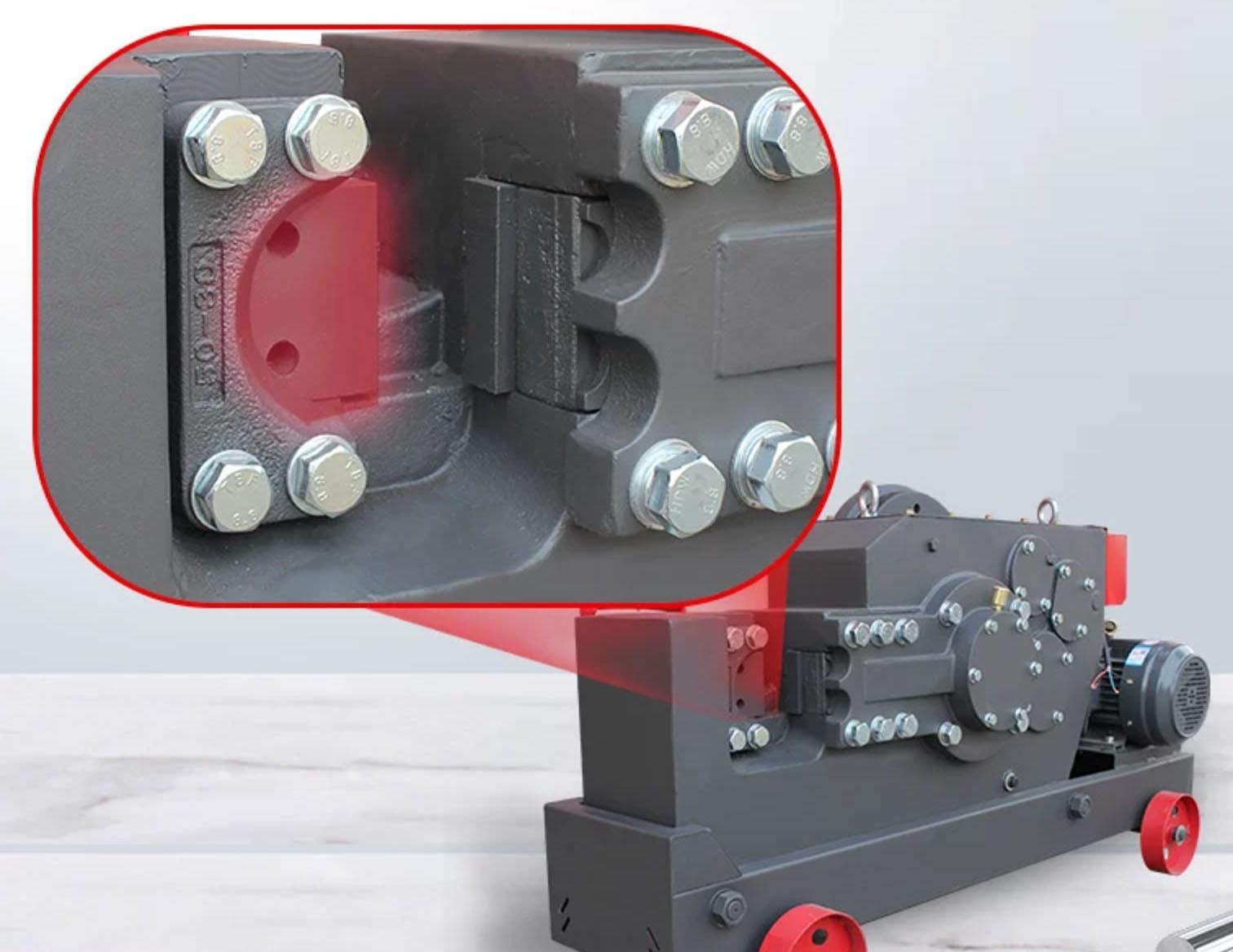
Fits most heavy-duty rebar shearing machines (like GQ40 and GQ50).
We can make custom sizes based on your technical drawings.
Adjust the blade gap to match the thickness of the rebar you’re cutting.
Check mounting bolts regularly.
Keep the cutting area clean of debris. This prevents early wear and keeps operators safe.
| NO. | Product Name | Specification Dimensions (length x width x height/thickness) ) | Material | Remarks |
| 1 | Rebar Shearing Blades size | 78*78*17 mm | H13 | Customization services are available; we can manufacture according to your drawings, with a minimum order quantity of 2 piece. |
| 2 | 80*80*17 mm | |||
| 3 | 80*80*30 mm | |||
| 4 | 83*83*16 mm | |||
| 5 | 83*83*26 mm | |||
| 6 | 83*83*26 mm | |||
| 7 | 90*90*20 mm | |||
| 8 | 90*90*26 mm | |||
| 9 | 100*100*20 mm | |||
| 10 | 100*100*30 mm | |||
| 11 | 110*110*20 mm | |||
| 12 | 100*30*75 mm | |||
| 13 | 85x65x30 mm | |||
Base Grade | Steel Category | Chinese Standard GB/T 1299 | American Standard ASTM | German Standard DIN (W-Nr.) | Japanese Standard JIS |
H13 | Hot Work Die Steel | 4Cr5MoSiV1 | H13 | 1.2344 | SKD61 |
Cr12MoV | Cold Work Die Steel | Cr12MoV | 1.2601 | SKD11 | |
9CrSi | Alloy Tool Steel (Cutting Tool Steel) | 9CrSi | 1.2108 |


Based on different working conditions and budget requirements, we offer three general industrial-grade alloy steel materials:
9CrSi (Alloy Tool Steel): An economical choice. It has good hardenability and machinability, suitable for cutting ordinary medium-to-low strength rebar, and is widely used in small and medium-sized projects.
Cr12MoV (Cold Work Die Steel): High-end wear-resistant type. High carbon and high chromium content, after heat treatment, it has excellent wear resistance, making it an ideal choice for continuous cutting of high-strength rebar. Its service life is much longer than 9CrSi.
H13 (Hot Work Die Steel/Red Hard Steel): High toughness and high wear resistance. It exhibits excellent resistance to chipping and thermal stability in rebar cutting applications, especially suitable for high-speed production lines or online cutting of hot-rolled rebar, and cutting of ultra-thick rebar and composite materials of scrap rebar.
Chipping is usually caused by the following factors:
Insufficient toughness: Using ultra-hard but low-toughness materials to cut large-diameter or ultra-hard rebar can easily lead to brittle fracture. In this case, we recommend switching to H13 material, as its excellent toughness can effectively absorb impact forces.
Improper clearance: Too large or too small a gap between the upper and lower blades will lead to uneven stress, resulting in chipping.
Insufficient heat treatment: Internal stress is not completely eliminated. All our blades use vacuum heat treatment technology to ensure uniform hardness from the inside out, greatly reducing the chipping rate.
English: Rebar Shearing Blades | Reinforcing Bar Cutter Knives
French (Français): Lames de cisaille à béton | Couteaux pour coupe-fer à béton
Portuguese (Português): Lâminas de corte de vergalhão | Facas para cisalha de vergalhão
Polish (Polski): Noże do cięcia prętów zbrojeniowych | Noże do nożyc do prętów
Turkish (Türkçe): İnşaat Demiri Kesme Bıçakları | Demir Kesme Makas Bıçakları
Vietnamese (Tiếng Việt): Lưỡi dao cắt sắt xây dựng | Dao cắt thép thanh công nghiệp
Thai (ภาษาไทย): ใบมีดตัดเหล็กเส้น | ใบมีดสำหรับเครื่องตัดเหล็กข้ออ้อย
Filipino: Mga Blade na Pang-shearing ng Rebar | Kutsilyo para sa Pagputol ng Bakal
Arabic (العربية): شفرات قص حديد التسليح | سكاكين مقصات قضبان الحديد
Hindi (हिन्दी): सरिया काटने वाला ब्लेड | रिबार शीयरिंग मशीन चाकू
Indonesian (Bahasa Indonesia): Pisau Potong Besi Beton | Bilah Shearing Rebar Hidrolik
Malay (Bahasa Melayu): Bilah Gunting Besi Rebar | Pisau Pemotong Keluli Konstruksi
Dutch (Nederlands): Betonstaal snijmessen | Messen voor betonijzer scharen
Swedish (Svenska): Armeringsklippskär | Knivar för armeringsstål
Hungarian (Magyar): Betonacél nyíró pengék | Betonacél vágó kések
Greek (Ελληνικά): Λεπίδες ψαλιδιού οπλισμού | Μαχαίρια κοπής σιδήρου
Nanjing Alas International Co., Ltd. is a professional industrial tooling manufacturer focused on shear blades, bending dies, shredder blades, and custom wear parts. We offer full application engineering, material selection, setup guidance, and after-sales support to global customers.
Tell us your requirements, and our engineering team will provide professional solutions for blade specification, tool life optimization, and cost-effective production.