


Phone:
86-15852949220


 |


| Quantity: | |
|---|---|
Longer life: Our Total Quenching and vacuum hardening keep edges sharp much longer than standard surface‑hardened blades.
Stable performance: Excellent thermal stability means no warping during long, heavy use.
Wide compatibility: Fits all major hydraulic and mechanical rebar cutters.
Custom sizes available: Match GQ40, GQ50, GQ60 and other machines.
Best overall quality
High wear resistance + high toughness
Stays stable under long, heavy cutting
No deformation, no chipping
Perfect for high‑tensile rebar
Very hard and wear‑resistant
Good for hard cold‑rolled rebar
Lower toughness — avoid heavy impact jobs
Low-cost, practical option
Easy to machine
Best for normal, low‑to‑medium strength rebar
Square blade: 4 usable edges → longer life
Rectangle blade: 1 or 2 edges → for small machines
Thickness, length, width, and hole positions follow machine standards
Always match your machine manual
Ordinary round steel: Use 9CrSi or Cr12MoV
High‑strength ribbed rebar: Use H13
Scrap rebar (dirty, rusty): Use high‑nickel material
Full grinding
Vacuum hardening
Total quenching
Results: Uniform hardness, long edge life, less chipping and dulling.
| NO. | Product Name | Specification Dimensions (length x width x height/thickness) ) | Material | Remarks |
| 1 | Reinforcing Bar Cutting Blade size | 78*78*17 mm | 9crsi,SKD-11,H13 | Customization services are available; we can manufacture according to your drawings, with a minimum order quantity of 2 piece. |
| 2 | 80*80*17mm | |||
| 3 | 80*80*30mm | |||
| 4 | 83*83*16 mm | |||
| 5 | 83*83*26 mm | |||
| 6 | 83*83*26 mm | |||
| 7 | 90*90*20 mm | |||
| 8 | 90*90*26 mm | |||
| 9 | 100*100*20 mm | |||
| 10 | 100*100*30mm | |||
| 11 | 110*110*20mm | |||
| 12 | 100*30*75 mm | |||
| 13 | 85x65x30 mm | |||
| 14 | Handheld rebar cutting machine blade | 26×20×10mm | ||
| 15 | 30×24×11 mm | |||
| 16 | 36×28×14mm | |||
| 17 | 40×30×15 mm | |||
Base Grade | Steel Category | Chinese Standard GB/T 1299 | American Standard ASTM | German Standard DIN (W-Nr.) | Japanese Standard JIS |
H13 | Hot Work Die Steel | 4Cr5MoSiV1 | H13 | 1.2344 | SKD61 |
Cr12MoV | Cold Work Die Steel | Cr12MoV | 1.2601 | SKD11 | |
9CrSi | Alloy Tool Steel (Cutting Tool Steel) | 9CrSi | 1.2108 |

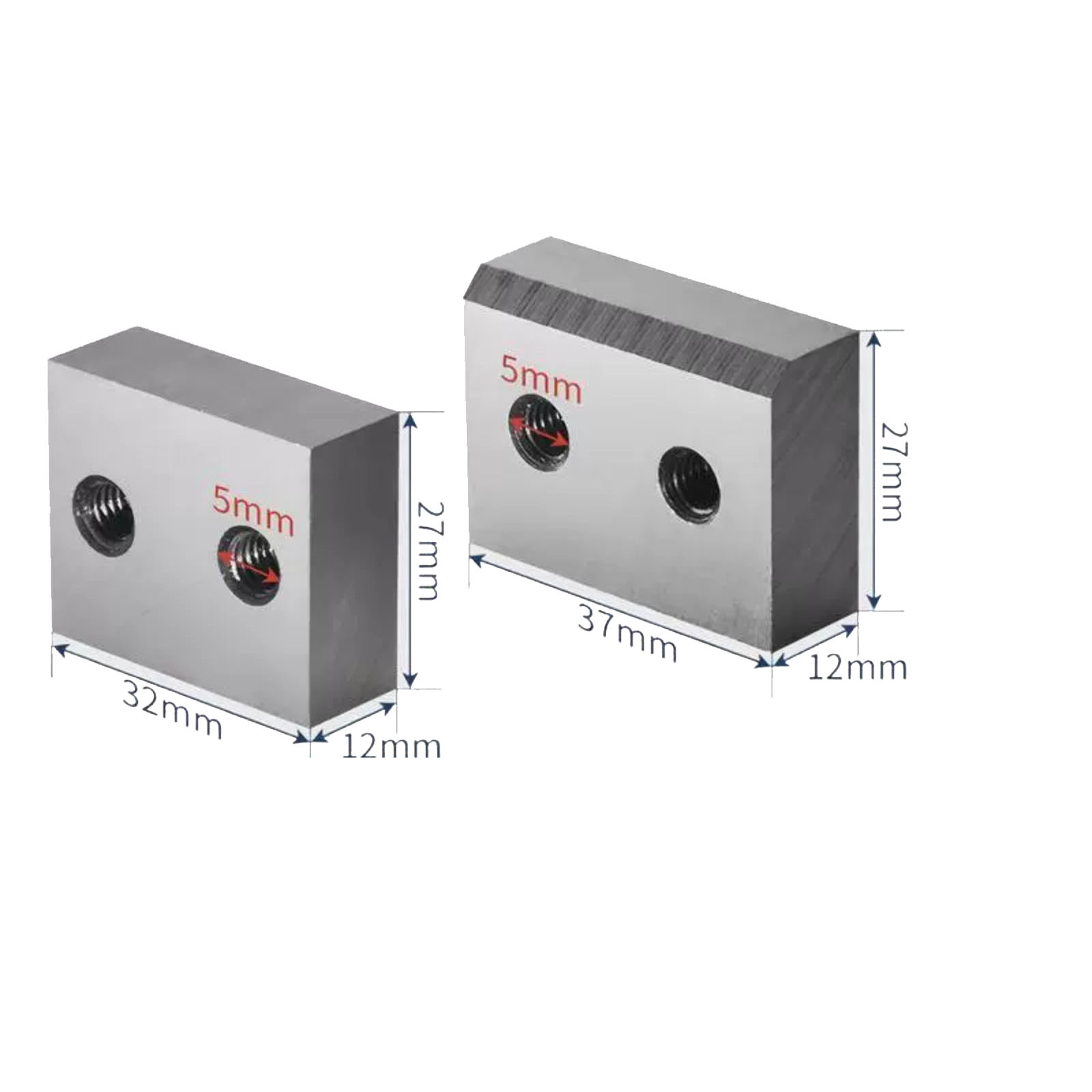


Based on different working conditions and budget requirements, we offer three general industrial-grade alloy steel materials:
9CrSi (Alloy Tool Steel): An economical choice. It has good hardenability and machinability, suitable for cutting ordinary medium-to-low strength rebar, and is widely used in small and medium-sized projects.
Cr12MoV (Cold Work Die Steel): High-end wear-resistant type. High carbon and high chromium content, after heat treatment, it has excellent wear resistance, making it an ideal choice for continuous cutting of high-strength rebar. Its service life is much longer than 9CrSi.
H13 (Hot Work Die Steel/Red Hard Steel): High toughness and high wear resistance. It exhibits excellent resistance to chipping and thermal stability in rebar cutting applications, especially suitable for high-speed production lines or online cutting of hot-rolled rebar, and cutting of ultra-thick rebar and composite materials of scrap rebar.
Chipping is usually caused by the following factors:
Insufficient toughness: Using ultra-hard but low-toughness materials to cut large-diameter or ultra-hard rebar can easily lead to brittle fracture. In this case, we recommend switching to H13 material, as its excellent toughness can effectively absorb impact forces.
Improper clearance: Too large or too small a gap between the upper and lower blades will lead to uneven stress, resulting in chipping.
Insufficient heat treatment: Internal stress is not completely eliminated. All our blades use vacuum heat treatment technology to ensure uniform hardness from the inside out, greatly reducing the chipping rate.
Wear resistance: Cr12MoV has significantly better wear resistance than 9CrSi. Under the same working conditions, the number of cuts for Cr12MoV is usually 2-3 times that of 9CrSi.
Cost: 9CrSi is more cost-effective, suitable for projects sensitive to initial purchase costs; although the unit price of Cr12MoV is slightly higher, its lower replacement frequency results in a lower overall cutting cost per ton of rebar.
For high-strength or ribbed rebar, we strongly recommend H13:
If you are facing extremely high operating intensity and are concerned about downtime due to blade chipping, choose H13. Its impact fatigue resistance is top-notch in the rebar processing industry.
Yes. We understand that blade specifications vary among different equipment brands (e.g., from Italy, Germany, or China). We are equipped with a full set of CNC machining equipment, and you only need to provide the following information:
Detailed drawings (including length, width, thickness, and hole dimensions).
Material requirements (9CrSi, Cr12MoV, or H13).
Specifications of the workpiece to be processed (rebar diameter and strength grade).
We can provide a 1:1 precise customized solution.
Regular rotation: Our blades are usually designed with 4 or 8 cutting edges. Please rotate the blade promptly when one cutting edge becomes dull.
Tighten bolts: Ensure the blades are securely installed. Any slight looseness will cause destructive impact during the cutting process.
Control the gap: Adjust a reasonable blade gap according to the rebar diameter, usually about 10% of the rebar diameter.
Nanjing Alas International Co., Ltd. is a professional industrial tooling manufacturer focused on shear blades, bending dies, shredder blades, and custom wear parts. We offer full application engineering, material selection, setup guidance, and after-sales support to global customers.
Tell us your requirements, and our engineering team will provide professional solutions for blade specification, tool life optimization, and cost-effective production.