


Phone:
86-15852949220


 |


L/C, T/T, Paypal, Money Gram
10
| Quantity: | |
|---|---|
D2 Tool Steel: Typical Chemical Composition: C 1.40-1.60%, Cr 11.00-13.00%, Mo 0.80-1.20%, V 0.20-0.50%, Mn ≤0.60%, Si ≤0.40%. Performance: High carbon and chromium make it very sharp and wear-resistant. It works well for medium-hard materials like plastic, wood, and light metal scraps. Molybdenum keeps the edge from softening when hot. Vanadium makes it tougher. After heat treatment, D2 blades reach 58-62 HRC. This means you don’t need to sharpen them as often.
DC53 Tool Steel: Typical Chemical Composition: C 1.00-1.10%, Cr 8.00-10.00%, Mo 2.00-2.50%, V 0.80-1.20%, Mn ≤0.50%, Si ≤0.40%. Performance: DC53 is an improved version of D2. It has more molybdenum and vanadium. This makes it 2-3 times tougher. It won’t crack easily under heavy impact—good for thicker plastics or small electronic scrap. It also stays sharp (58-62 HRC) and resists deformation during heat treatment.
9CrSi Alloy Tool Steel: Typical Chemical Composition: C 0.85-0.95%, Cr 1.20-1.50%, Si 1.00-1.30%, Mn ≤0.40%. Performance & Use: It has a hardness of 56-60 HRC. It resists wear well and is cheap. It works best for soft materials like rubber, paper, fibers, and thin plastics—materials with low impact.
Cr12MoV Cold Work Tool Steel: Typical Chemical Composition: C 1.45-1.70%, Cr 11.00-12.50%, Mo 0.40-0.60%, V 0.15-0.30%, Mn ≤0.40%, Si ≤0.40%. Performance & Use: It has a hardness of 58-62 HRC. It resists wear and impact well. It doesn’t deform much. It works for medium-to-hard materials like wood, hard plastics, metal scraps, and tires. It stays sharp longer than 9CrSi.
H13 Hot Work Tool Steel: Typical Chemical Composition: C 0.32-0.45%, Cr 4.75-5.50%, Mo 1.10-1.75%, V 0.80-1.20%, Si 0.80-1.20%, Mn 0.20-0.50%. Performance & Use: It has a hardness of 52-58 HRC. It balances wear resistance, impact resistance, and heat resistance well. It works in many scenarios, especially for high-load, non-stop industrial waste processing.
High Manganese Steel (Complementary): Chemical Composition: C 1.00-1.40%, Mn 11.00-14.00%. Performance & Use: It is very tough and impact-resistant. Its surface gets harder when used. It works for municipal and construction waste—waste with lots of sand and impurities. Pair it with H13 for mixed waste.
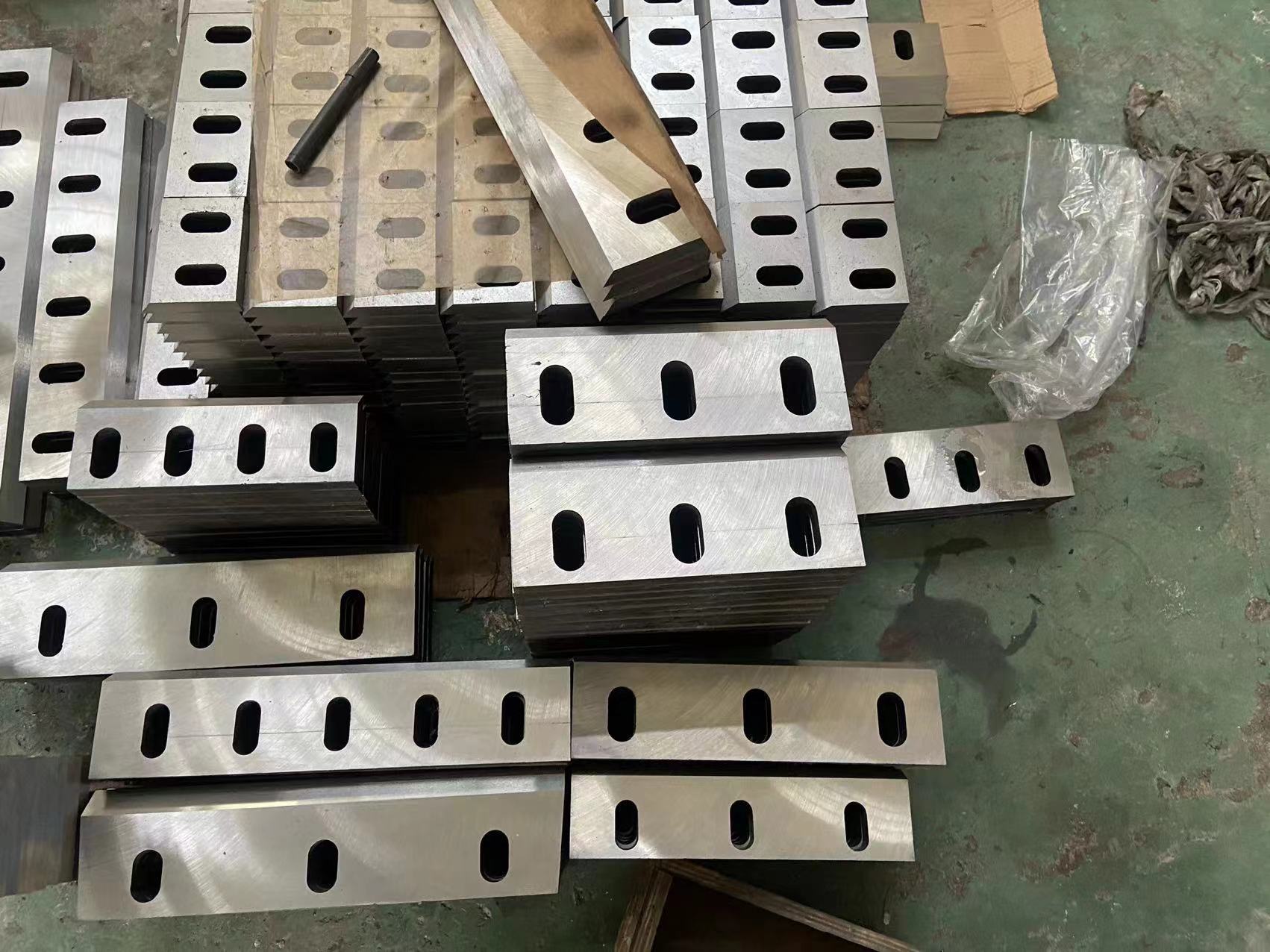
For single-shaft machines. They can be fixed or replaceable inserts (compatible with rotary inserts). D2/DC53 materials keep them precise and sharp. They work well for uniform, medium-hard materials.
For double-shaft machines. They have a claw-like, interlocking design and use 9CrSi/Cr12MoV/H13 materials. They cut and tear irregular, high-impact, or hard waste (like metal scraps and construction waste). Their staggered spiral layout prevents jamming and boosts output.
Choose material (D2/DC53), thickness, and insert shape to match your machine’s anvil and material density.
Choose claw type (2/3/8-claw), thickness (10-75mm), and material (9CrSi/Cr12MoV/H13) to get the right output size and cutting speed.
D2/DC53 with vacuum heat treatment (58-62 HRC). They stay sharp and tough.
9CrSi/Cr12MoV/H13, matched to your waste. 9CrSi for soft rubber, Cr12MoV for heavy metal scraps, H13 for mixed industrial waste.
Single-shaft: Choose insert shape (square/round), thickness, and D2/DC53 grade to match torque and material density.
Double-shaft knives: Choose tooth shape, number of claws, and material (9CrSi/Cr12MoV/H13) to get the right particle size.
Two counter-rotating shafts have spiral, staggered claw-like blades (9CrSi/Cr12MoV/H13). They form a meshing crushing chamber. Materials are grabbed quickly to prevent slipping and jamming.
Powerful torque provides two forces: cutting and tearing. This cuts large, irregular materials into uniform pieces. Material traits (Cr12MoV’s wear resistance, H13’s toughness) handle low-speed (5.5–10 rpm), high-torque operation.
Staggered blades ensure constant cutting. This makes them more efficient than single-cut designs. Shaft design and blade fit (improved by H13’s resistance to deformation) keep operation stable.
Choose 2/3/6/8/12 claws (more claws = finer output). Thickness ranges from 10-75mm (thicker blades = better impact resistance). Pair thicker blades with Cr12MoV/H13 for hard materials.
It has a “blade body + clawed blade + auxiliary blade” structure. You can replace worn parts with bolts. This reduces downtime. It works well with rotary inserts’ modular design for single-shaft machines.
Spline/hexagonal main shafts have blade holes that fit perfectly. This distributes force evenly. It prevents cracking (thanks to H13/Cr12MoV’s toughness) and spindle deformation. It’s good for high-load, non-stop operation.
Metals: Cr12MoV/H13 blades process aluminum cans, car shells, and scrap steel. Single-shaft D2/DC53 rotary inserts handle smaller metal pieces.
Synthetic Materials: 9CrSi/Cr12MoV blades process large PE/PP films, plastic barrels, and electronic casings. Single-shaft D2 rotary inserts provide precise, uniform shredding.
Construction/Mixed Waste: High-manganese steel/H13 blades process renovation and bulky waste. Single-shaft D2 blades handle secondary shredding.
Organic Materials: Single-shaft D2/DC53 blades/rotary inserts provide uniform output for furniture and branches. Double-shaft 9CrSi blades process bulky pieces.
Special Industrial Materials: Reinforced Cr12MoV blades process whole tires. H13 blades process mixed industrial waste. Rotary inserts make maintenance quick.
Long Wear Life: Cr12MoV/H13 blades can be sharpened 4 times. They have 4 rotatable cutting edges. This matches D2/DC53 single-shaft blades/rotary inserts. It reduces replacement costs.
Stable Operation: It has PLC control and overload reversal. It also has sealed bearings and high-manganese steel liners. H13’s toughness and Cr12MoV’s wear resistance keep noise low (<85dB), dust low, and enable 24-hour trouble-free operation.
Efficient & Energy-Saving: Blade structure and variable frequency drive work together. Material efficiency (9CrSi’s low friction, H13’s balance) cuts energy use by 15-30%.
Regular Sharpening: Sharpen worn blades quickly to restore sharpness. Cr12MoV/H13 blades (like D2/DC53 single-shaft blades/rotary inserts) can be sharpened 4 times. This extends their life.
Adjust Gaps: Check and adjust blade gaps regularly. Too much gap reduces efficiency and output uniformity. This is important for all blade types.
Replace Parts Timely: Replace chipped or cracked blades. Also replace blades that can’t be sharpened back to good performance. This prevents equipment failure and high energy use.
Daily Bolt Checks: Tighten blade fixing bolts before and after use. This prevents loosening. It applies to all blade types, including rotary inserts.
Match Material Precisely: Single-shaft/rotary inserts: Choose D2 (for sharpness retention) or DC53 (for more toughness) for medium-hard materials. These include plastic, wood, and light metal. - Double-shaft knives: Choose Cr12MoV for hard materials. Choose H13 or high-manganese steel for high-impact, impurity-rich waste. Choose 9CrSi for soft materials.
Choose the Right Structure: Single-shaft machines: Use rotary inserts for easy replacement and less downtime. - Double-shaft machines: Prioritize modular quick-change designs and hexagonal shafts. Use 8/12 claws for fine output, 2/3 claws for coarse crushing. Use thicker blades (paired with Cr12MoV/H13) for hard materials.
Choose Cost-Effective Options: For urban waste recycling, use high-manganese steel double-shaft blades, D2 single-shaft rotary inserts, and variable frequency drive. This balances impact resistance, wear resistance, and energy savings.
Provide Custom Details: To avoid wrong choices and low efficiency, share key details with manufacturers. These include equipment model, shaft diameter, installation size, material type (hardness/impurities), and required output size.


Nanjing Alas International Co., Ltd. is a professional industrial tooling manufacturer focused on shear blades, bending dies, shredder blades, and custom wear parts. We offer full application engineering, material selection, setup guidance, and after-sales support to global customers.
Tell us your requirements, and our engineering team will provide professional solutions for blade specification, tool life optimization, and cost-effective production.