Phone:
86-15852949220


 |


A press brake’s accuracy depends on its dies (tools).
Even good CNC systems can’t fix worn or poorly made dies.
Bad dies cause inconsistent angles or deformed parts.
Alas Machinery makes dies that stay strong under heavy use.
Upper Die (Punch): Moves with the machine’s slider. Its shape decides the part’s outer look (straight, sharp, curved, etc.).
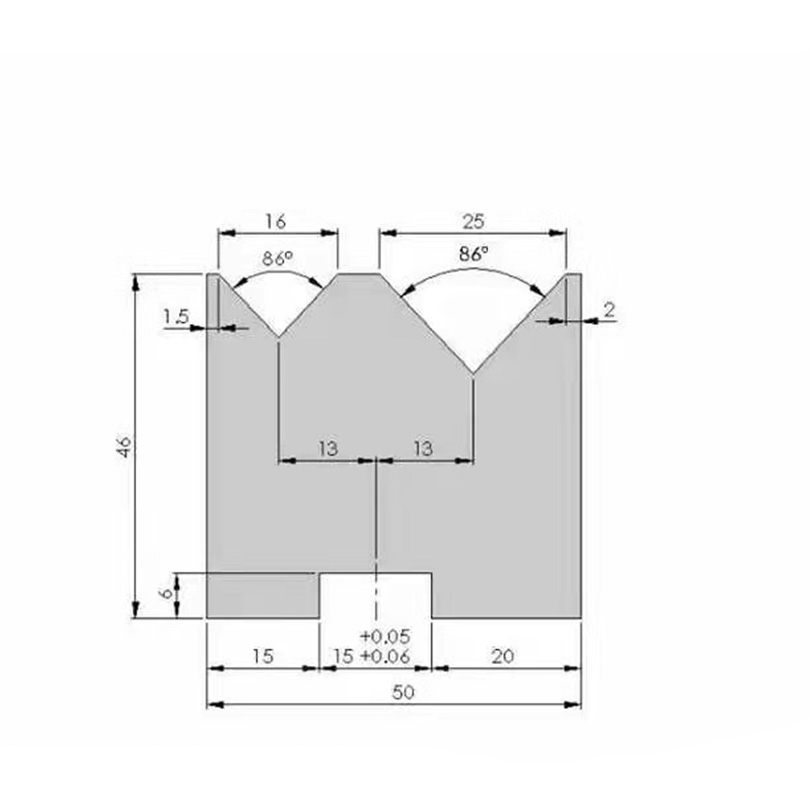
Lower Die: Fixed on the machine’s table. It usually has a V-shaped groove. The groove width affects bending force and part quality.
Place the sheet metal on the lower die.
The slider moves the upper die down to press the metal.
The metal bends into the shape of the dies.
The upper die moves back up, and you take the part out.
Strong & Durable: Made of tough steel (like 42CrMo) and heat-treated. Hard enough to handle heavy pressure and friction.
Customizable: Can be made in special shapes/sizes to match your parts.
Fits Your Machine: Must match your bending machine’s size and power.
Standard Sizes: Common sizes fit popular machines (Amada, Trumpf, Wille).
Standard Straight: For regular straight bends (most common).
Sharp Angle: For small angles or precise bends.
Gooseneck: For U-shaped or deep parts (avoids interference).
Arc: For curved or rounded parts.
Custom Irregular: Made for special part shapes.
Standard: For common metals (mild steel, galvanized steel) — good value.
High-Strength: For tough metals (stainless steel) — thicker and harder.
Thin Material: Prevents damage to thin sheets.
Amada/Promecam: Fits Amada machines.
Trumpf/Wila: Fits Trumpf and Wila machines.
New Standard: Fits most domestic machines.
Match the Material: Different metals bend differently (e.g., stainless steel needs a special punch to avoid wrong angles).
Follow the 8x Rule: Lower die V-groove width = 8 × material thickness (adjust for thin/thick sheets).
Check Machine Power: Dies must handle your machine’s pressure (don’t overload).
Choose the Right Punch Shape: Match the punch to your part’s final shape.
Ensure a Good Fit: Dies must fit your machine’s clamping system and size.
Medium sheets (3–8mm): V = 8 × material thickness
Thin sheets (<3mm): V = 6 × material thickness
Thick sheets (>8mm): V = 10–12 × material thickness
Don’t ignore how metal springs back — it causes wrong angles.
Follow the 8x rule — or parts will crack and dies will break.
Make sure dies fit your machine — or they won’t install right.
Country/Standard Organization | Standard Code | Corresponding Grade |
China (GB) | GB/T 3077 | 42CrMo or 42CrMo4 |
USA (AISI/ASTM) | ASTM A29 | 4140 |
International Organization for Standardization (ISO) | ISO 683-1 | 42CrMo4 |
Germany (DIN) | DIN EN 10083 | 1.7225 (or 42CrMo4) |
Japan (JIS) | JIS G4105 | SCM440 |
UK (BS) | BS 970 | 708M40 (EN19) |
42CrMo alloy steel offers significantly higher durability compared with ordinary carbon steel, thanks to its alloy composition, heat treatment performance, and mechanical properties.
It contains chromium(Cr), molybdenum(Mo) and manganese, which greatly improve:
Higher hardness and wear resistance
Better strength and toughness
Higher tensile and yield strength
Excellent performance under high pressure and heavy load
Longer service life in industrial applications
Ordinary carbon steel is soft, wears out quickly, and deforms easily under pressure.42CrMo maintains shape, stability even under long-term heavy working conditions, making it the ideal material for press brake toolingand molds.