

Phone:
86-15852949220


Views: 10 Author: Site Editor Publish Time: 2026-01-08 Origin: Site
Core Logic: Slitting Quality = Blade Material Matching + Machining Accuracy + Heat Treatment Process + Component Synergy, all four are indispensable.
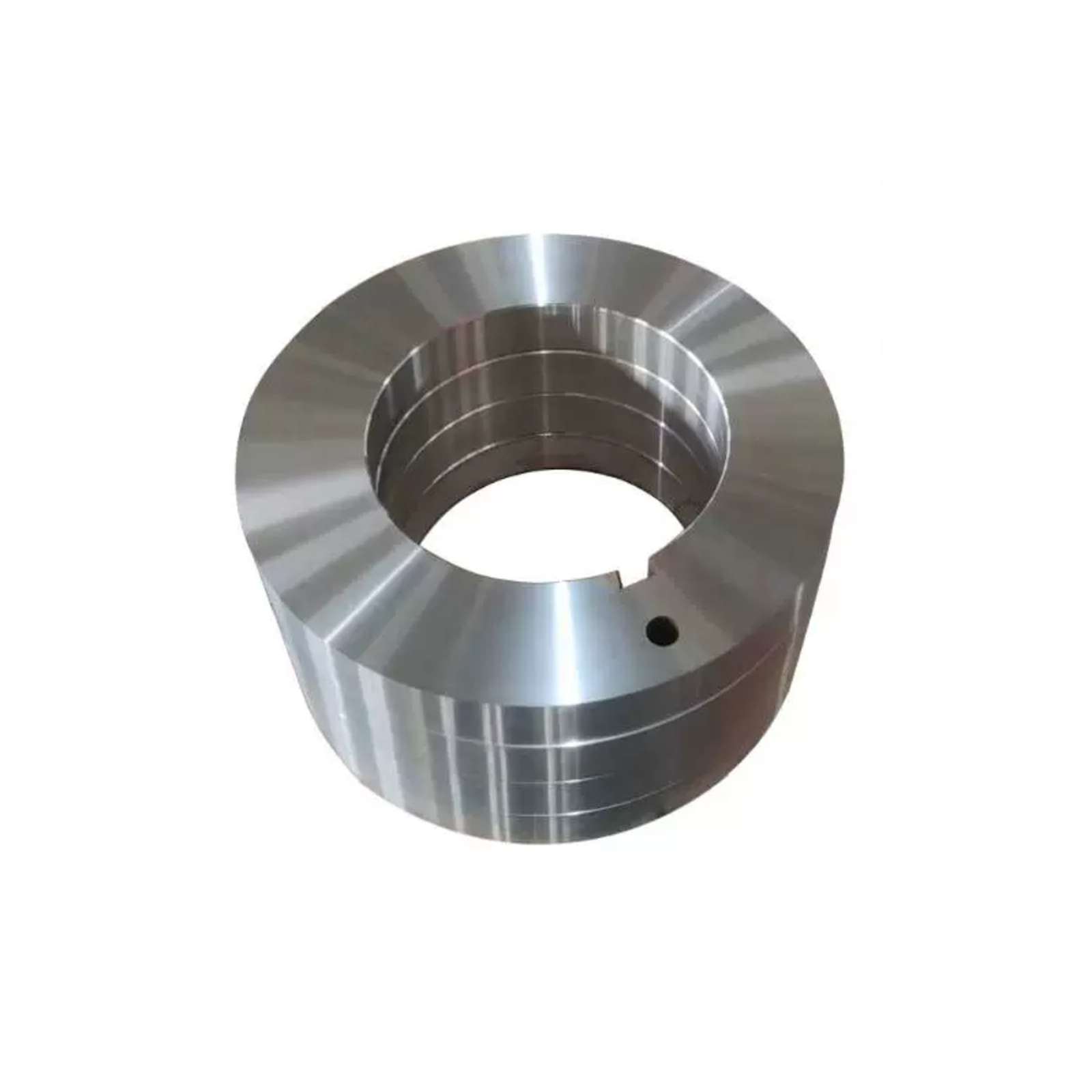
Choosing the wrong material is the primary reason for burrs, chipping, and material sticking during slitting. It must strictly correspond to the material being processed:
Recommended Materials: Cr12MoV, D2, SKD-11
Core Advantages: High-wear-resistant general-purpose material, suitable for high-speed continuous slitting conditions, long-lasting sharpness, effectively controls burrs on the strip edges, and offers the best balance of cost-effectiveness and durability.
Recommended Materials: LD (7Cr7Mo2V2Si) / H13 (4Cr5MoSiV1)
Core Advantages: Stainless steel has strong work hardening characteristics, and ordinary D2 is prone to micro-chipping; LD material combines high toughness and anti-adhesion properties, preventing material sticking to the blade edge; H13 is suitable for heavy-duty slitting scenarios and has excellent impact fatigue resistance.
Recommended Materials: Tungsten Carbide (Cemented Carbide) / ASP-23 Powder High-Speed Steel
Core Advantages: The mainstream solution for precision slitting in 2026, with a hardness of up to HRA 88-92 (tungsten carbide) / HRC 64-68 (powder steel), enabling burr-free ultra-precision cutting, and a service life more than 10 times that of ordinary tool steel.
The accuracy of the slitting blade directly determines the strip width tolerance and edge flatness. Suppliers must meet the following standards during selection:
Must reach ±0.001mm, otherwise, errors will accumulate when multiple blades are combined, causing the total strip width to deviate from the requirements.
Should be controlled within 0.002mm to avoid wavy edges on the slit strip, affecting subsequent processing and use.
Must reach mirror-grade (Ra < 0.1μm), otherwise it will increase lateral friction, causing metal powder to adhere to the blade edge, leading to secondary scratching of the strip material.
Material is the foundation, and heat treatment process directly affects the dimensional stability and service life of the blade:
Function: Ensures uniform hardness of the blade from inside to outside, preventing slight wobbling due to uneven hardness during high-speed rotation, thus damaging the spindle and affecting slitting accuracy.
Slitting aluminum plates and color-coated plates
Significantly reduces the friction coefficient of the blade surface, preventing aluminum adhesion and coating peeling, maintaining a clean and stain-free cut.
Applicable Materials: Silicon steel, copper and aluminum foil
Recommended Blades: Powder steel or tungsten steel
Hardness Requirements: HRC 64-68 (powder steel), HRA 90 (tungsten steel)
Core Focus: Extremely sharp edges and zero burrs
Applicable Materials: Cold-rolled plates, galvanized plates
Recommended Blades: Cr12MoV (D2)
Hardness Requirements: HRC 58-61
Core Focus: High wear resistance and cost-effectiveness
Applicable Materials: Automotive AHSS
Recommended Blades: LD or DC53
Hardness Requirements: HRC 60-63
Core Focus: Impact resistance and anti-micro-chipping
Recommended Blades: 6CrW2Si or H13
Hardness Requirements: HRC 54-58
Core Focus: Toughness and heat fatigue resistance
50% of slitting quality depends on the blade, and 50% depends on the synergy of spacers and rubber rings.
The accuracy must be exactly the same as the blade (±0.001mm), otherwise it will lead to excessive spindle clearance and exceeding the slitting width deviation.
We recommend using high-elastic polyurethane material, which combines strong material ejection function with surface protection, preventing indentations and scratches on the surface of the strip material.
Nanjing Alas International Co., Ltd. is a professional industrial tooling manufacturer focused on shear blades, bending dies, shredder blades, and custom wear parts. We offer full application engineering, material selection, setup guidance, and after-sales support to global customers.
Tell us your requirements, and our engineering team will provide professional solutions for blade specification, tool life optimization, and cost-effective production.