


Phone:
86-15852949220


 |


L/C, T/T, Paypal, Money Gram
10
| Quantity: | |
|---|---|
Papermaking and pulping industry
Engineered wood products (particleboard, MDF)
Biomass energy production
Analyze your wood type and working environment
Recommend the best edge shape and coating
Help you cut TCO and increase daily processing volume
Mounted on a rotating cutter head
Common configurations: 4-6 blades, 8-12 blades, spiral blades
Good for large-diameter logs
Makes clean, high-quality wood chips
Mostly used in paper mills
Fixed on a cylindrical cutter drum
Works well with different raw materials (bark, wood chips, small-diameter wood)
Suitable for small to medium processing plants
Good for complex raw material needs
Wood chip uniformity is slightly worse than disc blades
Type: High Toughness Cold Work Die Steel
Key strengths: Very high toughness, strong impact resistance (hard to break)
Typical hardness: HRC 58–62
High temperature resistance: Good
Corrosion resistance: Average
Toughness rating: ★★★★★ (best)
Wear resistance rating: ★★★☆☆ (moderate)
Type: Optimized A8 Steel
Key strengths: Good toughness and wear resistance, excellent high temperature resistance (hard to anneal)
Typical hardness: HRC 58–62 (stable)
High temperature resistance: Excellent
Corrosion resistance: Good
Toughness rating: ★★★★☆ (better than A8)
Wear resistance rating: ★★★★☆ (better than A8)
Type: High Carbon High Chromium Cold Work Die Steel
Key strengths: Top wear resistance, high hardness, long service life
Typical hardness: HRC 60–62
High temperature resistance: Average (easily softens at high temperatures)
Corrosion resistance: Semi-stainless (better than A8/A8B)
Toughness rating: ★★☆☆☆ (weakest)
Wear resistance rating: ★★★★★ (best)
Focus: High toughness and impact resistance
Alloy Features: Low carbon content; chromium, molybdenum and vanadium ratios focus on toughness.
Strengths: Hard to chip or break when cutting hardwood, knotty wood or wet wood
Best for: Small to medium chippers, branch shredders; processing high-impact raw materials (logs, branches, mixed wood)
Focus: Modified A8 steel; better wear resistance and high-temperature stability, while keeping A8’s toughness
Alloy Features: Adjusted alloy composition and heat treatment process.
Strengths: Toughness similar to A8; better wear resistance; stays sharp longer during continuous use
Best for: Medium to large continuous production lines (papermaking, wood-based panels, pulping); processing hardwood (rubber wood, eucalyptus)
Focus: High carbon and high chromium (≈12% Cr) steel; called “semi-stainless steel”
Key traits: Extreme wear resistance, high hardness, long service life
Strengths: Wear resistance 2–3 times that of A8; stays sharp longer; better corrosion resistance than A8/A8B
Weaknesses: Poor toughness, easy to crack under high impact
Best for: Large, high-capacity continuous chippers; processing low-impact, high-wear raw materials (softwood, bamboo, straw)
Mixed raw materials, high impact (hardwood, knotty wood, wet wood) → Choose A8 (prioritize toughness to avoid breakage)
Continuous production, mainly hardwood → Choose A8B (balanced efficiency and service life)
Softwood/bamboo/straw, high capacity → Choose D2 (best wear resistance, longest service life)
C: 0.50–0.60%
Cr: 4.50–5.50%
Mo: 1.00–1.50%
V: 0.90–1.40%
Si: ≤0.40%
Mn: ≤0.60%
P, S: ≤0.030%
C: 0.55–0.65%
Cr: 5.00–6.00%
Mo: 1.20–1.80%
V: 1.10–1.60%
Small amounts of W or Co (proprietary) for high-temperature stability
Si, Mn, P, S: Strictly controlled for better purity
C: 1.40–1.60%
Cr: 11.50–13.00%
Mo: 0.70–1.20%
V: 0.50–1.10%
Si: ≤0.60%
Mn: ≤0.60%
P, S: ≤0.030%
Affects hardness and wear resistance; more carbon = harder carbides
A8: Moderate carbon (keeps toughness and avoids brittleness).
A8B: Slightly more carbon (improves hardness and keeps toughness).
D2: Very high carbon (maximizes wear resistance but reduces toughness).
Improves hardenability, wear resistance, corrosion resistance and high-temperature stability
A8/A8B: Moderate Cr (provides balanced performance).
D2: ~12% Cr (semi-stainless with better corrosion and wear resistance).
Boosts toughness, temper resistance and high-temperature strength; prevents softening during continuous cutting
A8B: More Mo than A8 (better high-temperature stability and less annealing during heavy use).
Forms hard carbides; improves wear resistance and edge retention
A8/A8B: More V (keeps toughness and boosts wear resistance).
D2: Less V (relies on Cr and C for wear resistance).
A8: Moderate carbon + balanced Cr-Mo-V → Focuses on toughness and impact resistance.
A8B: Optimized alloy + better purity → Keeps A8’s toughness and improves wear and high-temperature performance.
D2: Ultra-high carbon + high Cr → Maximizes wear resistance and long life but reduces toughness.
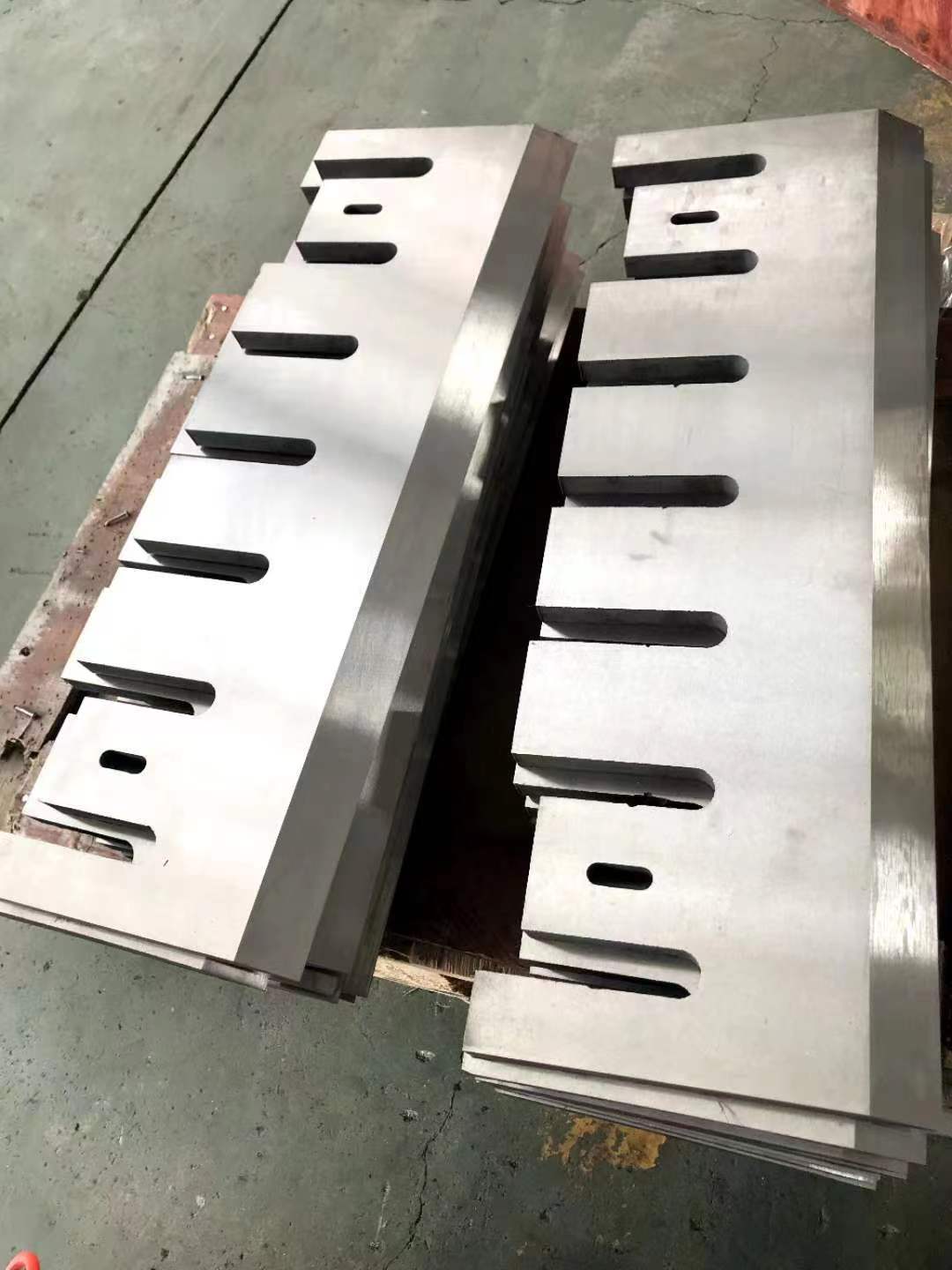
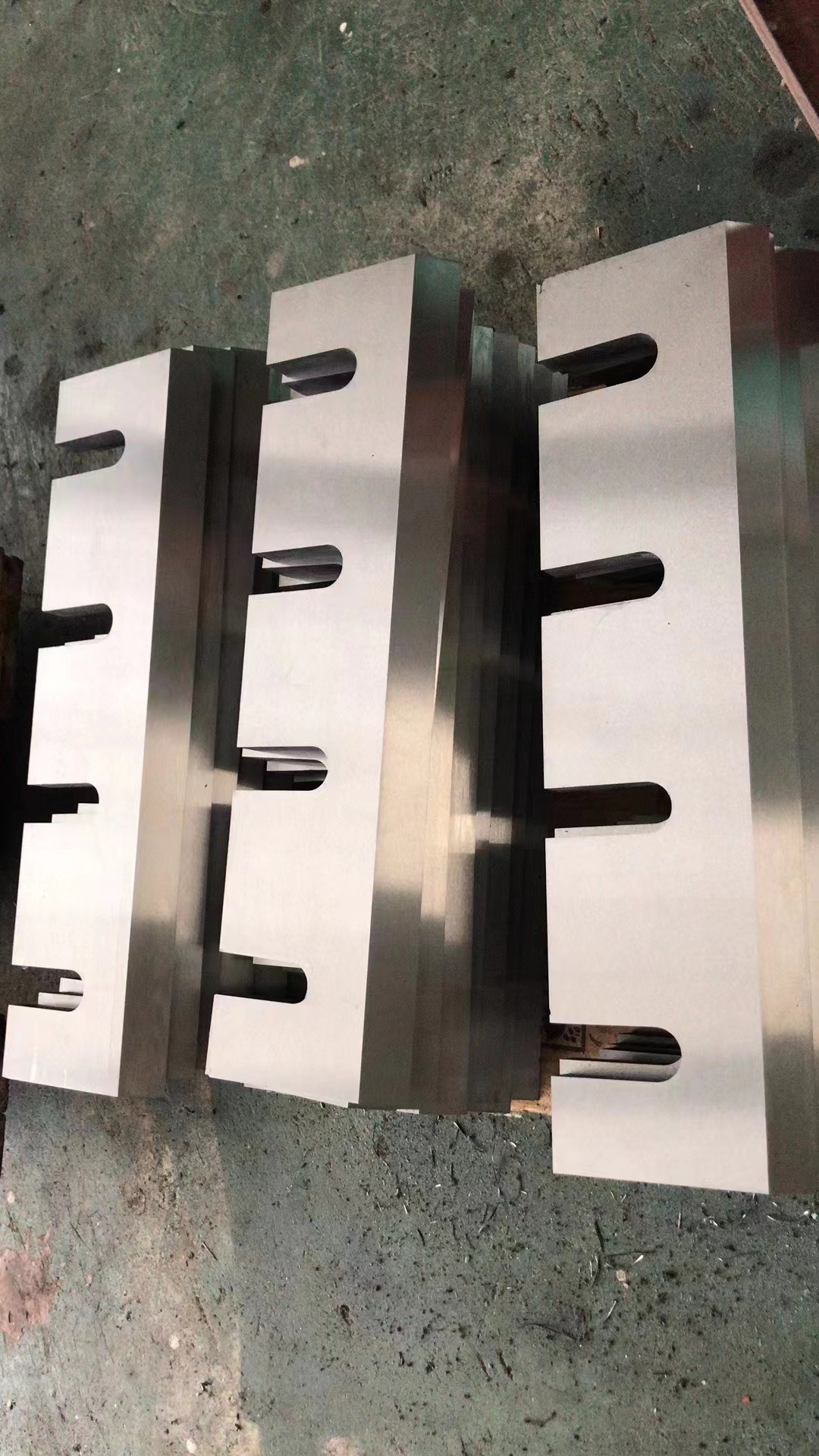

Nanjing Alas International Co., Ltd. is a professional industrial tooling manufacturer focused on shear blades, bending dies, shredder blades, and custom wear parts. We offer full application engineering, material selection, setup guidance, and after-sales support to global customers.
Tell us your requirements, and our engineering team will provide professional solutions for blade specification, tool life optimization, and cost-effective production.