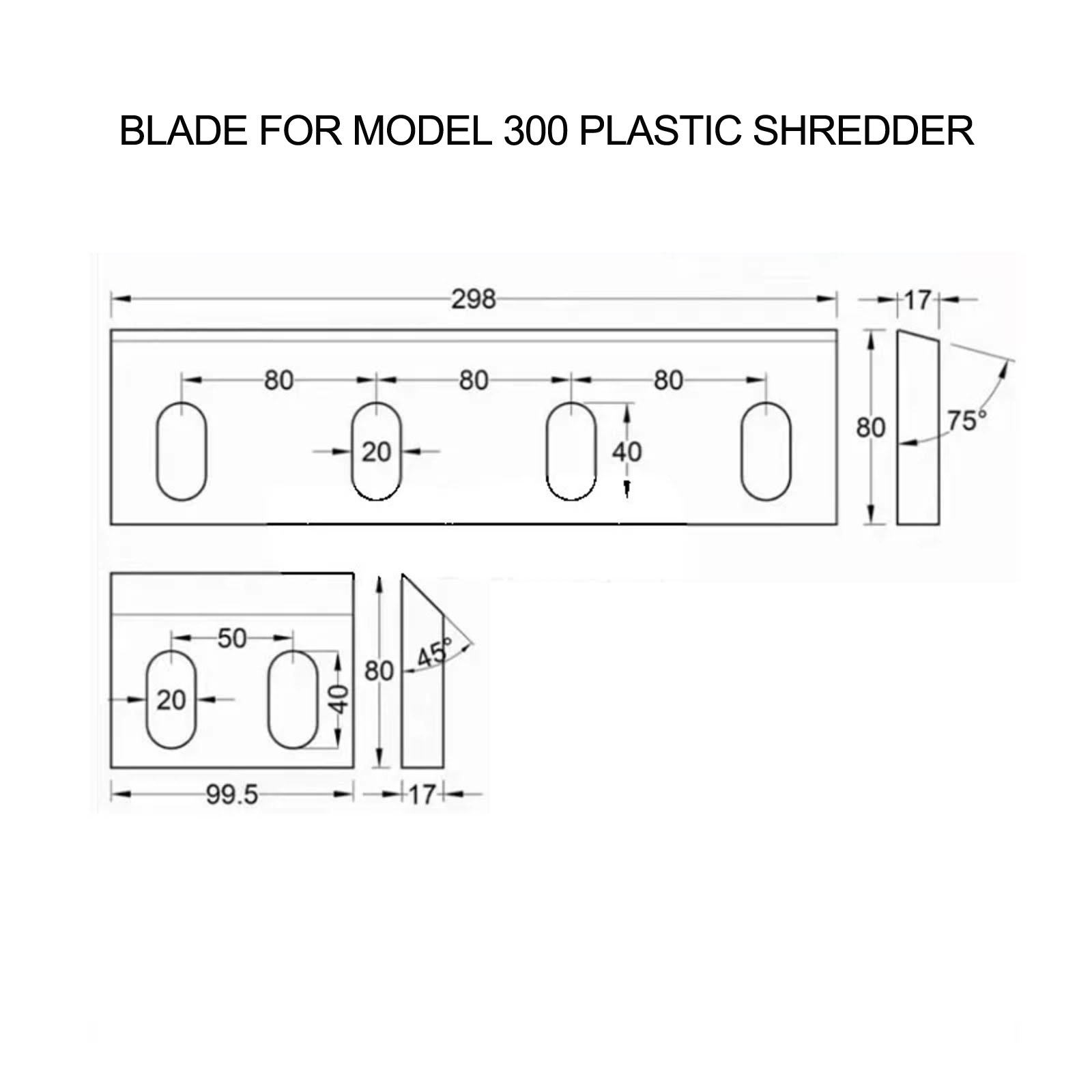
Plastic Crusher Blade Material Selection Guide
The material of plastic shredder blades directly determines shredding effect, service life, and equipment stability. Different plastics—including hard & brittle, soft & tough, and fiber‑reinforced thick materials—have distinct requirements for blade hardness, toughness, and shear performance.
This guide matches suitable blade materials for three major plastic groups: ABS / PS / rigid PVC, PE / PP / PA / film, and Fiber‑reinforced / thick / mixed materials. It explains core characteristics, mechanical properties, chemical composition, and application scenarios to support professional material selection.
Plastic Characteristics & Blade Selection Principles
The hardness, toughness, and fiber content of plastics create different stress conditions during shredding:
Hard & brittle plastics generate strong instantaneous impact
Soft & tough plastics easily wrap around blades and cause adhesion
Fiber‑reinforced plastics cause severe edge wear
Blade selection follows these principles:
Hard plastics: high hardness, wear resistance, impact resistance
Soft plastics: high toughness, strong shear force, smooth cutting surface
Fiber‑reinforced materials: ultra‑high wear resistance, chipping resistance
Accurate material matching reduces operating costs and improves crushing efficiency.
Blade Materials for Hard & Brittle Plastics
Application Scope
ABS, PS, hard PVC, hard plastic profiles, rigid plastic blocks
Material Performance Requirements
These materials are hard and brittle. During crushing, blades endure strong impact, which can cause chipping, cracking, and rapid dulling. Blades must have high hardness, wear resistance, and impact toughness.
Recommended Material: SKD‑11
SKD‑11 is a high‑carbon, high‑chromium alloy tool steel widely used for precision crushing blades.
Chemical Composition of SKD‑11
C: 1.40–1.60%
Cr: 11.00–13.00%
Mo: 0.80–1.20%
V: 0.20–0.50%
Si: 0.40% max
Mn: 0.60% max
High carbon and chromium provide strong hardness and wear resistance; molybdenum and vanadium improve toughness and dimensional stability.
Core Mechanical Properties
Hardness after heat treatment: HRC 60–64
Excellent wear resistance and edge retention, maintaining a sharp cutting edge for a long time
Good impact toughness, resistant to chipping and breakage during impact from hard plastics
High edge strength, suitable for high‑speed cutting of hard brittle materials
Advantages in Application
Reduces frequent sharpening and blade replacement, lowering maintenance costs
Withstands instantaneous impact force during hard plastic crushing, ensuring stable operation
Maintains consistent shredding effect for long-term use
Blade Materials for Soft & Tough Plastics
Application Scope
PE, PP, PA, soft PU, plastic film, woven bags, soft sheets
Material Performance Requirements
Soft plastics have high elasticity and ductility. They are difficult to cut cleanly and tend to wrap around blades or stick to edges. Blades need high toughness, strong shear capacity, and finely ground smooth surfaces.
Recommended Material: 9CrSi
9CrSi is a classic chromium‑silicon alloy tool steel suitable for general soft plastic crushing. For ultra‑thin films and woven bags, special alloy tool steel can be used.
Chemical Composition of 9CrSi
C: 0.85–0.95%
Cr: 1.20–1.50%
Si: 1.00–1.30%
Mn: 0.30–0.60%
P: 0.030% max
S: 0.030% max
Chromium enhances hardness and wear resistance, while silicon improves toughness and heat resistance, making it suitable for the continuous shearing of soft plastics.
Core Mechanical Properties
Hardness after heat treatment: HRC 58–62
High toughness, not easy to break or chip during high‑speed shearing motion
Good machinability, supporting precise grinding of the cutting edge to achieve a smooth surface
Moderate wear resistance, matching the low‑abrasion characteristics of soft plastics
Advantages in Application
Smooth cutting edge reduces material wrapping and adhesion, ensuring efficient shredding
Cost-effective, avoiding unnecessary waste for small-batch or regular soft plastic crushing
Easy to process and sharpen, reducing maintenance difficulty
Blade Materials for Fiber‑Reinforced / Thick / Mixed Materials
Application Scope
Glass fiber reinforced plastics, carbon fiber composites, thick plastic blocks, mixed waste plastics, hard thick plates
Material Performance Requirements
Fiber additives cause severe abrasive wear. Thick and mixed materials subject blades to combined stress: impact, abrasion, and shear. This places the highest demand on overall blade performance.
Recommended Material: DC‑53
DC‑53 is a high‑strength, high‑toughness alloy tool steel designed for heavy‑duty crushing, with better comprehensive performance than SKD‑11.
Chemical Composition of DC‑53
C: 1.00–1.10%
Cr: 7.50–8.50%
Mo: 1.80–2.20%
V: 0.20–0.50%
Si: 0.10–0.35%
Mn: 0.20–0.50%
Higher molybdenum content than SKD‑11 significantly improves toughness and high‑temperature stability, while appropriate chromium content ensures wear resistance.
Core Mechanical Properties
Hardness after heat treatment: HRC 62–65
Superior wear resistance compared to SKD‑11, effectively resisting wear from fiber-reinforced materials
Excellent chipping and fracture resistance, adapting to the strong impact of thick material crushing
Good high-temperature stability; the cutting edge is not easily deformed during long-term continuous crushing
Advantages in Application
Significantly extends blade service life when crushing fiber-reinforced plastics, reducing replacement frequency
Withstands complex stress from mixed materials, ensuring stable operation and consistent shredding effect
Suitable for heavy-duty continuous work, improving equipment productivity
Common Mistakes & Practical Selection Recommendations
Avoid Blind Selection of High‑End Materials
Using SKD‑11 or DC‑53 for small‑batch soft plastic waste causes unnecessary cost increases. For soft plastics, 9CrSi is sufficient; match materials according to plastic types: hard plastics with SKD‑11, fiber / thick / mixed materials with DC‑53.
Do Not Use Non‑Standard Blade Sizes
Incorrect dimensions lead to uneven assembly gaps, abnormal vibration, and long-term damage to blade shafts and the crusher body. Always use original or standard-sized blades.
Do Not Ignore Edge Precision
Rough edges worsen wrapping and adhesion when processing soft plastics. Always use precision‑ground blades to maintain shredding efficiency and reduce equipment failure.