Ironworker Punch & Die Set: Product, Performance & Service Life
1. Product Overview of Ironworker Punch Dies
Our ironworker punch dies are designed to fit different stations of ironworker machines, primarily punching dies and forming dies. They integrate seamlessly with the machine’s punching, bending and forming operations.
High precision: Ironworker punch dies handle various hole sizes and shapes, as well as angle steel bending and channel steel forming
Durable build: Ironworker dies offer strong compression and wear resistance, with no deformation or chipping during long-term heavy use
Broad application: Ironworker punch dies meet the needs of steel structure manufacturing, metal processing and other related industries
2. Punch: Core Component of Ironworker Punch Dies
The punch is the key part of the punching station for ironworker tooling. It works closely with the die to create clean, accurate holes in metal sheets and profiles.
Built for durability: Integral forging and strengthening treatment ensure long-lasting ironworker punch dies
Reliable performance: Even hardness and strong impact resistance prevent ironworker dies from breaking or wearing easily
Versatile design: Adapts to different hole sizes, making it suitable for flexible ironworker tooling
3. Recommended Materials for Ironworker Punch Dies
Choosing the right material extends ironworker tooling life and cuts costs. We offer three high-quality alloy steels for different ironworker dies needs, all with HRC 55-62 hardness after heat treatment.
3.1 9CrSi Steel (Cost-Effective Ironworker Dies)
Low-alloy cold work die steel with balanced performance for general ironworker tooling
Ideal for regular punching of medium-thick carbon steel with ironworker punch dies
A cost-effective option for general use, balancing performance and budget for ironworker dies
3.2 SKD-11 Steel (High Wear Resistance for Ironworker Punch Dies)
High-carbon high-chromium steel, perfect for long-lasting ironworker tooling
Great for mass production of thin steel sheets with ironworker punch dies
Minimal wear reduces ironworker dies replacement, boosting overall efficiency
3.3 DC53 Steel (Heavy-Duty Ironworker Punch Dies)
An upgrade from SKD-11, with better toughness for heavy-duty ironworker tooling
Suitable for heavy-duty tasks with ironworker punch dies: thick steel plates, heavy angle steel
Longer service life than 9CrSi and SKD-11 ironworker dies
4. Key Tip: Punch-Die Clearance for Ironworker Tooling
Incorrect clearance leads to early damage of ironworker punch dies. For most carbon steel, the optimal clearance is 10% of the material thickness.
Too small: Increases friction, accelerates ironworker dies wear, and causes burrs on workpieces
Too large: Results in hole deformation and reduced punching accuracy for ironworker punch dies
Our CNC-ground ironworker tooling ensures precise clearance, reducing burrs and extending ironworker dies service life.
5. Benefits of High-Quality Ironworker Tooling
Cleaner cuts and fewer burrs, reducing the need for secondary grinding with premium ironworker punch dies
Durable ironworker dies mean less frequent replacement and lower costs
Versatile ironworker tooling handles round, square, slotted and oval holes
Fits most mainstream ironworker machines, with universal ironworker punch dies
6. Maintenance Tips for Ironworker Punch Dies (Extend Service Life)
Lubrication: Use high-quality cutting oil to protect ironworker tooling from friction and heat
Calibration: Regularly check and adjust ironworker punch dies alignment to avoid uneven wear
Load Control: Follow the rated tonnage to prevent damage to ironworker dies
Cleaning: Promptly remove iron scraps and dirt from ironworker tooling
Material recommendations for ironworker punch and die
Material | Applicable Working Conditions | Core Advantages | Core Disadvantages |
9CrSi | Light-duty machines, ≤5mm thin/soft materials, small-batch | Good toughness, low cost, entry-level general-purpose | Average wear resistance, not for thick/high-strength conditions |
Cr12MoV | Small-medium tonnage, ≤10mm ordinary steel/profiles, regular batch | High cost-effectiveness, wear-resistant, small deformation, strong versatility | Average high-impact resistance, not for thick/hard materials |
DC53 | Small-medium tonnage, 8-15mm medium-thick/low-alloy steel, complex profiles | High toughness, wear-resistant, stable quenching, longer service life | Slightly higher cost than Cr12MoV, upgraded pricing |
Metal Materials International Grade Corresponding Table
China (GB) | USA(ASTM) | Japan (JIS) | Germany (DIN) | Germany (W-Nr) | France (NF) | Russia (ROCT) | U.K (BS) |
9CrSi | - | - | 90CrSi5 | 1.2108 | - | 9XC | - |
Cr12MOV | - | SKD11 | X165CrMov12 | 1.2601 | - | X12M | - |
Cr12Mo1V1 | D2 | - | X155Cr12Mo12 | 1.2379 | X160CrMoV12 | - | BD |
Ironworker Punch Dies drawing
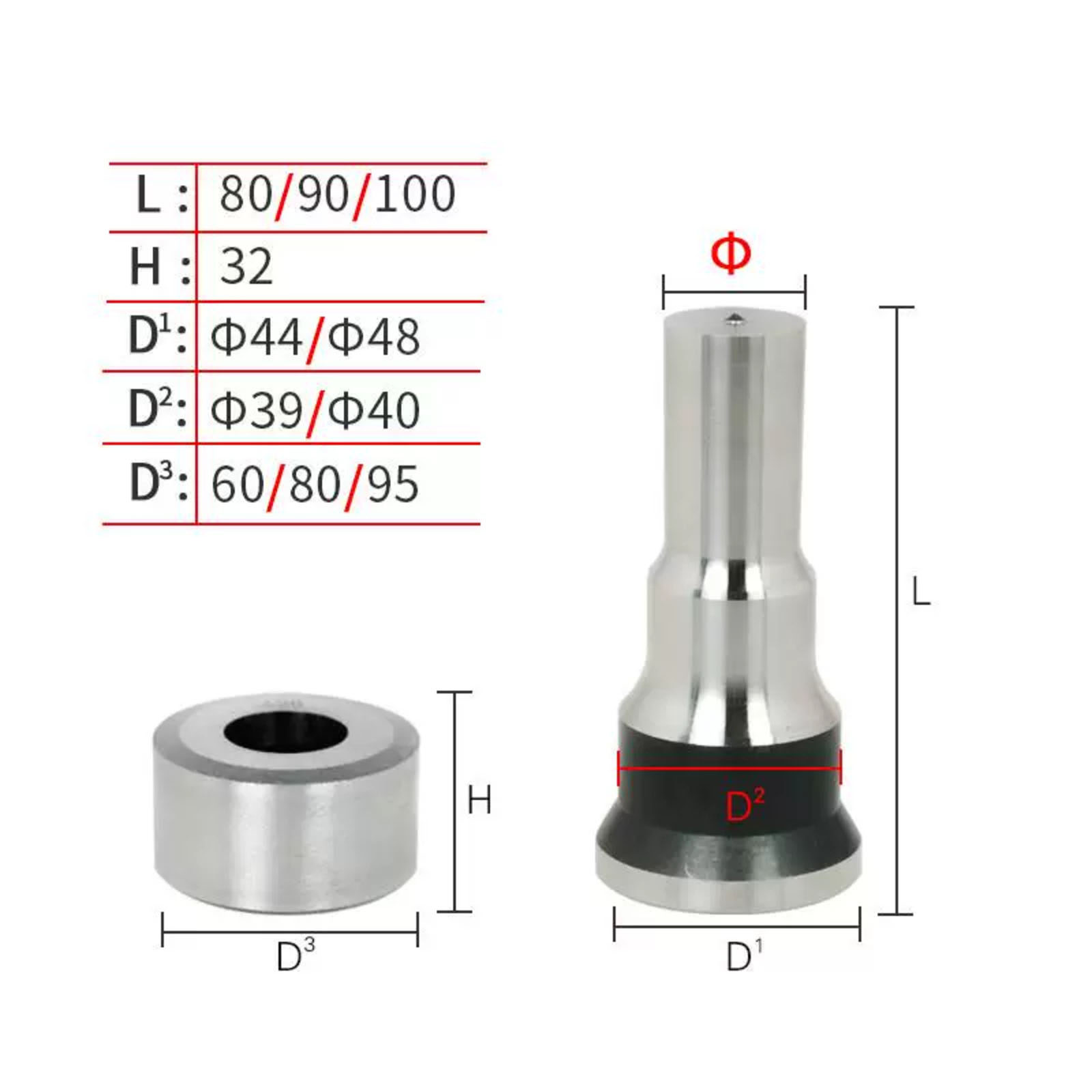
Versatile Shapes and Custom Tooling
We offer a comprehensive range of standard and custom ironworker dies, including:
Round Punches & Dies: The most common tooling for structural assembly.
Oblong & Oval Dies: Perfect for adjustable bolting applications and slots.
Square & Rectangular: For architectural metalwork and specialized bracket fabrication.
Custom Shapes: Hexagon, star, or unique geometry based on your CAD drawings.
Custom Tooling for Unique Projects
Sometimes standard round or square holes aren’t enough to meet your unique processing needs. We specialize in custom oblong, offset, hex, and other special-shaped punches and dies, tailored to your specific project requirements. By using advanced vacuum heat treatment technology, we ensure our custom tools have a consistent hardness of HRC 58-64 (depending on the material), making them as durable and reliable as our stock punch and die sets.
All Brand Compatibility
Our ironworker replacement tooling is precision-engineered to be 100% compatible with leading hydraulic ironworker brands, including Geka, Piranha, Edwards, Kingsland, Sunrise, and Cleveland.
Conclusion
Stop wasting money on low-quality punch and dies that chip or wear out after a few hundred hits. Upgrade to our high-performance ironworker punch and die sets—available in 9CrSi, SKD-11, and DC53 materials—to enjoy superior performance, fewer tool changes, and lower operational costs. Remember, punch and dies are usually purchased as a set (pair) for optimal compatibility and performance.
Contact us today with your ironworker machine model for a compatibility check and get a tailored punch and die solution!
Global Sourcing Tags for Metalworking and Punching Equipment:
English: Ironworker Punch Dies, France: Matrices de poinçonnage, Brazil: Matrizes de puncionamento, Poland: Matryce do wykrawarek, Turkey: Delme Kalıpları, Vietnam: Khuôn đột lỗ liên hợp, Thailand: แม่พิมพ์เจาะรูเหล็ก, Philippines: Mga Die sa Pag-punch ng Ironworker, Saudi Arabia: قوالب تثقيب حديد التسليح, India Hindi: आयरनवर्कर पंच डाइज़, Indonesia: Matriks Pelubang Logam, Malaysia: Acuan Penebuk Ironworker, Netherlands: Ponsmatrijzen voor metaal, Sweden: Stansdynor för järnarbetare, Hungary: Lyukasztó matricák, Greece: Μήτρες διάτρησης μετάλλου, Denmark: Lokkematricer til metal, Norway: Stansematriser for jernarbeider, Finland: Lävistysmeistit ja matriisit, Czech Republic: Razníky a matrice pro děrovačky, Romania: Matrițe de perforare metal, Slovakia: Razníky a matrice pre dierovačky, Bulgaria: Щанци и матрици за пробиване, Croatia: Matrice za probijanje metala, Ukraine: Пуансони та матриці для металу, Azerbaijan: Metal deşmə qəlibləri, Bangladesh: আয়ρωνওয়ার্কার পাঞ্চ ডাইস, India Tamil: அயர்ன்வொர்க்கர் பஞ்ச் டைஸ், Iran: قالب های پانچ آهن, Israel: מבלטים לניקוב פלדה, South Africa: Ponse en matryse vir ponsmasjiene.


