

Phone:
86-15852949220


 |


ALAS
Nanjing, China
L/C, T/T, Paypal, Money Gram
10
Wooden Crate Packaging
| Quantity: | |
|---|---|
We use three reliable, industry-standard materials: 45# steel, 40Cr and 42CrMo. Working surfaces are strictly controlled at HRC 45–55, while core load-bearing areas can be optimized to HRC 58–62. Every part undergoes professional quenching and tempering, balancing wear resistance, impact toughness and fracture resistance to withstand long-term cyclic bending.

Center Mandrel (Central Shaft): Fixed central pivot that maintains bending dimension stability
Work Pin (Eccentric Bending Pin): Rotating offset pin that applies pressure to bend and shape rebar
Roller / Sleeve: Auxiliary guiding part that reduces sliding friction during feeding and bending
| Failure Mode | Root Cause | On-Site Impact |
|---|---|---|
| Rapid surface wear & grooving | Surface hardness below HRC 35 | Altered bending radius, high rebar scrap rate |
| Plastic deformation (pin bending) | Insufficient core hardness, soft base material | Unstable bending angles, inconsistent finished parts |
| Brittle fracture & cracking | Over-hardened without matched tempering | Sudden breakage during operation, serious safety risks |
On-Site Engineer Feedback: Most failed pins returned for replacement have unqualified and untested hardness. HRC 45–55 is not a recommended standard — it is the minimum requirement for parts used in mass rebar bending. 90% of premature pin failures on construction sites stem from substandard heat treatment. — Equipment Manager, Precast Component Plant, Jiangsu
| Hardness Range (HRC) | Actual Service Life (Bending Cycles) | Main Failure Mode | Cost per Bend (Incl. Labor) |
|---|---|---|---|
| <35 (Mild Steel / Untreated) | <5,000 | Fast grooving & severe abrasive wear | ~ $0.006 |
| 35–44 (Conventional Tempered Steel) | 10,000–20,000 | Continuous gradual surface wear | ~ $0.003 |
| 45–55 (ALAS Standard, Industry Optimal) | 50,000–150,000 (100,000+ under ideal conditions) | Slow, uniform and predictable wear | As low as $0.0007 |
| 58–62 (High-Hardness Die/Bearing Steel) | 200,000+ (Small rebar & rolling friction only) | Brittle chipping or sudden cracking under high rebar impact | High material cost, not suitable for general rebar bending |
Below HRC 35: Untreated mild steel performs poorly with HRB400/HRB500 ribbed rebar. The soft surface cannot resist scraping from hard rebar ribs, forming deep grooves after a small number of bends. This changes the bending radius directly and produces unqualified rebar parts.
HRC 35–44: This is the most common hardness for low-cost replacement parts on construction sites. When working against hard rebar mill scale, it remains in a typical steel-on-steel friction state. Visible surface wear occurs quickly during cyclic use, requiring frequent flipping or replacement to maintain processing accuracy.
HRC 45–55 (ALAS Standard): This range is universally recognized as the most balanced and reliable for professional rebar bending. With precise quenching and tempering treatment, the pins gain stable wear resistance and sufficient impact toughness. They resist rib scratching and effectively offset rebar rebound impact, avoiding deformation and breakage. The performance stays consistent for both automated high-speed lines and ordinary site operation.
HRC 58–62: Ultra-high hardness materials deliver excellent wear resistance in laboratory tests, but lack the toughness required for real rebar bending conditions. Strong instantaneous impact and springback force from high-strength rebar easily cause edge chipping, microcracks and sudden brittle fracture, bringing hidden safety hazards.
Mill Scale & Rust Abrasion: Rebar surfaces are covered with high-hardness iron oxide scale, which acts like abrasive sandpaper. Every bending cycle produces continuous scraping wear on the pin surface.
Improper On-Site Operation: Unreasonable baffle gaps, tilted rebar feeding and irregular operation cause serious eccentric load impact. Local stress concentration leads to early chipping and pin fracture.
High-Strength Rebar Application: Modern projects widely use HRB400 and HRB500 rebar. Compared with ordinary round steel, these high-strength rebars generate far greater rebound force and surface extrusion, accelerating tool fatigue and wear.
Dry & Dust-Intensive Working Conditions: Construction sites have no stable lubrication. Pins work under complete dry friction or mixed friction with dust and grit, multiplying wear speed.
ALAS 45–55 HRC Premium Pins: Although the theoretical laboratory life reaches 200,000–400,000 cycles, the stable usable life on real sites is 50,000 to 150,000 cycles. After this range, obvious grooves and indentations appear, requiring maintenance or replacement to ensure bending precision.
58–62 HRC High-Hardness Pins: Actual on-site service life ranges from 150,000 to 300,000 cycles. Most failures are not caused by wear, but by sudden brittle fracture under strong impact from large-diameter high-strength rebar.
| Material Grade | International Equivalent | Core Performance | Applicable Working Scenarios |
|---|---|---|---|
| 45# Steel | SAE 1045 / JIS S45C / DIN C45 | Tensile strength ≥600MPa, surface hardness up to HRC 55+ | Small pins ≤Φ30mm, rebar ≤Φ20mm, light-duty and intermittent use |
| 40Cr | SAE 5140 / JIS SCr440 / DIN 41Cr4 | Tensile strength around 1000MPa, better core toughness than 45# steel | Medium-size pins, regular heavy bending, suitable for GW40/GW42 machines |
| 42CrMo | SAE 4140 / JIS SCM440 / DIN 42CrMo4 | Molybdenum alloyed, deep hardening, excellent fatigue resistance | Large pins >Φ60mm, large-diameter rebar Φ32–Φ60mm, 24/7 continuous production, GW50/GW60 equipment |
Production Site Experience: For continuous bending of Φ25 high-strength rebar on GW50 machines, 42CrMo is the only reliable choice. 45# steel cannot achieve deep hardening on large-diameter pins and bends easily under load. 40Cr works for standard tasks, while 42CrMo is tailored for round-the-clock heavy production. — Production Manager, Rebar Processing Plant, Shandong
Pin ≤Φ30mm / Rebar ≤Φ20mm / <500 cycles per day → 45# Steel (HRC 50–55)
Pin Φ30–50mm / Rebar Φ20–32mm / 500–1000 cycles per day → 40Cr (HRC 48–52)
Pin >Φ50mm / Rebar Φ32–60mm / >1000 cycles per day → 42CrMo (Core HRC 45–50 / Surface HRC 58–62)
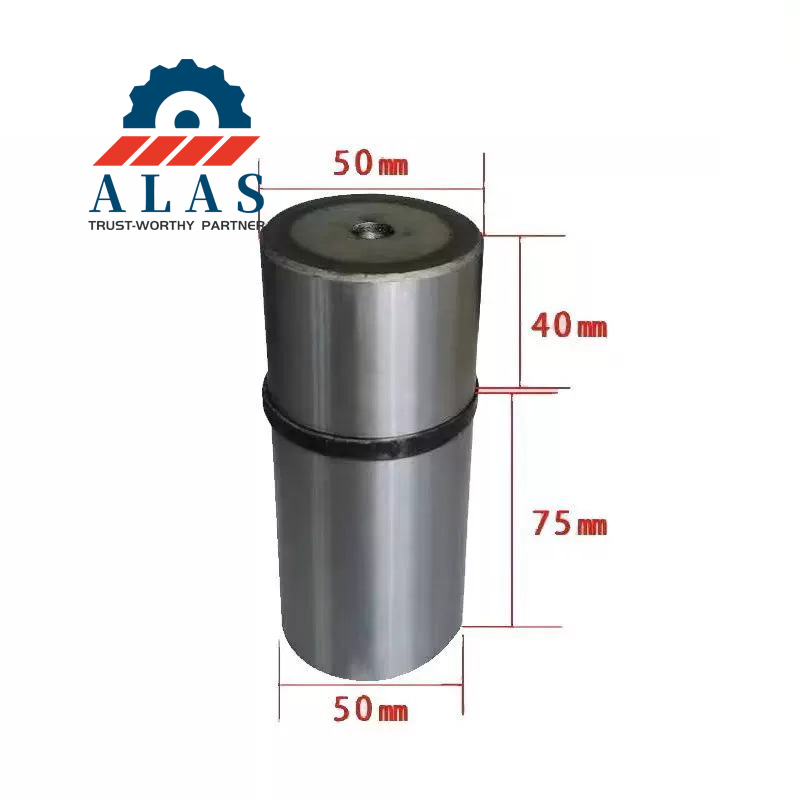
Dimensional tolerance data: Exact pin diameter with tolerance class (h6/h7 for matching positions, f8 for non-matching areas), overall length, keyway width and depth, taper angle and custom groove dimensions
Heat treatment and hardness zoning: Specify quenching + tempering or surface induction hardening process; clarify hardness values for the main body and working surface, and mark test points on drawings
Material grade confirmation: Select 45# steel, 40Cr or 42CrMo according to actual working conditions
End structure requirements: Confirm flat end, spherical head (with specified radius) or countersunk size

Cutting Machine Parts: Fixed and movable blade holders, connecting rods, slider blocks, precision gear shafts
Bending Machine Parts: Heavy-duty center mandrels, bending turntables, clamping assemblies, positioning baffles
Straightening Machine Parts: Wear-resistant straightening wheels, high-traction feed wheels, heavy cutting assemblies
A1: Working surface hardness of HRC 45–55 delivers the best balance of wear resistance and impact toughness. Core load-bearing areas can be optimized to HRC 58–62 for heavy-load scenarios.
A2: Under conventional heavy-duty operation (around 500 bends daily), GW40 and GW50 series pins maintain stable performance for more than 180 days.
A3: Yes, but only for small rebar diameters ≤Φ20mm and intermittent use. 40Cr or 42CrMo is required for continuous mass production and large-diameter high-strength rebar.
A4: The center mandrel is a fixed pivot point; the eccentric work pin rotates around the mandrel to apply pressure and complete rebar bending forming.
A5: Yes. We produce fully compatible drop-in parts for all mainstream international bending machine models, customized according to equipment model or OEM part number.
A6: Send engineering drawings, dimensional tolerances, material grade and hardness requirements via email. Our technical team will confirm details and provide a formal quotation quickly.

Email: mt@alasmachinery.com
WhatsApp: +86-15852949220
Nanjing Alas International Co., Ltd. is a professional industrial tooling manufacturer focused on shear blades, bending dies, shredder blades, and custom wear parts. We offer full application engineering, material selection, setup guidance, and after-sales support to global customers.
Tell us your requirements, and our engineering team will provide professional solutions for blade specification, tool life optimization, and cost-effective production.