

Phone:
86-15852949220


 |


ALAS
Nanjing, China
L/C, T/T, Paypal, Money Gram
10
Wooden Crate Packaging
| Quantity: | |
|---|---|
| Shearing Process | Sawing Process |
|---|---|
| No material chip removal; rebar fractured via blade extrusion | Material removed via cutting chips and fine metal powder |
| Ultra-fast cutting: 1–3 seconds per single cut | Continuous cutting, low overall working efficiency |
| Nearly no heat, sparks or metal debris generated | Produces massive sparks, high heat and fine dust |
| Flat cutting surface, negligible burrs | Smooth surface but prone to secondary processing |
| Low single-cut operating cost, less wearing loss | Fast tool abrasion, high single-cut production cost |
General Construction Sites: Prioritize portable and compact rebar cutters. Key demands: flexible mobility, fast blade replacement and easy on-site maintenance.
Rebar Fabrication & Precast Concrete Plants: Automated production lines require long-life blades to reduce downtime. Four-sided indexable blades are the mainstream option for extended service cycles.
Steel Mills & Hot Rolling Plants: Extreme high-temperature and heavy-load working conditions. Billet shear blades mostly adopt upgraded H13K steel. Mill blade specifications vary greatly: weight 5kg–600kg, maximum overall length up to 5.5m.
Large Infrastructure Projects: Bridges, tunnels and highway projects widely use Grade 80 / Grade 100 seismic high-strength rebar, requiring blades with enhanced impact resistance and material toughness.
Precast Component Manufacturing: Strict cutting flatness required. Any burr or section deformation will hinder rebar positioning inside concrete molds.
Scrap Metal Recycling Yards: Process rusted, bent, welded mixed scrap rebar. Random impact and aggravated abrasion occur; high toughness becomes the core performance index. H13 and H13K are preferred materials.
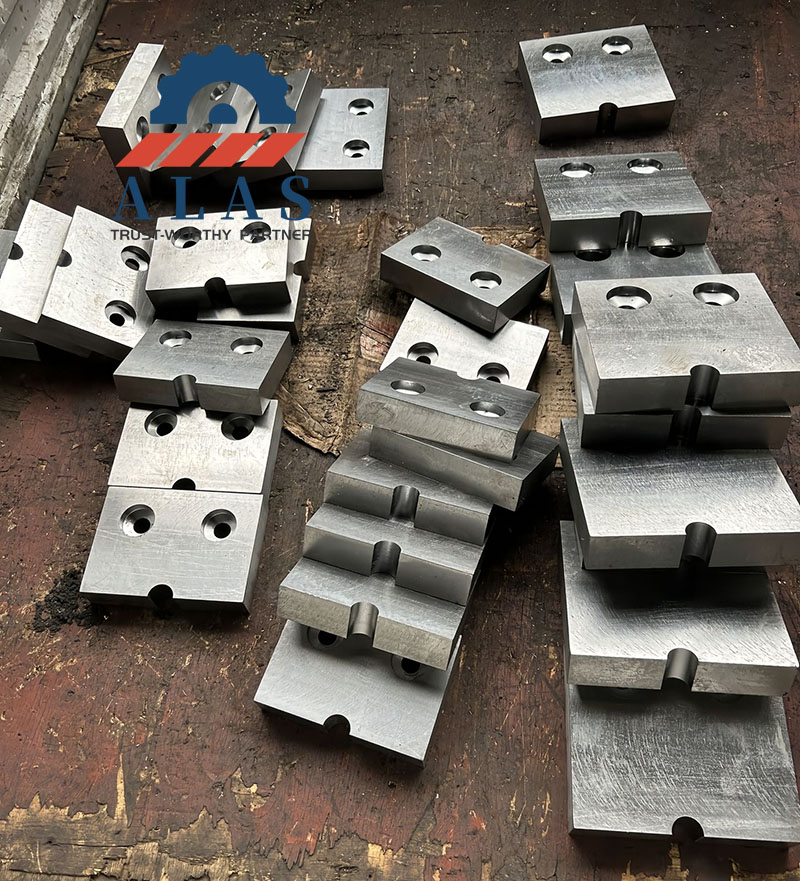
Proper surface hardness: resist abrasive wear and keep cutting edges sharp
Moderate core toughness: absorb instant impact load to avoid edge chipping and blade breakage
| Material Grade | International Equivalent Grade | Hardness (HRC) | Core Performance & Suitable Working Conditions |
|---|---|---|---|
| Cr12MoV | D2 / SKD11 | 58–62 | High wear resistance, moderate toughness. Ideal for mass shearing of HRB400 & lower-grade rebar, ≤25mm medium-small diameter rebar, automated continuous cutting lines. |
| H13 | SKD61 | 50–55 | Excellent toughness, impact resistance and hot hardness. Fit for HRB500 high-strength rebar, >32mm large-diameter rebar, welded rebar, scrap rebar cutting and long-term heavy-impact operation. |
| H13K | Modified Premium H13 | 52–56 | Optimized toughness, anti-impact and high-temperature resistance based on standard H13. Designed for mill extreme conditions: continuous casting, billet shearing and heavy-duty scrap recycling. |
| 9CrSi | N/A | 55–60 | Economical low-alloy steel, low heat-treatment deformation. Fit for HPB300 plain round rebar, light-load intermittent cutting and portable electric rebar cutters. |
HRC 50–54: Hot rolling mills, demolition sites, heavy scrap recycling — maximum toughness & fracture prevention prioritized
HRC 54–58: General building construction — balanced hardness and toughness for universal use
HRC 58–62: High-volume cold shearing — top-level wear resistance; standardized operation required to avoid impact damage
Mini portable blade: 36×28×15mm, net weight hundreds of grams
Heavy mill large blade: max length 5.5m, max weight 600kg
Portable electric cutter blade: Max φ16–25mm rebar, fit for Grade 60 rebar and below
Stationary hydraulic shear blade: Max φ36–42mm rebar, fit for Grade 80 rebar and below
Steel mill flying shear blade: Over φ50mm rebar, compatible with Grade 100 high-strength rebar
Rebar Grade & Diameter: Large-diameter, high-strength rebar requires high-toughness H13/H13K blades; small-diameter standard rebar pairs well with wear-resistant Cr12MoV blades.
Equipment Compatibility: Match blade dimension, bolt hole layout and thickness to original cutter specs.
Daily Cutting Volume: Continuous high-volume cutting → Cr12MoV; mixed heavy-impact cutting → H13/H13K; occasional light cutting → 9CrSi.
Working Environment: High-temperature mill operation → H13K; mixed scrap cutting → H13; indoor automated lines → Cr12MoV.
Blade Structure: Select four-sided indexable blades. Four usable cutting edges extend service life and lower replacement frequency.
| Material Grade | Standard Hardness (HRC) | Core Strength | Best Applicable Scenarios |
|---|---|---|---|
| H13 | 50–55 | High toughness, heat resistance, anti-chipping | HRB500 rebar, >32mm large rebar, welded rebar, heavy-impact long-hour operation |
| Cr12MoV | 58–62 | Superior abrasion resistance | HRB400 and lower rebar, ≤25mm small rebar, automated batch cutting lines |
| 9CrSi | 55–60 | Cost-effective, low deformation | HPB300 plain rebar, intermittent light cutting, portable cutter equipment |
Material Traceability: Official verifiable HRC hardness inspection report provided
Heat Treatment Capacity: Mature vacuum heat treatment and multi-tempering production line
Customization Service: OEM support for non-standard size and customized steel formula
Full-process QC: Strict dimension, hardness and surface finish inspection
Global Supply Qualification: Stable export record meeting regional industry standards
Lockout Power: Cut equipment power fully; release hydraulic pressure; clear metal chips inside blade seats.
Mark & Remove Blades: Loosen clamping bolts; mark upper/lower blade orientation for correct reinstallation.
Inspect Blade Seat: Check seats for scratches, deformation and wear; refinish mounting surfaces to ensure full flat contact.
Torque Fastening: Install matched blade sets; tighten bolts to 80–100 N·m with calibrated torque wrenches.
Set Blade Gap: Adjust gap via feeler gauge. New blade standard gap: 0.05–0.1mm. Maximum allowable working gap: 0.2mm.
Test Run: Run 1–2 minutes idle; make 5–10 trial cuts on scrap rebar to confirm stable operation and clean cuts.
| Maintenance Item | Execution Frequency | Functional Purpose |
|---|---|---|
| Clean steel chips around blade assembly | After every working shift | Avoid blade offset caused by debris accumulation |
| Coat guide rail with high-temperature lubricant | Daily before startup | Reduce friction, ensure smooth blade movement |
| Check clamping bolt tightness | Daily before startup | Prevent blade dislocation and accelerated unilateral wear |
| Visual inspection of cutting edge status | Before each cutting operation | Detect tiny chipping or wear in advance to avoid sudden failure |
| Fault Phenomenon | Root Cause | Solutions |
|---|---|---|
| Rough cutting surface, heavy burrs | Unqualified blade gap; dull cutting edge | Adjust gap to standard value; rotate or replace blades |
| Abnormal noise & vibration during shearing | Loose bolts; blade misalignment | Fasten bolts to rated torque; recalibrate blade position |
| Frequent edge chipping | Over-high blade hardness; too narrow blade gap | Switch to high-toughness H13 blades; properly enlarge gap |
| Serious unilateral blade wear | Equipment misalignment; unbalanced hydraulic pressure | Calibrate cutter frame; overhaul hydraulic system |
| Integral blade fracture | Overload cutting; raw material defect | Cut rebar within rated specification; adopt certified branded blades |
Material Demand Diversification: Cr12MoV dominates standard cold shearing lines; H13 and H13K see rising demand for scrap yards and steel mill heavy-duty jobs; 9CrSi holds steady for low-cost light-duty cutting.
Infrastructure-Driven Market Growth: Urbanization and infrastructure investment across emerging economies boost demand for rebar processing equipment and high-performance shear blades.
Automation Raises Precision Requirements: Automated rebar lines require dimensionally stable blades with consistent performance, pushing manufacturers to upgrade machining and heat treatment workflows. ALAS supplies custom high-precision blades for automated production lines.
No fixed replacement schedule. Inspect edges daily. Rotate indexable edges or replace blades once wear affects cutting quality. ALAS blades deliver longer service life via professional heat treatment.
Rotate four-sided indexable blades to unused edges first. Full regrinding is not recommended, as it alters factory assembly tolerances. Direct replacement is safer and more economical.
Cr12MoV (HRC 58–62): superior wear resistance for bulk standard cold cutting. H13 (HRC 50–55): higher toughness and hot hardness for large high-strength rebar, welded rebar and scrap cutting. H13K is optimized for extreme steel mill conditions.
Use a feeler gauge: new blade gap 0.05–0.1mm; maximum working gap 0.2mm. Improper gap causes poor cuts and accelerated blade wear.
Verifiable official HRC hardness test report
Stable vacuum heat treatment & multi-tempering process
Non-standard size and material customized service available
Strict dimension and surface quality full inspection
Mature global cross-regional supply experience
Improper hardness grade matching, incorrect blade gap, overloaded cutting beyond rated rebar size, impact from deformed rebar, defective raw material. ALAS full-process quality control minimizes such failure risks.
Mass ordinary cutting (HRB400 & below, ≤25mm): Cr12MoV
Large rebar / high-strength rebar / scrap welded rebar / heavy impact: H13
Mill continuous casting & billet high-temperature shearing: H13K
Plain round rebar / portable cutter / intermittent light cutting: 9CrSi
Source certified blades from qualified suppliers with complete material documentation
Follow standard assembly: 0.05–0.1mm blade gap, 80–100 N·m bolt torque
Complete daily cleaning, rail lubrication and edge inspection for routine maintenance
Evaluate total operational cost instead of only initial purchase price
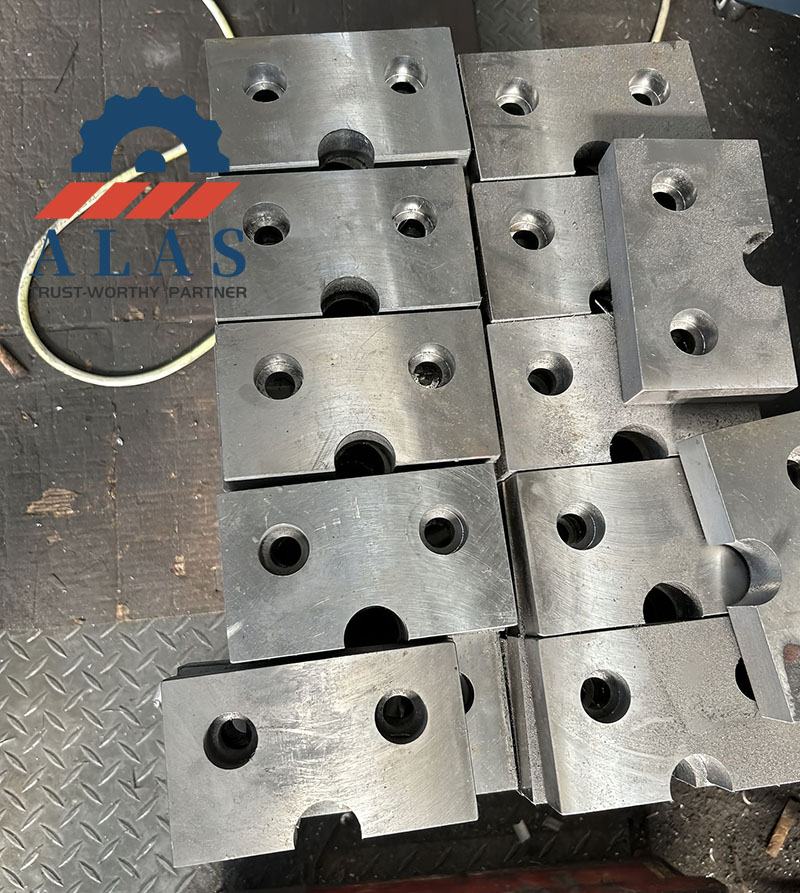
Base Grade | Steel Category | Chinese Standard GB/T 1299 | American Standard ASTM | German Standard DIN (W-Nr.) | Japanese Standard JIS |
H13 | Hot Work Die Steel | 4Cr5MoSiV1 | H13 | 1.2344 | SKD61 |
Cr12MoV | Cold Work Die Steel | Cr12MoV | 1.2601 | SKD11 | |
9CrSi | Alloy Tool Steel (Cutting Tool Steel) | 9CrSi | 1.2108 |
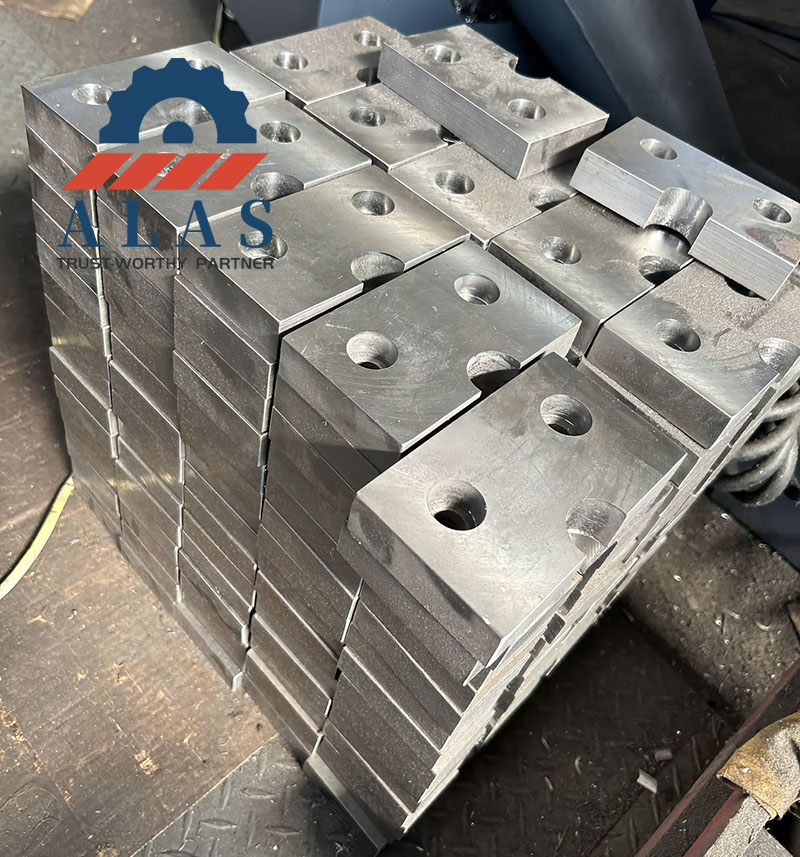
Nanjing Alas International Co., Ltd. is a professional industrial tooling manufacturer focused on shear blades, bending dies, shredder blades, and custom wear parts. We offer full application engineering, material selection, setup guidance, and after-sales support to global customers.
Tell us your requirements, and our engineering team will provide professional solutions for blade specification, tool life optimization, and cost-effective production.