Premium Guillotine Shear Blades & Custom Shear Knives for Industrial Metal Workshops
In busy metal fabrication shops, cutting accuracy and tool life directly impact your overall productivity. Using dull, bent or low-grade guillotine shear blades will leave your metal sheets warped, create sharp edge burrs, and lead to costly unplanned downtime. Worse still, uneven blade wear generates strong reverse shock, which can damage hydraulic cylinders and even the main frame of your shearing machine.
At ALAS, we build heavy-duty replacement shear blades to solve these common production issues. Our blades are engineered for continuous heavy-load cutting, delivering straight, clean and burr-free square cuts on metal sheets day in and day out.
Why ALAS Guillotine Shear Knives Stand Up to Tough Metal Processing
-
High-grade shock-resistant tool steelWe only use certified premium alloys including D2 (1.2379), SKD11 (Cr12MoV), 9CrSi, H13 and LD. These materials deliver exceptional wear resistance and prevent chipping even under extreme cutting pressure.
-
Multi-stage vacuum heat treatmentEvery blade goes through uniform vacuum quenching and precise tempering. Hardness stays consistent from surface to core at HRC 50–62, with no soft spots whatsoever.
-
Micron-level CNC grindingOur blades are finished on high-precision surface grinders. Flatness and edge straightness are held within 0.01 mm, keeping blade clearance consistent during high-speed production runs.
-
Cost-effective 4-way reversible designAll standard rectangular blades feature four symmetrical cutting edges. When one edge wears down, simply rotate the blade 90 degrees and keep working with a fresh edge. This design extends service life four times over before regrinding is required.
-
Full OEM compatibilityOur blades fit perfectly on Amada, LVD, Accurpress, Cincinnati, Pearson, Edwards, Gasparini, Yawei and many other popular shear models. We also offer custom machining based on your technical drawings, with no minimum order quantity beyond 1 piece.
Reach out to us for wholesale factory pricing. All orders come with export-grade anti-rust treatment and sturdy wooden crate packaging for safe shipment.
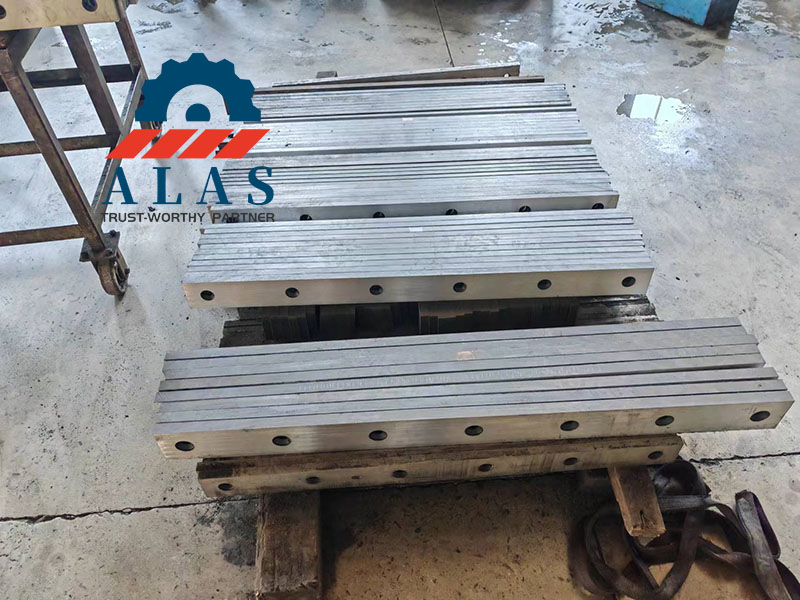
Technical Specifications: Blade Materials & Performance
All blades are processed with strict vacuum heat treatment and precision grinding. Below is our full material selection guide.
| Material / Grade | Hardness (HRC) | Key Features | Best Applications |
| 9CrSi Alloy Tool Steel | 58–60 | Balanced performance, low deformation, cost efficient | Thin cold-rolled sheets, galvanized steel, aluminum, copper, Q195/Q235 mild steel |
| 6CrW2Si Alloy Tool Steel | 58–62 | Maintains hardness at high temperatures, great chipping resistance | Hot shearing, light-gauge stainless steel, medium-strength steel |
| Cr12MoV / SKD11 | 58–60 | Excellent wear resistance, minimal distortion, less material build-up | High-volume production on stainless steel, silicon steel, high-strength steel and sticky alloys |
| D2 (Cr12Mo1V1) | 58–62 | Versatile long-wear performance, resists minor chipping, holds tight tolerances | Medium to low hardness steel, alloy steel, aluminum, brass, plastic, rubber, fiberboard |
| H13 / H13K Hot Work Die Steel | 50–55 | Strong heat resistance, high impact toughness, crack resistant | Hot-rolled plates, thick stainless steel, scrap metal, heavy-duty shearing jobs |
| LD (7Cr7Mo2V2Si) | 58–62 | Fine grain structure, superior toughness and fatigue resistance | High-strength steel, thick hard plates, large hydraulic shears, heavy industrial CNC cutting |
Precision Blade Clearance Guidelines
Correct blade gap is critical for clean cuts and longer tool life.
Properly set clearance stops sheet bending, material jams and burr formation. It also reduces sudden hydraulic pressure spikes and machine vibration during operation.
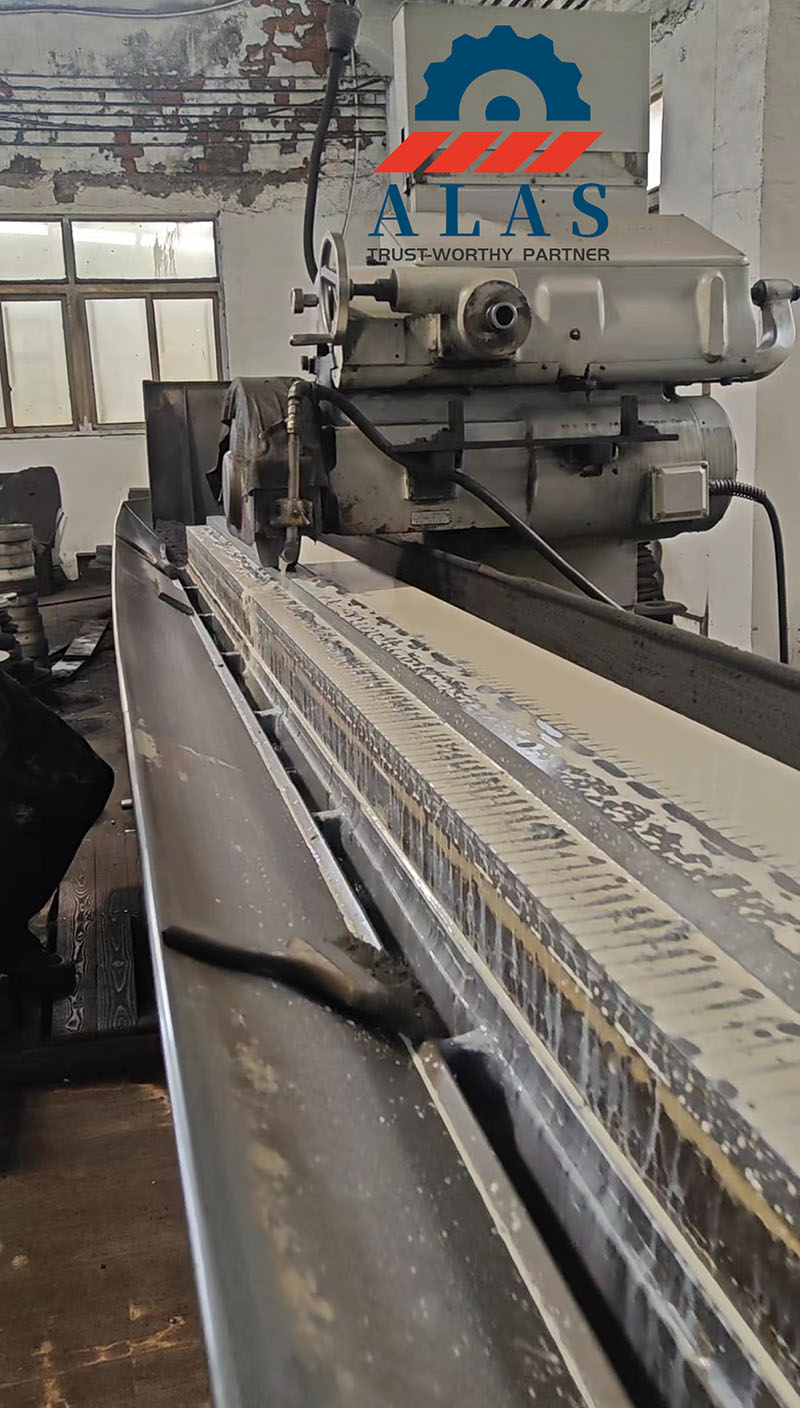
How We Build ALAS Blades for Longer Service Life
We are a real manufacturing facility with solid technical capabilities, not a trading company. Our complete production workflow is built to deliver reliable, long-lasting shear blades.
-
Multi-stage vacuum quenching & tempering
Removes internal stress and soft spots. Hardness remains uniform across the entire blade, with no decarburization or irregular grain structure.
-
Guarantees accurate edge straightness and parallelism within 0.01 mm. Blades run stably long-term, avoiding machine vibration and uneven cuts.
-
Strict quality inspection
For every batch of blades, 100% manual dimensional verification and flatness calibration are performed, along with spot checks on cutting-edge hardness..
-
Export-standard anti-rust packaging
Blades are fully coated with heavy-duty anti-rust oil, wrapped with multi-layer protective film against moisture and scratches, then packed into reinforced wooden crates to withstand rough handling and transit shocks.
Field data from customer workshops proves our blades hold a sharp edge 30% longer than generic alternatives, cutting unplanned downtime by more than 40%.
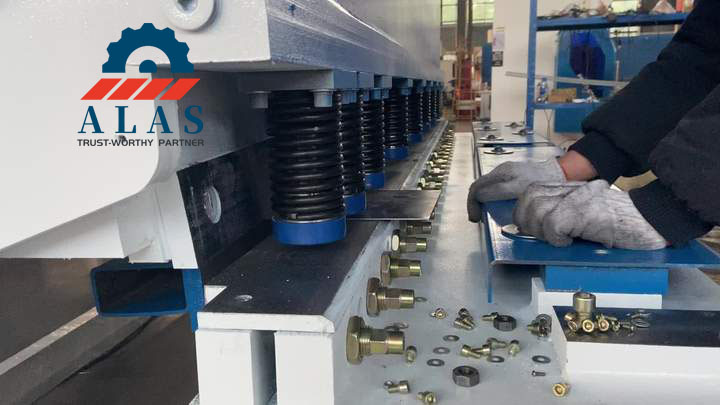
Industry Applications & Compatible Machine Brands
Industries We Serve
Heavy metal fabrication & job shops
Automotive and aerospace blanking
HVAC systems and electrical enclosure manufacturing
Shipbuilding and structural steel work
Metal recycling and scrap shearing
Direct Replacement for Global Shear Brands
Our precision ground replacement blades match original mounting dimensions perfectly for the following equipment:Amada, LVD, Accurpress, Cincinnati, Pearson, Edwards, Gasparini, Yawei, Bystronic, Haco, Durma, MVD
Custom Blade Service
We produce custom blades based on your required dimensions (L × W × T), bolt hole patterns, countersinks and special edge profiles.
FAQ – Guillotine Shear Blades: Common Questions & Answers
1. What causes burrs and crooked cuts? How do your blades fix this?
The main triggers are poor blade flatness and parallelism, incorrect blade gap, or blade movement and deformation during operation.
We use high-quality steel and professional vacuum heat treatment to reach stable HRC 50–62 hardness. Precision grinding keeps flatness and parallelism within 0.01 mm. The end result is clean, straight square cuts with far fewer burrs, so you can skip extra secondary grinding work.
2. How do I pick the right blade material for my work?
Ordinary carbon steel (Q195, Q235) and thin cold-rolled sheets: 9CrSi or Cr12MoV
Medium to low hardness steel, aluminum, copper: SKD11 or D2 for extended wear life
Light-gauge stainless steel and medium-strength steel: SKD11 or D2
Thick stainless steel and hard high-strength plates: H13 or LD
Hot shearing and high-temperature working conditions: H13 / H13K
Sticky alloys such as 304 stainless and galvannealed steel: Cr12MoV, SKD11 or D2 to reduce material adhesion and burrs
3. When should I rotate or regrind blades? How many rotations are possible before regrinding?
All our standard rectangular blades have four usable cutting edges. Simply rotate the blade 90 degrees once one edge wears out. This simple step greatly cuts your tool replacement costs.
You need to rotate or regrind blades when you notice obvious burrs on finished parts, unusual loud knocking during cutting, or rounded edges and small chips on the blade surface.
You can rotate the blade 3 times to use all four edges before regrinding becomes necessary.
4. What blade gap should I use for different materials?
Mild steel & thin plates: 5%–10% of material thickness
Alloy & high-carbon steel plates: 8%–12% of material thickness
Thin, sticky materials like stainless steel, aluminum and copper: Use a tighter gap to prevent sheet folding
Thick, high-strength materials: Use a slightly wider gap to lower machine load and stop blades from cracking
Always refer to your machine’s official manual for exact parameter settings.
5. Can you make custom blades for international brand machines?
Yes. Our replacement blades meet full OEM standards and fit most mainstream shear machine brands worldwide. We support custom production for standard, old and special machine models.
Send us your drawings, physical measurements, bolt layouts and countersink requirements. All parts are CNC machined for a perfect fit. Minimum order is 1 piece.
6. How to prevent blades from chipping and cracking?
Do not cut material harder than your blade’s rated capacity
Keep blade gap set correctly – incorrect clearance is the top cause of edge chipping
Clean rust, scale and debris off metal sheets to ensure even cutting pressure
Match blade material to your plate thickness and steel grade. Overly hard blades chip easily, while softer blades dull quickly.
Our blade advantagesProfessional vacuum heat treatment and multi-stage fine grinding deliver stable, uniform hardness at HRC 50–62 with no soft spots. Our blades balance wear resistance and impact toughness well, so they resist cracking under heavy cutting loads.
7. How are blades packaged for shipping?
Every blade is coated with heavy-duty anti-rust oil, suitable for long sea freight and warehouse storage. We wrap each item with thick protective film to avoid scratches and moisture damage, then pack everything into reinforced solid wooden crates to handle shocks during transport. Your blades will arrive sharp, flat and undamaged.
8. How does vacuum heat treatment balance hardness and toughness?
Multi-stage vacuum quenching and tempering eliminate decarburization and uneven grain structure. Our blades hit HRC 50–62 while retaining strong core toughness. Even at HRC 60, D2 and SKD11 blades deliver reliable chipping resistance, tested to ISO impact standards. With no soft spots, blades wear evenly and stay free of micro-cracks.
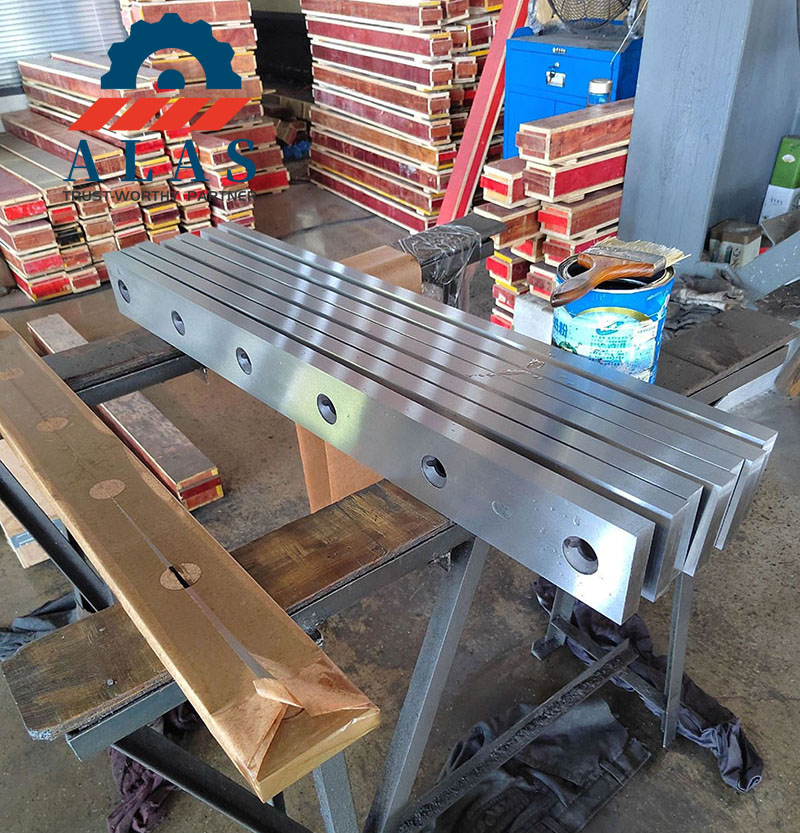
Get Factory Pricing & Technical Support
ALAS specializes in manufacturing premium guillotine shear blades and industrial hydraulic shear knives. We supply standard finished blades as well as fully custom cutting knives made to your technical drawings.
Why work with ALAS?
Direct factory supply, stable quality and competitive wholesale prices
4-way reversible design lowers your consumable expenses
Vacuum heat treatment plus CNC precision grinding for longer tool life
Fully compatible with Amada, LVD, Accurpress and other major brands
Export-grade packaging for safe delivery across the globe
Blade Metal Materials International Grade Corresponding Table
China (GB) | USA(ASTM) | Japan (JIS) | Germany (DIN) | Germany (W-Nr) | France (NF) | Russia (ROCT) | U.K (BS) |
9CrSi | - | - | 90CrSi5 | 1.2108 | - | 9XC | - |
6CrW2Si | - | - | 60WCrV7 | 1.255 | 55WC20 | 6XB2C | - |
Cr12MOV | - | SKD11 | X165CrMov12 | 1.2601 | - | X12M | - |
Cr12Mo1V1 | D2 | - | X155Cr12Mo12 | 1.2379 | X160CrMoV12 | - | BD |
4Cr5MoSiVI | H13 | SKD61 | X40CrMoV5-1 | 1.2344 | X40CrMoV5 | 4X5MO1C | BH13 |
LD | - | - | - | - | - | - | - |
W18Cr4V | T1 | SKH2 | S18-0-1 | 1.3355 | HS18-0-1 | P18 | BT1 |
W6Mo5Cr4V2 | M2 | SKH9 | S6-5-2 | 1.3343 | - | P6M5 | BM2 |


