Industrial metal cutting shear blades are hardened steel cutting tools made from H13, D2, DC53, and SKD11 tool steels, built to cut clean through sheet metal and plate up to 40mm thick. How hard they get depends entirely on what you're cutting — cold-cut grades run 58–62 HRC for wear resistance, while H13 hot-shear blades are intentionally brought down to 48–52 HRC because anything harder shatters under thermal shock. Nanjing ALAS makes both standard and custom shearing knives that fit Amada, Cincinnati, Accurpress, Komatsu, LVD, and most other major brands. We ship to 30+ countries and have supplied over 1,000 shops so far.
What Are Industrial Metal Cutting Shear Blades?
Shear blades — some people call them shearing knives or guillotine blades — are the hardened steel edges that bolt onto your hydraulic, mechanical, or pneumatic shear. They slam down (or swing through) and cut straight through metal, clean and consistent, all day long.
You'll find them everywhere metal gets worked: fabrication shops, structural steel plants, HVAC shops cutting aluminum, scrap yards, job shops doing custom work. If it's metal and it needs a straight cut, there's a shear blade doing the work.
For reference, a standard D2 blade from us will usually do 80,000 to 120,000 cuts on 6–10mm mild steel before it needs sharpening. Your mileage will vary based on material, thickness, and how well you maintain them.
Which Types of Shear Blades Are Available?
Standard Guillotine Shear Blades
These are your off-the-shelf replacement blades — built to drop right into the major brand machines. We stock lengths from 500mm up to 4,000mm in D2 and SKD11, usually with 4 to 16 mounting holes depending on length.
Fits Amada, Cincinnati, Accurpress, Komatsu, LVD, and a bunch of others. Most standard sizes go out the door in 5 to 7 business days. No machining needed, just pull the old ones out and bolt the new ones in.
Custom Shearing Knives
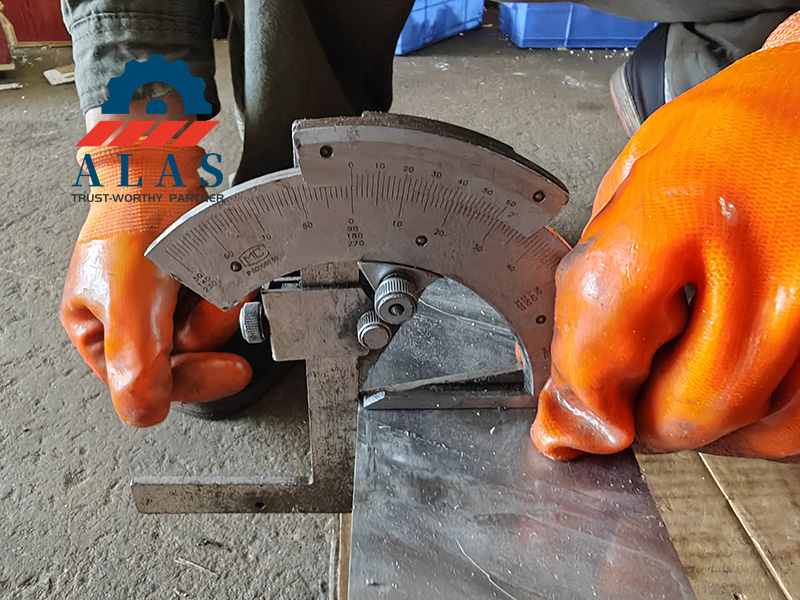
When standard doesn't fit, we do custom. And we try to make it as painless as possible.
Send us drawings — PDF, CAD, DWG, whatever you've got. Or send us a sample blade. Or even just your machine model number and we'll figure it out from there. We can do non-standard lengths up to 6,000mm, custom hole patterns, different rake angles, whatever you need.
Custom orders usually run 15 to 25 business days, depending on how complex it is and what's in the production queue.
Specialty Shear Blades
Not everything is standard sheet metal cutting. We also make blades for more specific applications:
Rotary shear blades for continuous processing lines
Crop shear blades for steel mill hot rolling lines
Slitter knives for precision coil slitting
Scrap shear blades for heavy-duty recycling equipment
Each of these uses a different material grade and hardness profile matched to what it's actually doing. Tell us what machine you've got and what you're cutting, and we'll spec it out.
Which Blade Material Should You Choose?
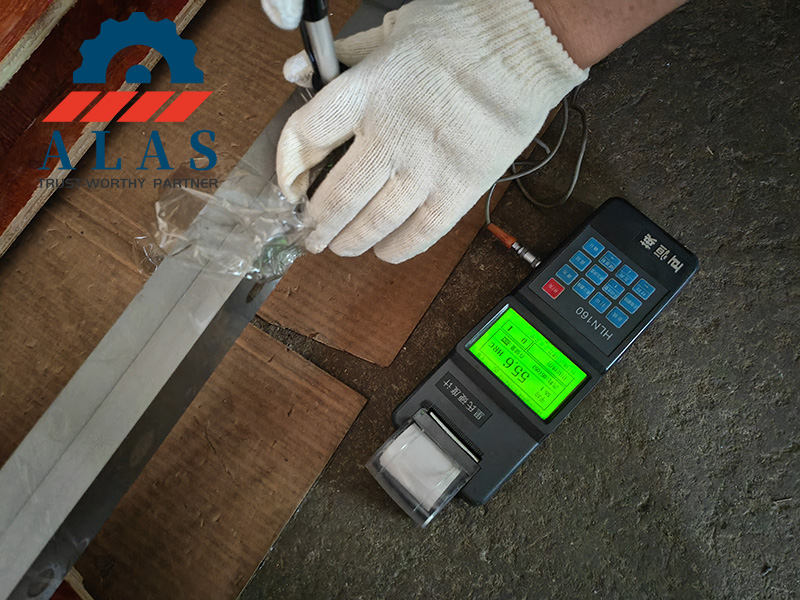
Strict Quality Control (QC) in Action: Every single ALAS shear blade undergoes rigorous post-heat-treatment inspection. Here, our technician uses a digital hardness tester to verify the exact Rockwell hardness (55.6 HRC) of a custom-engineered high-impact blade, ensuring it perfectly matches the client's material specs before packaging.
Picking the right steel is the biggest decision you make when ordering blades. Get it wrong and you'll either be replacing blades twice as often or dealing with chipping and cracking.
Here's the quick comparison:
| Material | Hardness (HRC) | Best For | Wear Resistance | Toughness | Typical Applications |
| H13 (Hot Shear) | 48–52 | Hot shearing, 800–1000°C red-hot billets | ★★☆☆☆ | ★★★★★ | Continuous casting, steel mills, hot rolling |
| H13 (Cold Impact) | 52–56 | Heavy-duty cold shear, high-impact work | ★★★☆☆ | ★★★★☆ | Ultra-thick plate, scrap shear, high-strength alloys |
| D2 | 58–62 | General cold cutting | ★★★★☆ | ★★★☆☆ | Mild steel, stainless, aluminum up to 25mm |
| DC53 | 60–62 | Heavy-duty, high-strength materials | ★★★★☆ | ★★★★☆ | Thick plate, high-strength steel, where D2 chips |
| SKD11 | 58–61 | Japanese-spec machines | ★★★★☆ | ★★★☆☆ | Asian-market shears, general fabrication |
"Here's the thing people get wrong about H13 — they see it's 'only' 48 to 52 HRC and think it's a softer, cheaper blade. That's backwards. We intentionally temper it down that far because if you run H13 above 54 HRC on a hot line cutting 800°C billets, the thermal cycling will make it brittle enough to shatter. We're talking catastrophic failure, not just wear. So we double or even triple temper at 560 to 610°C to lock in that 48–52 range. Yeah, you give up some wear life. But what you gain is impact toughness and heat-checking resistance that keeps a mill running instead of shutting down for a blade replacement and safety inspection."— Senior Metallurgical Engineer, Nanjing ALAS
Quick guide to H13 hardness by application:
-
Hot shear (800–1000°C red-hot billets): 48–52 HRC. Some mills spec even lower, 44–50 HRC, if the thermal cycling is extreme. Achieved by quenching then double or triple tempering at 560–610°C. The whole point is impact toughness and heat-checking resistance — wear resistance is secondary.
-
Heavy-duty cold shear (ultra-thick plate, scrap, high-strength alloys): 52–56 HRC. This is when you use H13 instead of D2 because chipping is your problem, not wear. You get better wear resistance than hot-shear H13 but still way tougher than D2.
How Are ALAS Shear Blades Manufactured?
Every blade we make goes through the same process, start to finish. No shortcuts.
First, we buy certified tool steel from mills we trust, with full traceability on every batch. No mystery metal.
Then it's forged and rough machined. The forging aligns the grain structure so the blade is stronger where it actually needs to be strong.
Then heat treatment — and this is where it gets specific. Cold-cut grades (D2, DC53, SKD11) go through standard vacuum hardening and tempering to hit their 58–62 HRC target. H13 hot-shear blades are a different story — they get double or even triple tempering at 560–610°C to intentionally bring the hardness down to 48–52 HRC. Different tools for different jobs.
After heat treat, everything goes through CNC surface grinding — flatness held to ±0.02mm per meter, thickness to ±0.05mm. Blades that aren't flat don't cut evenly, simple as that.
Then the edge gets honed sharp and ready to work.
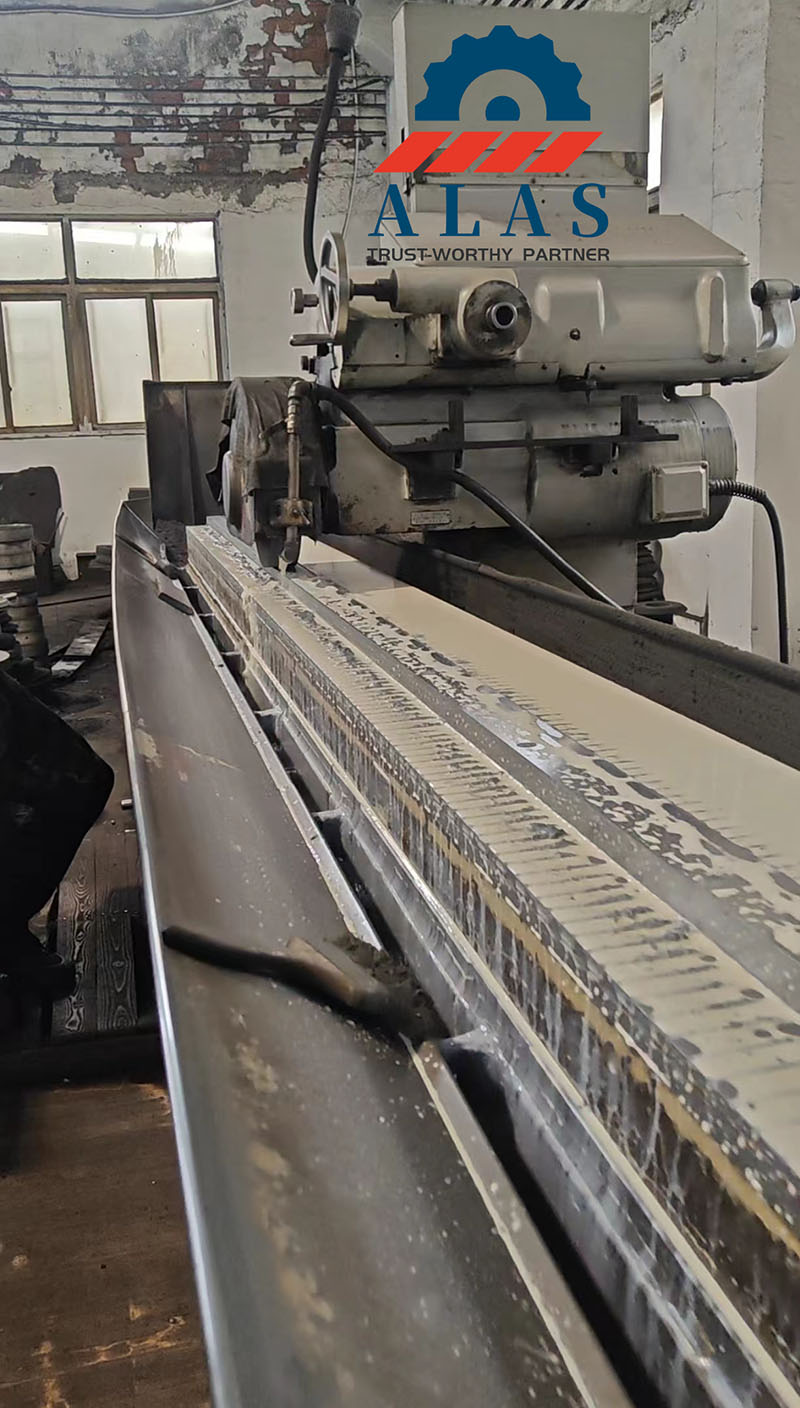
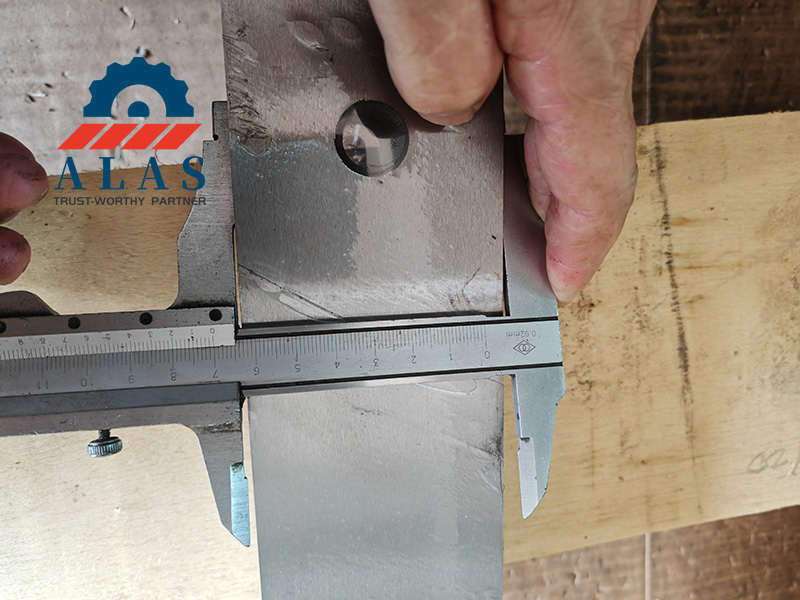
And finally, every single blade gets checked — hardness test, dimensional check, visual inspection — before it gets packed and shipped.
How to Extend the Life of Your Shear Blades
You'd be surprised how many shops burn through blades way faster than they need to because of basic stuff. A little attention will get you 30–50% more life out of every set.
Get your clearance right. This is the big one. Wrong clearance is the number one cause of early blade wear. Follow your machine manual — usually 5–10% of material thickness for mild steel. If you're not sure, ask us.
Sharpen early, not late. Waiting until the edge is beat to hell means you're grinding away way more material, and you risk chipping. A quick touch-up when you first notice the cut quality dropping extends total blade life a lot.
Match the blade to the material. Trying to cut something your blade wasn't designed for is a fast way to ruin it.
Keep them clean. Metal chips and gunk act like sandpaper. Wipe them down regularly.
Store them right. Keep spares someplace dry, with a rust inhibitor on them. Corrosion will eat an edge faster than you'd think.
What's the Real Cost of Shear Blades Over Time?
Here's something most buyers don't think about: the sticker price on a blade is barely half the story. Total cost of ownership is what actually matters.
A good D2 blade from us might cost 15–25% more up front than a cheap one. But it'll usually do 2–3 times more cuts between sharpenings, and you can sharpen it 8–12 times versus 3–5 times on the cheap stuff. Add in less downtime for changes, fewer bad parts from poor cuts, and fewer replacements overall, and you're usually looking at 30–40% lower total cost over a year.
For a mid-size shop running two shifts, that's real money — we're talking $8,000 to $15,000 a year in savings.
And for hot mills? It's not even close. A blade that shatters because it was hardened wrong can shut a line down for hours. The downtime alone costs more than a year's worth of blades.
How to Select the Right Shear Blade for Your Application
Picking the right blade isn't complicated if you go in the right order: figure out your conditions first, pick the material second, dial in the hardness third.
Step 1 — What's your actual situation? Start with the basics. What are you cutting? How thick? Hot or cold? If it's hot, how hot? What size shear? How many cuts per shift?
Cutting 800–1000°C billets on a continuous caster at 500 hits a shift is one thing. Cutting 6–12mm cold mild steel at 200 cuts a day in a job shop is another. Cutting 30–40mm thick high-strength plate on a heavy scrap shear is something else entirely. Different problems, different blades.
Step 2 — Pick the material.
Hot shear on red-hot steel → H13 (hot-shear grade)
Heavy cold shear where chipping is the problem → H13 (cold-impact grade, 52–56 HRC)
General cold cutting on mild steel, stainless, aluminum under 25mm → D2 at 58–62 HRC
Heavy cold cutting on thick or high-strength material where D2 chips → DC53 at 60–62 HRC
Japanese machines or existing SKD11 tooling → SKD11 at 58–61 HRC
Step 3 — Fine-tune the hardness. Within each material's range, adjust based on what's actually killing your blades. If you're wearing through edges too fast, go harder. If you're chipping or cracking, go softer for more toughness.
With H13, the rules are pretty firm: hot-shear stays at 48–52 HRC — thermal shock resistance isn't optional. Heavy cold-shear can go up to 52–56 HRC for better wear while still staying tough.
If you're not sure, send us your specs and our engineers will tell you what to run.
How Are Blades Packaged for International Shipping?
Let's be real — heavy steel blades sitting in a shipping container for 30–45 days crossing an ocean will rust if you don't pack them right. We've heard too many horror stories from customers who got blades from other suppliers that showed up spotted with rust because they were wrapped in newspaper and tossed in a cardboard box.
We don't do that. Every export order gets our full 3-layer seaworthy packaging, no exceptions.
VCI Anti-Rust Coating: Every blade gets coated with premium VCI (volatile corrosion inhibitor) oil before it goes in anything. The VCI molecules form an invisible protective layer on the steel surface that stops rust from forming, even in humid container environments. It's good for 6–12 months, which covers basically any ocean transit.
Vacuum Sealed Moisture Barrier: Then each blade gets individually sealed in heavy-duty moisture-proof vacuum plastic. The vacuum pulls all the air and moisture out, so there's nothing to cause rust. It also keeps the VCI oil from evaporating.
ISPM-15 Certified Wooden Crates: Finally, everything goes into heat-treated wooden crates certified to ISPM-15 standards — which you need for customs in most countries anyway. Inside, custom foam padding and supports hold each blade tight so nothing shifts, nothing hits, and edges don't get chipped during loading, unloading, or the ride across the ocean.
"Packaging is one of those things nobody notices until it goes wrong. But when a $500 blade shows up rusty because someone saved $5 on packing, it's just dumb. We had a customer in Brazil once who received blades from another supplier that were so rusted they had to be reground before they could even install them. That's not savings, that's false economy. At Nanjing ALAS, the 3-layer packaging is standard on every export order. It's not negotiable."— Zhang Wei, Export Logistics Manager, Nanjing ALAS
Why Choose Nanjing ALAS?
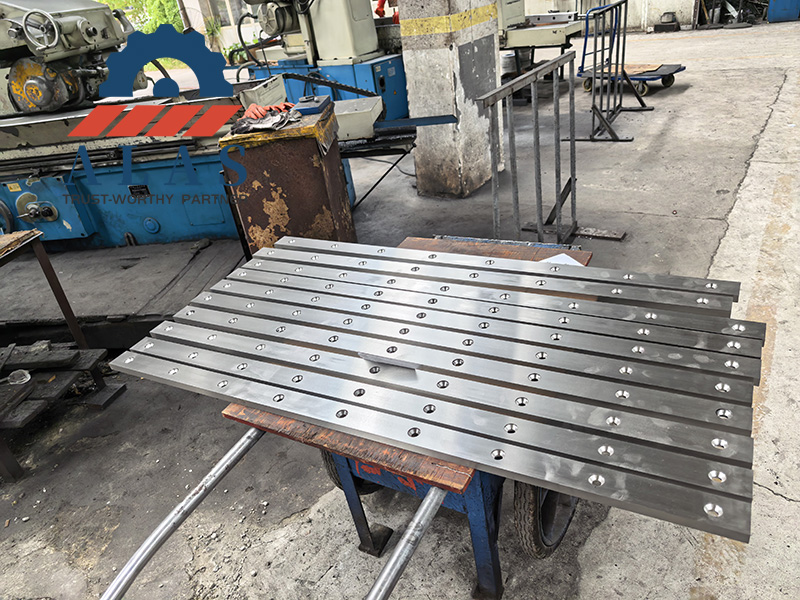
Nanjing ALAS is a direct manufacturer of industrial shear blades and custom cutting tools — China's tool steel blade manufacturing hub. We've been doing this for 15+ years.
We run our own in-house vacuum heat treatment and CNC grinding line, which means we control the whole process — quality, hardness consistency, lead time — instead of farming it out.
Our engineering team will help you pick the right blade for what you're actually cutting, not just sell you whatever's cheapest. We'll spec the material, the hardness, the geometry, all based on your application
Pricing is factory-direct, no middleman markup.
Standard blades go out in 7–10 business days. Custom runs 15–25 days. We ship to 30+ countries by sea, air, and express.
And everything we make is backed by a full quality guarantee. If there's a manufacturing defect, we make it right.
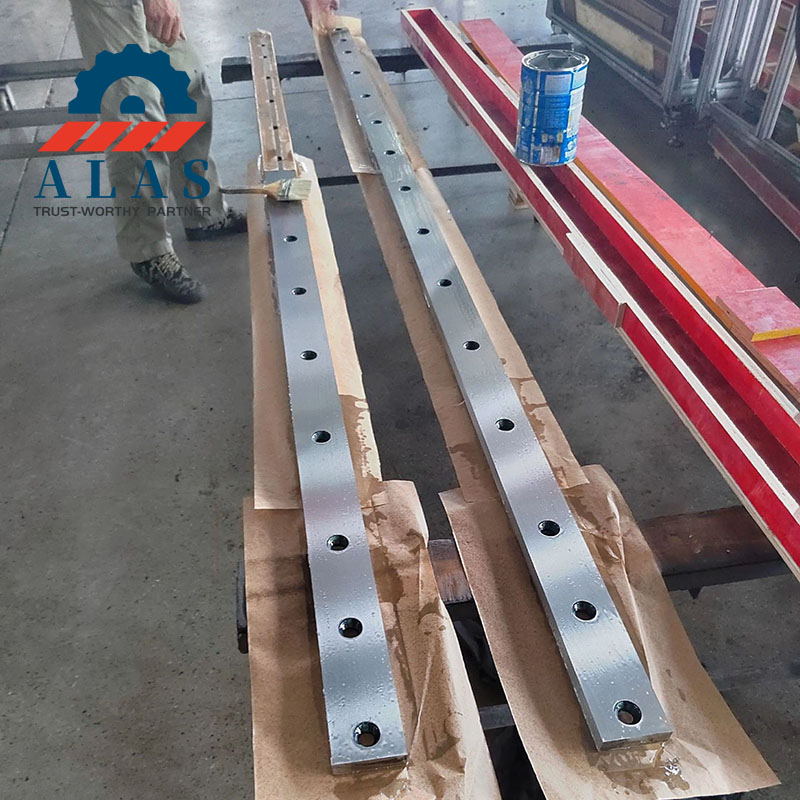
Zero-Rust Maritime Shipping Guarantee: Long-transit ocean freight involves heavy moisture and salt spray. At Nanjing ALAS, we protect your tooling investment before it leaves our floor. Here, our team applies a specialized layer of high-grade anti-rust oil onto a pair of custom guillotine shear blades, backed by VCI (Volatile Corrosion Inhibitor) protective barrier paper. We guarantee your blades arrive at your facility in pristine, razor-sharp condition, ready to bolt on.
Frequently Asked Questions
Q: How long do shear blades typically last?
A: On 6–10mm mild steel, a D2 blade will usually do 80,000–120,000 cuts before sharpening. H13 hot-shear blades don't last as long in terms of wear, but they're not specified for wear — they're specified for thermal shock resistance. Real-world life depends a lot on material, thickness, speed, and how well you maintain them.
Q: Can you make blades for my specific machine brand?
A: Yeah, most likely. We make blades that fit Amada, Cincinnati, Accurpress, Komatsu, LVD, and a bunch of others. Send us your machine model number and we'll confirm.
Q: What file formats do you accept for custom blade drawings?
A: PDF, CAD, DWG — whatever you've got works. If you don't have a drawing, send us a sample blade or even just your machine model number and we'll figure it out.
Q: What's the typical lead time?
A: Standard stock blades usually ship in 5–7 business days. Custom blades are typically 15–25 business days, depending on how complex they are and what's in the production queue.
Q: Do you offer volume discounts?
A: We do. Orders of 10+ blades get tiered pricing. Send us your quantity and we'll put a quote together.
Q: Why are H13 hot-shear blades softer than D2 blades?
A: Because they have to be. H13 hot-shear blades are intentionally tempered down to 48–52 HRC because if they were harder, the thermal cycling from cutting 800–1000°C red-hot steel would make them brittle enough to shatter. You trade some wear resistance for dramatically better impact toughness and heat-checking resistance — which is what actually matters in a hot-shear application.
Q: Can H13 be used for cold cutting?
A: Yes, but at a different hardness. If you're doing heavy cold-shear work and chipping is your main problem — like cutting really thick plate or scrap metal — H13 at 52–56 HRC is a tougher alternative to D2. It won't wear as well as D2, but it's way less likely to chip or break.
Q: How are blades packaged for overseas shipping?
A: Every export order gets our 3-layer seaworthy packaging: VCI anti-rust oil coating, vacuum-sealed moisture barrier wrapping, and ISPM-15 certified wooden crates with internal padding. Good for 6–12 months of transit time, and nothing moves around or gets damaged. 


