High-Performance Commercial Forestry Wood Chipper Blades & Replacement Knives
Downtime costs money in commercial forestry, land clearing, and biomass processing. The overall throughput and efficiency of your wood chipping equipment rely heavily on the cutting edge quality. As core wear parts, industrial wood chipper blades must continuously process heavy logs, stubborn branches, abrasive bark, and green wood waste into uniform, high-quality wood chips.
Whether your end-products are destined for pulp & paper mills, particleboard & MDF manufacturing, or biomass power generation, ALAS manufactures heavy-duty industrial chipper knives and OEM replacement cutters engineered for superior performance. Our blades deliver cleaner cuts, outlast standard original factory parts, and maximize your machine uptime.
Beyond premium blade supply, we offer direct technical support. We customize blade edge geometry to match your specific feedstock, significantly extending blade service life while lowering your daily operational costs.
Premium Tool Steel Grades: Engineered for A8, A8B & D2
No single steel grade suits all chipping applications. Our engineering team selects the optimal tool steel grade according to your actual site conditions — including wood density, moisture content, and sand/rock impurity levels. Precise alloy ratios of carbon, chromium, molybdenum, and vanadium determine each blade’s impact resistance, service life, and overall production economy.
A8 Steel — Maximum Impact Resistance & Anti-Chipping
A premium cold-work die steel formulated for mixed feedstock, high-impact hardwood, knotted wet timber, and frozen wood logs. Vacuum heat-treated to a stable hardness of HRC 58–62, it eliminates micro-chipping issues commonly seen on low-cost economy blades. Its optimized low-carbon, medium-chromium, high-molybdenum and high-tungsten composition delivers exceptional shock absorption.
A8B Steel — Balanced Toughness & High Wear Resistance
An upgraded tool steel variant based on standard A8 steel. While retaining A8’s excellent impact toughness, it features elevated carbon and chromium ratios plus rare metal additives to boost wear resistance and high-temperature stability. Maintaining hardness at HRC 58–62, it is the top choice for round-the-clock continuous commercial hardwood chipping, where resistance to heat softening is essential for long-duration operation.
D2 Steel — Extended Wear Life for Clean Feedstock
A high-carbon, high-chromium cold-work die steel reaching HRC 60–62 hardness. Its service life is 2 to 3 times longer than conventional steel blades, with moderate corrosion and rust resistance. Ideal for high-speed industrial chipping of clean softwood, bamboo, and agricultural straw.Note: Due to lower fracture toughness, D2 is prone to cracking under severe impact, so it is not recommended for mixed logs or wood contaminated with stones and debris.
Quick Material Selection Matrix
| Feedstock & Working Conditions | Recommended Steel Grade | Primary Benefit |
| Mixed feedstock, heavy impact loads, hardwood, knotted wet wood, frozen logs | A8 Steel | Superior shock absorption & breakage prevention |
| 24/7 continuous hardwood processing, high friction & elevated operating temperatures | A8B Steel | Optimal balance of operational cost and productivity |
| High-volume processing of clean softwood, bamboo and agricultural straw | D2 Steel | Longest wear resistance, fewer re-sharpening cycles |
Heavy-Duty Disc & Drum Chipper Blade Designs
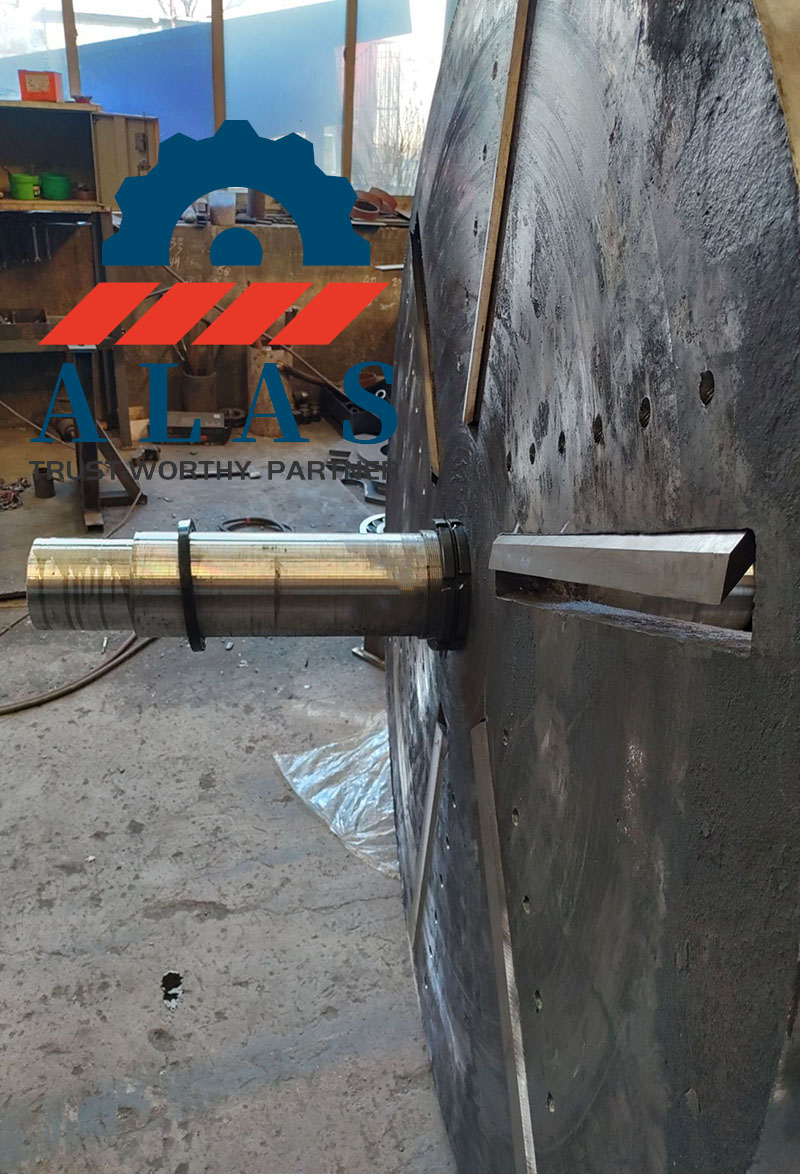
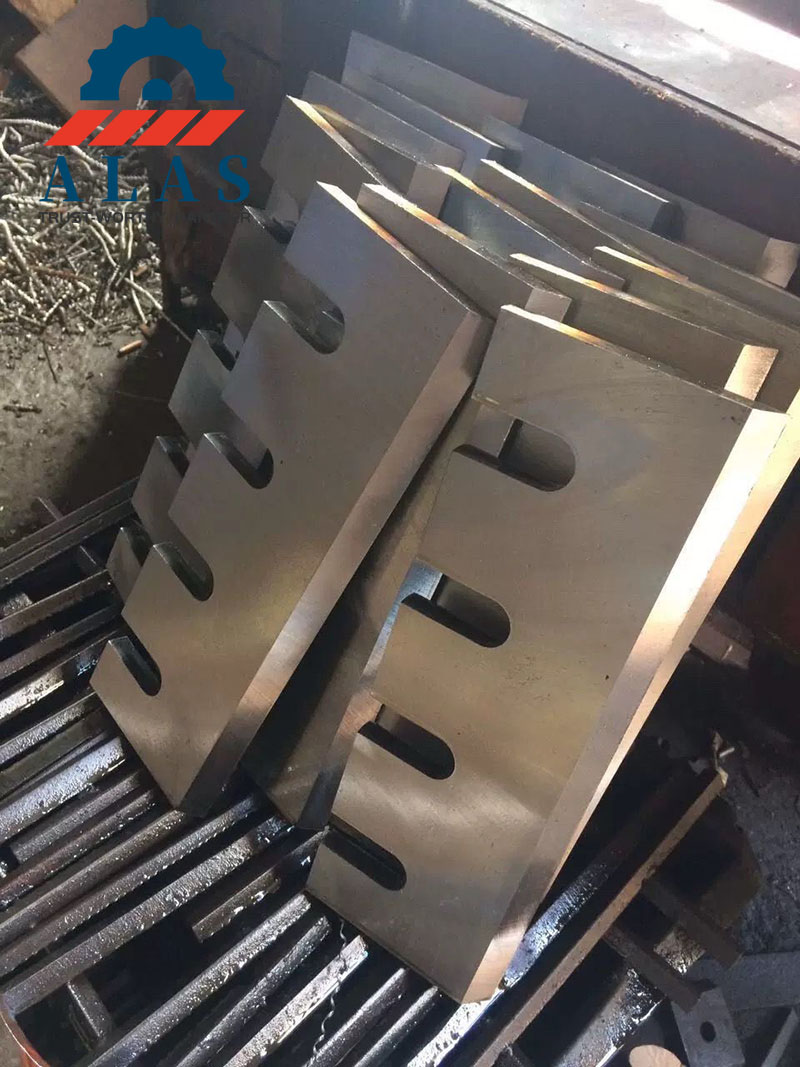
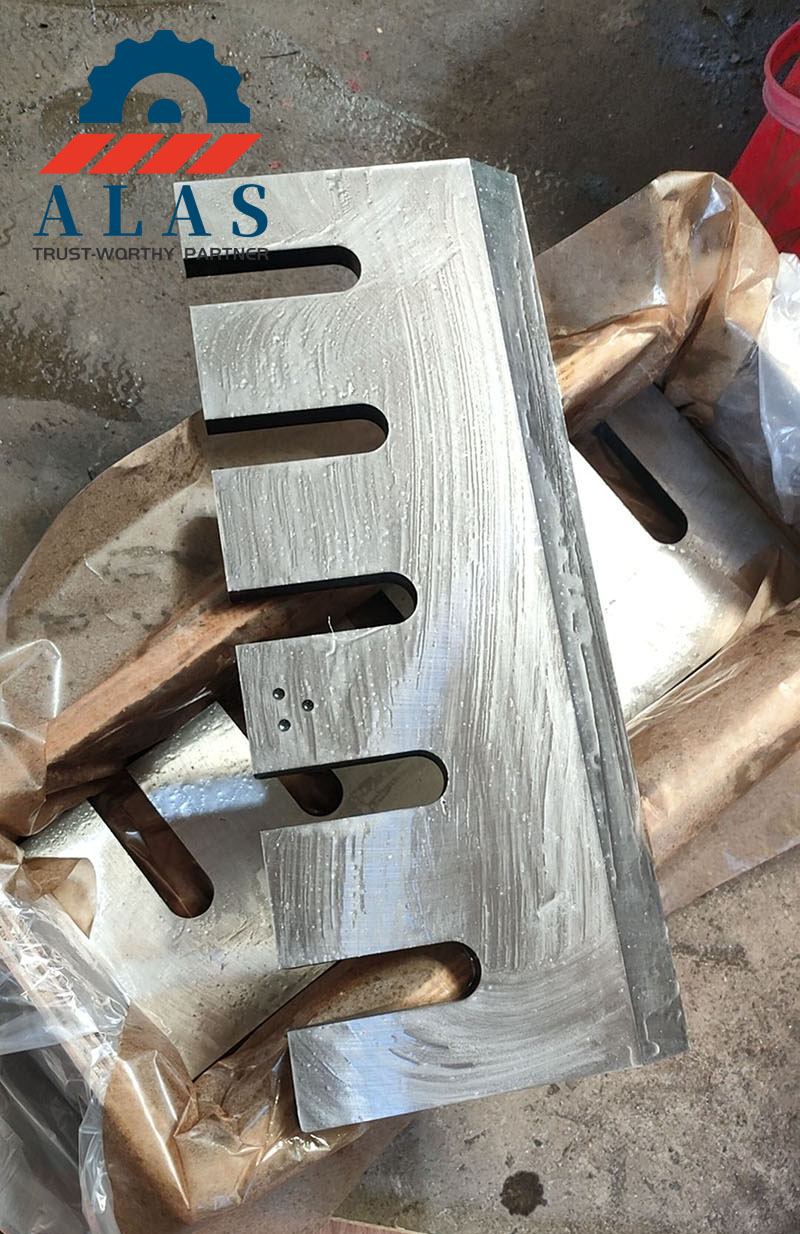
All ALAS replacement knives are precision CNC ground to meet or exceed OEM technical drawings for both disc-type and drum-type wood chippers. Every blade undergoes strict factory dynamic balancing to suppress machine vibration and prevent premature bearing failure.
-
Disc Chipper Blades & Counter KnivesCustom-designed for installation on rotating cutter discs, available in 4–6 piece, 8–12 piece, and special spiral layout configurations. Primarily engineered for chipping large-diameter logs, they produce highly uniform, clean-cut wood chips well-suited for pulp and paper mill production.
-
Drum Chipper Blades & PocketsPrecision-fitted for cylindrical cutting drums. These blades excel at processing irregular bark, sawmill residues, small-diameter logs, and mixed brush waste. Ideal for small-to-medium recycling yards and organic waste treatment facilities with variable daily incoming materials.
100% Direct-Fit OEM Compatibility for Industry-Leading Brands
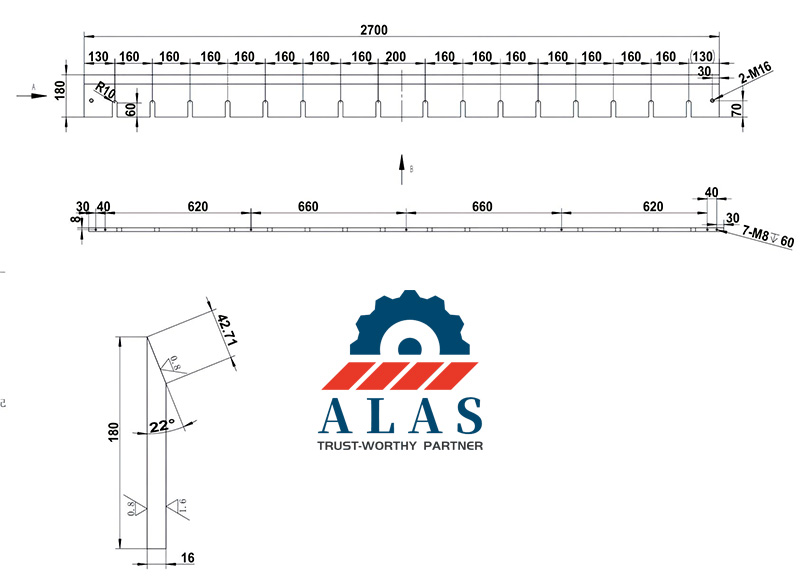
No more tedious searching for hard-to-source part numbers. ALAS forestry blades meet or exceed OEM specifications, serving as direct bolt-on replacements for mainstream commercial chippers and tub grinders:
Morbark® Wood Chipper Replacement Blades (Fits heavy-duty drum & disc models)
Vermeer® Brush Chipper Knives (Direct-fit replacements for BC1000XL, BC1500, BC1800XL series)
Bandit® Commercial Wood Chipper Blades (Compatible with popular hand-fed and whole-tree chippers)
Carlton® & Woods® Mobile Grinder & Mulcher Blades
Custom fabrication, custom hole spacing, and double-edged knife configurations are fully available against your technical drawings or OEM part numbers.
Legal Disclaimer: All manufacturers' names, brand trademarks, logos, machine models, and part numbers mentioned on this page (including Morbark®, Vermeer®, Bandit®, Carlton®, and Woods®) are the registered property of their respective owners. These references are used strictly for cross-reference, technical identification, and compatibility purposes to assist customers in finding the correct replacement parts. ALAS Machinery is an independent manufacturer of high-quality aftermarket replacement components and has no affiliation, authorization, or official connection with any original equipment manufacturers mentioned.
Why Global Forestry Operations Trust ALAS Blades
Precision Dynamic Balancing: Eliminates destructive high-speed vibration, directly protecting your machine’s rotor shafts and costly bearings from premature wear.
Optimized 30° to 35° Cutting Angles: Our specialized 30° cutting edge cuts clean virgin timber faster with lower cutting resistance, while the heavy-duty 35° edge delivers robust structural strength to withstand sand, soil and thick bark.
Reduced Fuel & Maintenance Costs: Ultra-sharp cutting edges lower torque demand on your chipper’s diesel engine, bringing measurable fuel savings and extending intervals between blade re-sharpening.
Frequently Asked Questions (FAQ for Industrial Buyers)
Q1: What is the best blade steel for commercial wood chippers?
A: Selection is fully dependent on your raw feedstock. For mixed hardwood, frozen logs and land-clearing debris, modified A8 steel is strongly recommended thanks to its high impact toughness that resists cracking. For high-volume processing of clean softwood, bamboo or straw, D2 (Cr12MoV) steel offers the best long-term wear resistance.
Q2: What grinding angle should industrial chipper knives adopt?
A: Single or double bevel angles ranging from 30° to 35° are industry standards. The sharper 30° edge speeds up cutting on clean lumber but is susceptible to edge chipping when striking foreign debris. A 35° edge delivers greater structural strength for processing wood mixed with sand, mulch or dirt.
Q3: How often should I sharpen or replace my wood chipper blades?
A: Frequency depends on wood hardness and cleanliness. We recommend inspecting cutting edges every 8 to 10 operating hours. You should sharpen or flip the blades immediately if you notice stringy, uneven wood chips, excessive fine sawdust, or an abrupt drop in engine RPM.
Q4: Are ALAS blades direct-fit replacements for OEM equipment?
A: Yes. Our blades are engineered as fully compatible direct replacements for major brands including Morbark, Vermeer, Bandit, Carlton, Woods and more. Simply provide your machine model or OEM part number for an exact match.
Q5: How do you prevent chipper blades from cracking or shattering under heavy load?
A: Micro-cracks and blade fragmentation usually stem from substandard heat treatment. ALAS applies advanced vacuum heat treatment to stabilize hardness uniformly between HRC 58–62 according to steel grade requirements. This refines internal grain structure, enabling the blade body to absorb extreme kinetic impacts from frozen timber and heavy wood knots without catastrophic fracture failure.


