

Phone:
86-15852949220


 |


ALAS
Nanjing, China
L/C, T/T, Paypal, Money Gram
10
Wooden Crate Packaging
| Quantity: | |
|---|---|
Stable, Uniform Hardness: Precision vacuum heat treatment delivers consistent hardness of HRC 58–62. Excellent hardenability ensures uniform hardness from surface to core, no soft spots, even on thick blade sizes.
Superior Wear Resistance: Fine, evenly distributed carbides effectively resist abrasive wear from high-tensile rebar ribs, delivering far longer service life than standard 9CrSi and ordinary alloy blades.
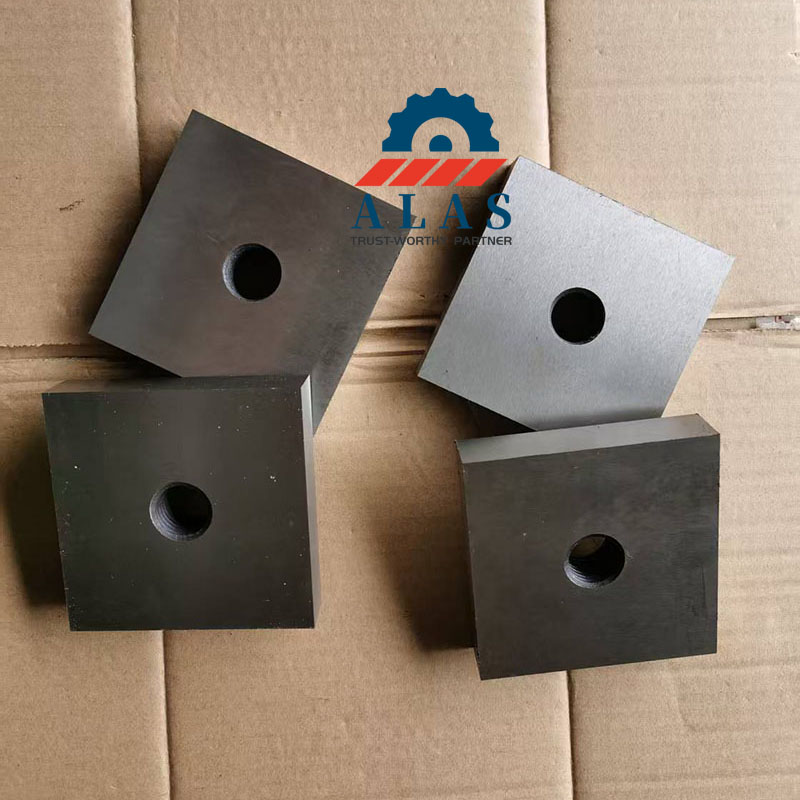
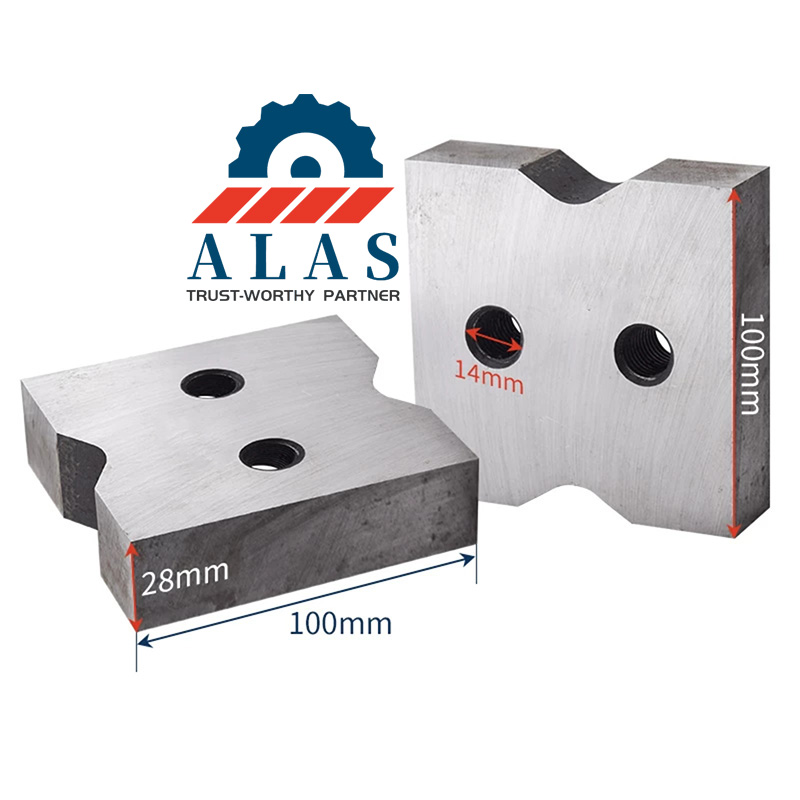
Minimal Heat Deformation: The steel maintains excellent dimensional stability during heat treatment. All ALAS blades are CNC precision ground, ensuring accurate edge geometry and precise bolt hole alignment for perfect machine fitting.
Longer Service Life & Lower Cost: In actual field conditions, Cr12MoV blades last 2–5 times longer than 9CrSi blades. Each blade features 4 indexable cutting edges, greatly reducing replacement frequency and unplanned machine downtime.
| Performance Dimension | Specification | Technical Remarks |
| Material Grade | Cr12MoV(GB) / D2(ASTM) / 1.2601(DIN) / SKD11(JIS) | High-carbon high-chromium cold-work tool steel |
| Heat Treatment | Vacuum Quenching (980–1050°C) + Multi-Stage Tempering | Eliminates internal stress and prevents edge chipping |
| Surface Hardness | HRC 58–62 (Typical: 60HRC) | Rockwell C hardness standard |
| Bending Strength | ≥2500 MPa | Resists deformation and bending under heavy loads |
| Impact Toughness | ≥20 J/cm² (Unnotched) | Balanced toughness to avoid brittle fracture |
| Edge Precision | Precision Ground, Ra ≤ 0.8μm | Delivers clean, square, burr-free cuts |
| Indexable Edges | 4 usable cutting edges per standard square blade | Simply rotate for a fresh sharp edge |
| Single-Edge Lifespan | ≥100,000 cuts (HRB400 Φ25mm rebar) | Slight fluctuation according to actual field conditions |
| Total Blade Lifespan | ≥400,000 cuts (4 edges total) | Greatly reduces tool replacement frequency |
| Installation Accuracy | CNC Machined, bolt hole tolerance ≤±0.02mm | Perfect machine fit, eliminates gap impact damage |
| Performance Dimension | 9CrSi Alloy Tool Steel | Cr12MoV Cold-Work Die Steel | H13 Hot-Work Die Steel |
| International Equivalent | — | D2, SKD11, 1.2601 | H13, SKD61, 1.2344 |
| Hardness (HRC) | 58–60 | 58–62 | 50–55 (Up to 56 for optimized cold shear) |
| Wear Resistance | Good | Excellent (High-hard carbides) | Moderate (Excellent high-temperature retention) |
| Impact Toughness | Moderate | Good (Ideal for standard rebar processing) | Extremely High (Anti-shock structure) |
| Thermal Stability | Low (Hardness drops above 200°C) | Moderate (Stable below 400°C) | High (Maintains hardness up to 600°C) |
| Typical Application | Light-duty carbon steel, small batches, low-budget projects | HRB400/500 high-strength rebar, high-volume continuous shearing | Extra-large diameter (>32mm) rebar, scrap metal, hot-rolling shearing |
| Relative Lifespan | 1× (Baseline) | 2–5× | 3–4× (Only under optimized impact conditions) |
| Tooling Cost | Low | Medium | High |
| ALAS Recommendation | ★★☆ | ★★★★★ | ★★★☆ (Site-specific) |
Why Choose Cr12MoV: It significantly extends blade replacement and maintenance cycles, reducing unplanned downtime and keeping your shearing line running at maximum efficiency during peak production.
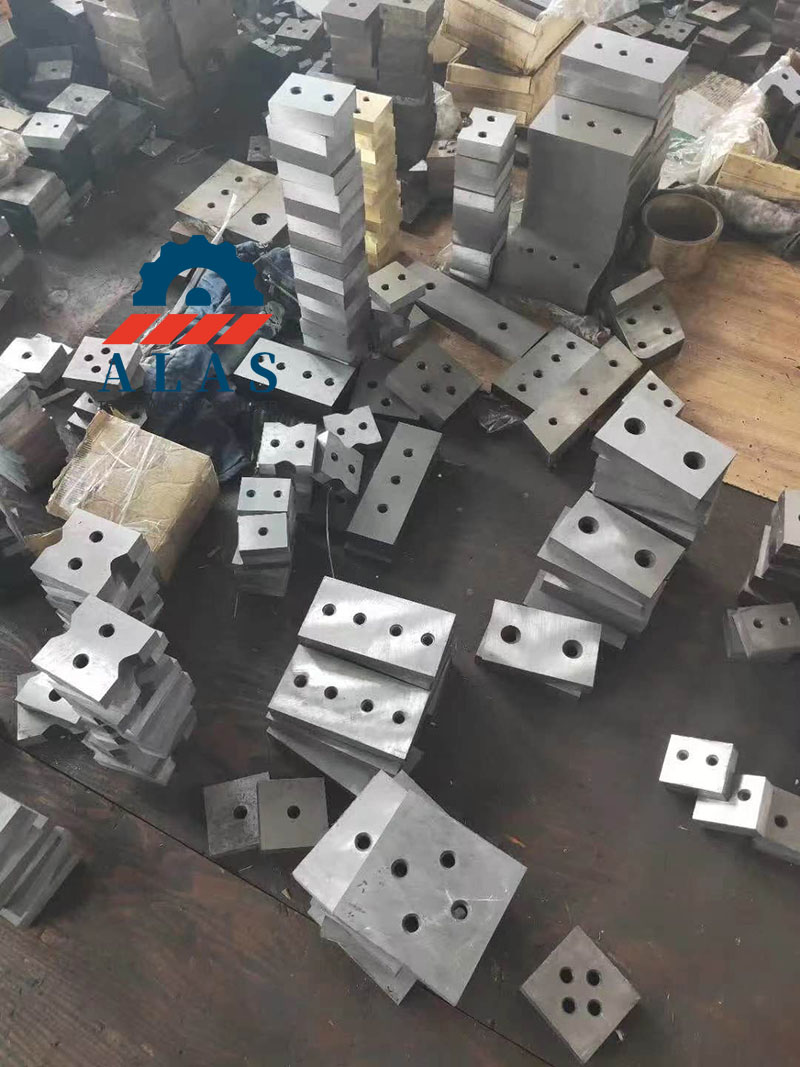
ALAS provides both standard-sized stock and premium OEM/ODM custom manufacturing. We can provide a 1:1 precise dimensional match for your Cr12MoV blades based directly on your machinery model or engineering drawings.
| No. | Product Name | Dimensions (L×W×T mm) | Available Materials | Technical Remarks |
| 1 | Rebar Cutting Blade | 78×78×17 | Cr12MoV / H13 / 9CrSi | Standard square blade, 4 usable edges |
| 2 | Rebar Cutting Blade | 80×80×17 | Cr12MoV / H13 / 9CrSi | Standard square blade, 4 usable edges |
| 3 | Rebar Cutting Blade | 80×80×30 | Cr12MoV / H13 / 9CrSi | Thickened type for large-diameter rebar |
| 4 | Rebar Cutting Blade | 83×83×16 | Cr12MoV / H13 / 9CrSi | Standard square blade, 4 usable edges |
| 5 | Rebar Cutting Blade | 83×83×26 | Cr12MoV / H13 / 9CrSi | Thickened type for large-diameter rebar |
| 6 | Rebar Cutting Blade | 90×90×20 | Cr12MoV / H13 / 9CrSi | Thickened type for heavy-duty cutting |
| 7 | Rebar Cutting Blade | 90×90×26 | Cr12MoV / H13 / 9CrSi | Thickened type for heavy-duty cutting |
| 8 | Rebar Cutting Blade | 100×100×20 | Cr12MoV / H13 / 9CrSi | Thickened heavy-duty model |
| 9 | Rebar Cutting Blade | 100×100×30 | Cr12MoV / H13 / 9CrSi | Ultra-thick type for super large rebar |
| 10 | Rebar Cutting Blade | 110×110×20 | Cr12MoV / H13 / 9CrSi | Large-size heavy-duty blade |
| No. | Product Name | Dimensions (L×W×T mm) | Available Materials | Technical Remarks |
| 11 | Special-shaped Blade | 100×30×75 | Cr12MoV / H13 / 9CrSi | Custom non-standard size |
| 12 | Special-shaped Blade | 85×65×30 | Cr12MoV / H13 / 9CrSi | Custom machine matching size |
| No. | Product Name | Dimensions (L×W×T mm) | Material | Remarks |
| 13 | Handheld Cutter Blade | 26×20×10 | Cr12MoV | For portable electric cutters |
| 14 | Handheld Cutter Blade | 30×24×11 | Cr12MoV | For portable electric cutters |
| 15 | Handheld Cutter Blade | 36×28×14 | Cr12MoV | For portable electric cutters |
| 16 | Handheld Cutter Blade | 40×30×15 | Cr12MoV | For portable electric cutters |
All non-standard special-shaped blades support exclusive customization. We manufacture fully matched blades according to customer equipment drawings, hole positions and special machine models, covering all non-universal industrial rebar cutting equipment.
| Root Cause | Field Manifestation | ALAS Preventive Solution |
| Improper Blade Clearance | Gap over 0.5mm or below 0.1mm causes severe stress concentration on blade edge | Set clearance to 10% of rebar diameter, keep standard gap between 0.2–0.5mm |
| Loose Mounting Bolts | Micro vibration and blade displacement lead to local edge fracture under heavy load | Check and fasten all bolts daily before operation, follow machine manual torque standard |
| Over-Capacity Shearing | Cutting rebar over 1.2 times blade thickness exceeds material bearing limit | Use multi-stage cutting or replace with H13 heavy-duty blades for oversized rebar |
| Rebar Impurities & Hard Spots | Weld joints, slag and hard inclusions cause instant impact overload and edge breakage | Pre-inspect raw materials or upgrade to shock-resistant H13 blades |
| Unrelieved Heat-Treat Stress | Low-quality blades with internal residual stress develop micro cracks during continuous cutting | ALAS blades adopt vacuum quenching + multi-stage deep tempering to eliminate internal stress completely |
| Financial & Operational Metrics | 9CrSi Standard Blades | ALAS Cr12MoV Blades | Business Impact |
| Unit Purchase Price | $18.00 | $42.00 | Higher initial investment |
| Single-Edge Lifespan | 30,000 cuts | 100,000 cuts | 3× longer single-edge service life |
| Total 4-Edge Lifespan | 120,000 cuts | 400,000 cuts | Greatly extended tool cycle |
| Cost per 1,000 Cuts | $0.150 | $0.105 | 30% lower direct tooling cost |
| Annual Blade Consumption | 20.8 pcs | 6.25 pcs | Less procurement & inventory pressure |
| Annual Procurement Cost | $374.40 | $262.50 | Direct cost savings on consumables |
| Annual Downtime Hours | ~40 hours | ~12 hours | 70% downtime reduction |
| Downtime Labor Loss | $6,000.00 | $1,800.00 | Avoid massive idle labor & machine loss |
| Total Annual TCO | $6,374.40 | $2,062.50 | 65% total cost saved per machine |
ROI Conclusion: Although Cr12MoV blades require higher upfront investment, they reduce overall operating costs by more than 60%. The extra cost is fully recovered within 60 days through reduced downtime and replacement frequency.
Regular Edge Rotation: Rotate the blade immediately when burrs, uneven cutting or increased shearing resistance appears. Make full use of 4 indexable edges to achieve 4 times the total service life.
Daily Bolt Inspection: Check and retighten all mounting bolts before daily startup. Loose bolts cause micro vibration and are the main cause of edge chipping.
Clearance Calibration: Readjust blade clearance every time you change rebar specifications. Maintain a 0.2–0.5mm gap to reduce friction and premature wear.
Seat Surface Cleaning: Clean iron filings, scale and grit on the blade seat during every replacement or rotation, ensuring flat mounting and uniform force bearing.
Mechanical Lubrication: Keep machine guide rails and moving parts well lubricated to reduce frictional heat, avoiding thermal softening of blade edges.
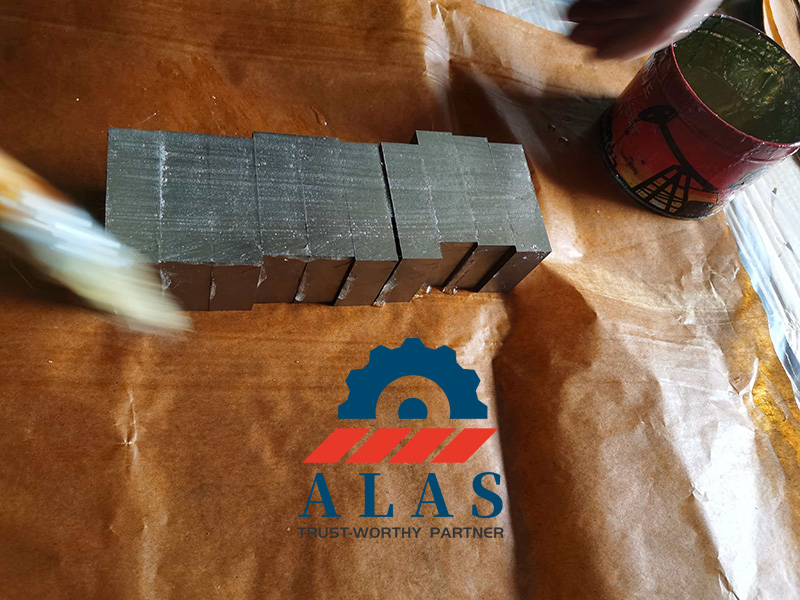
Anti-Rust Treatment: Each blade is coated with high-performance industrial anti-rust oil for long-term storage and marine transportation.
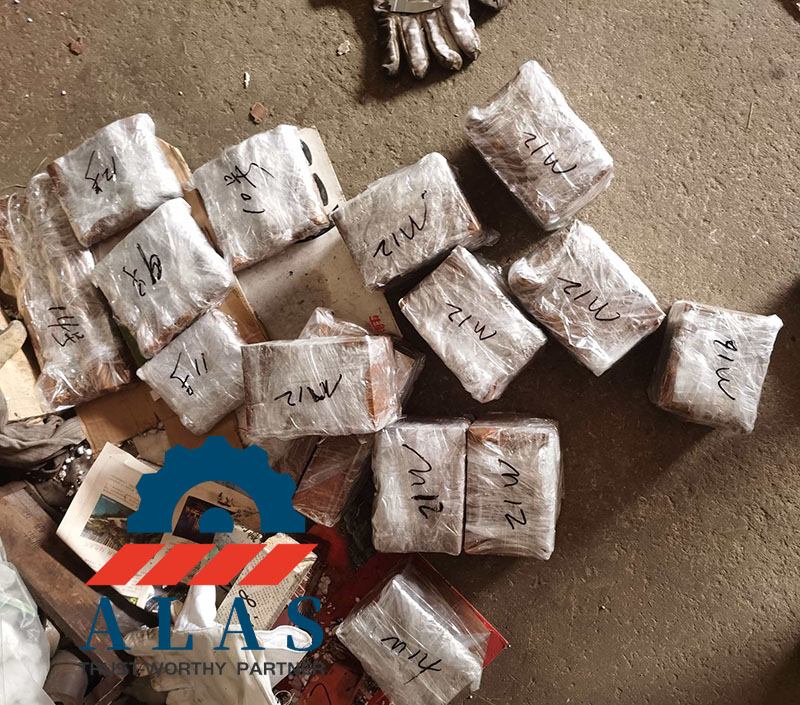
Vacuum Sealing: Single blade vacuum packed with thick waterproof film to isolate moisture and oxidation.
Impact-Proof Packing: Packed in padded ISPM-15 standard plywood cases to prevent extrusion and collision deformation.
Lead Time: Standard in-stock sizes ship within 48 hours. Custom OEM/ODM orders take 10–15 working days for precision processing.
A1: Cr12MoV is equivalent to D2 in chemical composition, but ALAS adopts strict vacuum heat treatment and grain refinement process. Uniform carbide distribution improves overall wear resistance and stability, obviously better than ordinary commercial D2 blades.
A2: Yes. With stable HRC 60 hardness, our blades fully adapt to HRB500 high-tensile rebar. With correct clearance and firm installation, single edge can reach 20,000 to 60,000 cuts depending on the rebar diameter.
A3: Almost not. All ALAS blades pass ultrasonic flaw detection and full hardness inspection before delivery. 90% of on-site chipping is caused by loose bolts, incorrect clearance or over-load cutting. We provide free remote calibration support.
A4: It is safe for rebar below 300°C with slight lifespan reduction. For materials over 400°C, H13 hot-work blades are mandatory to avoid rapid wear and edge fracture.
A5: Replace the working edge once obvious rebar burrs, skewed cutting surface or sudden hydraulic pressure increase occurs, which indicates edge dulling.
A6: Absolutely. For regular-scale rebar processing plants, Cr12MoV reduces comprehensive operating costs by 65% annually. The investment can be fully recovered within 2 months.
A7: Yes. We provide paid sample evaluation service. If the sample meets the promised lifespan standard on your site, the sample fee will be fully deducted from your bulk order payment.
Nanjing Alas International Co., Ltd. is a professional industrial tooling manufacturer focused on shear blades, bending dies, shredder blades, and custom wear parts. We offer full application engineering, material selection, setup guidance, and after-sales support to global customers.
Tell us your requirements, and our engineering team will provide professional solutions for blade specification, tool life optimization, and cost-effective production.