


Phone:
86-15852949220


 |


| Quantity: | |
|---|---|
Keep cutting fast
Ensure operator safety
Protect your machine from damage
Rapid Blunting: You need to stop work often to change blades, slowing down construction.
Breaking & Chipping: Cheap blades easily chip or break when cutting hard rebar, putting operators at risk.
Machine Damage: Dull blades make the motor and gears work harder, leading to costly fixes and shorter machine life.
Excellent wear resistance and toughness
Stable, long-lasting cutting (no deformation or chipping)
Cost-effective for international trade
Reduce blade changes, shipping costs, and customs fees
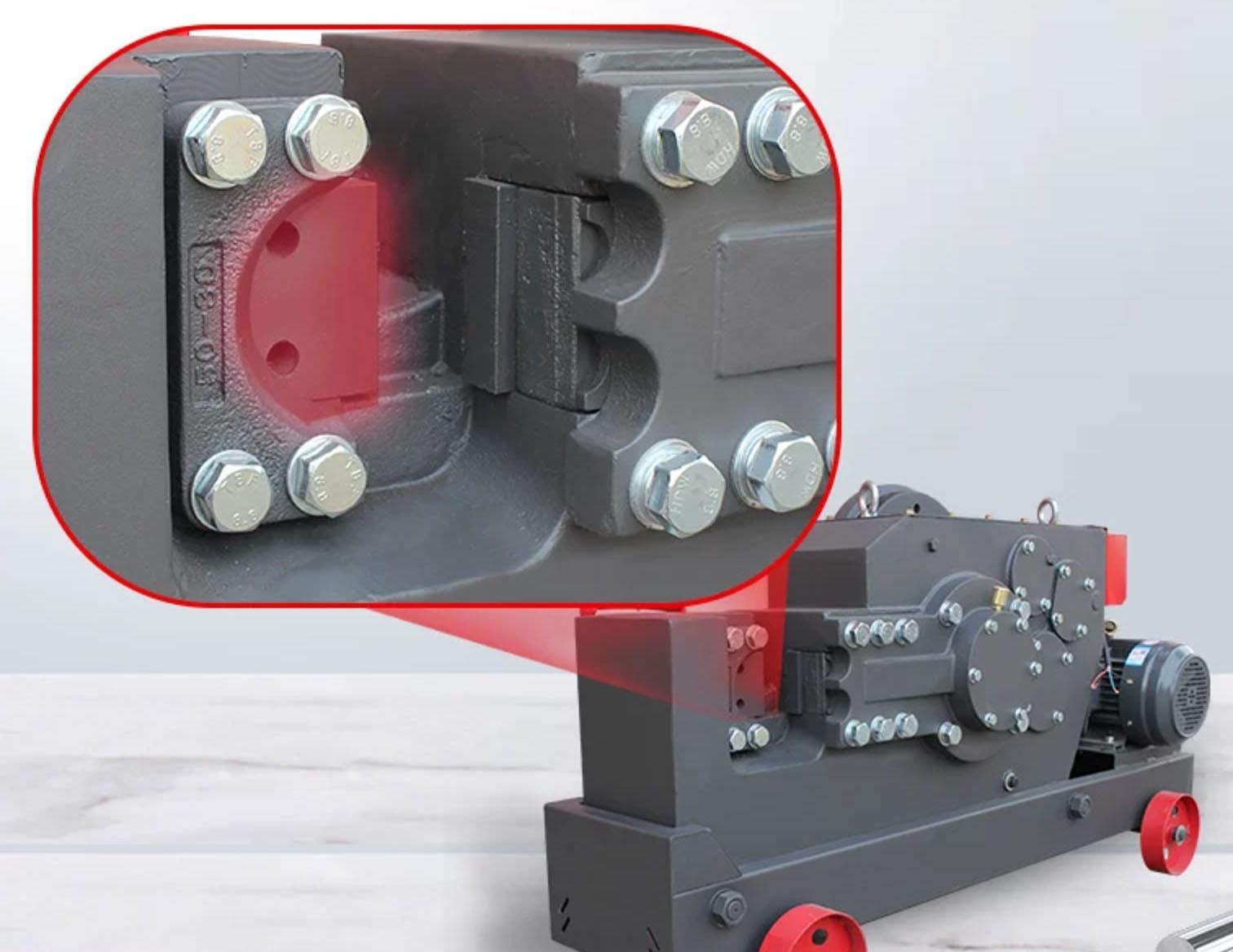
Perfect for GQ50 rebar cutting machines
Cheaper blades only harden the surface—ours can be ground and reused many times
Uniform internal structure prevents cracking during heavy cutting
Less vibration
Longer blade holder life
Clean, smooth cuts every time
Application: GQ40, GQ45, GQ50 rebar cutters
Material: H13 / Cr12MoV alloy steel
Hardness: HRC 50-62
Shape: Square or rectangular (depends on machine design)
Capacity: Cuts round steel, deformed bars, and carbon steel up to 50mm
Check Alignment: Adjust the gap between moving and fixed blades for clean cuts.
Lubricate Often: Keep machine parts oiled and free of scale to reduce friction.
Rotate Edges: Use all four blade edges to extend life.
Tighten Bolts: Check blade bolts daily—loose blades often break.
No middleman markups—factory-direct prices
Global shipping
Anti-rust treatment and reinforced wooden packaging
Ready to install when delivered (for Southeast Asia, Middle East, South America, etc.)
Model | Typical Blade Dimension (mm) | Thickness (mm) | Hole Configuration | Mainstream Materials | Key Parameters of Adaptable Machine |
GQ40 | 83×83 / 90×90 | 16–20 | Single-hole, Double-hole | H13, 9CrSi | Cuts Φ6–40mm round steel; Motor power 2.2kW; Overall weight ≈485kg |
GQ50 | 90×90 / 100×100 | 20–28 | Double-hole, Four-hole | H13, CR12MOV | Cuts Φ6–50mm round steel; Motor power 4kW; Overall weight ≈640kg |
GQ60 | 100×100 / 130×130 | 28–30 | Mainly Four-hole | H13, H13K | Cuts Φ6–55mm round steel; Motor power 5.5–7.5kW; Overall weight ≈1200kg |
Base Grade | Steel Category | Chinese Standard GB/T 1299 | American Standard ASTM | German Standard DIN (W-Nr.) | Japanese Standard JIS |
H13 | Hot Work Die Steel | 4Cr5MoSiV1 | H13 | 1.2344 | SKD61 |
Cr12MoV | Cold Work Die Steel | Cr12MoV | 1.2601 | SKD11 | |
9CrSi | Alloy Tool Steel (Cutting Tool Steel) | 9CrSi | 1.2108 |
English: Rebar Cutting Machine Blade | Reinforcing Bar Cutter Knives
French (Français): Lame de machine à couper le fer à béton | Couteaux pour coupe-boulons
Portuguese (Português): Lâmina de máquina de corte de vergalhão | Facas para corte de aço
Polish (Polski): Nóż do maszyny do cięcia prętów zbrojeniowych | Noże do giętarek
Turkish (Türkçe): İnşaat Demiri Kesme Makinesi Bıçağı | Demir Kesme Makas Bıçakları
Vietnamese (Tiếng Việt): Lưỡi dao máy cắt sắt xây dựng | Dao cắt thép thanh thủy lực
Thai (ภาษาไทย): ใบมีดเครื่องตัดเหล็กเส้น | ใบมีดสำหรับเครื่องตัดเหล็กก่อสร้าง
Filipino: Blade ng Machine sa Pagputol ng Rebar | Kutsilyo para sa Pagputol ng Bakal
Arabic (العربية): شفرة ماكينة قص حديد التسليح | سكاكين مقصات قضبان الحديد
Hindi (हिन्दी): सरिया काटने वाली मशीन का ब्लेड | स्टील बार कटिंग चाकू
Indonesian (Bahasa Indonesia): Pisau Mesin Pemotong Besi Beton | Bilah Potong Rebar Hidrolik
Malay (Bahasa Melayu): Bilah Mesin Pemotong Besi Rebar | Pisau Pemotong Keluli Konstruksi
Dutch (Nederlands): Mes voor betonstaal snijmachine | Betonstaal snijbladen
Swedish (Svenska): Blad för armeringsklippmaskin | Armeringsklippskär
Hungarian (Magyar): Betonacél vágógép penge | Betonacél nyíró pengék
Greek (Ελληνικά): Λεπίδα μηχανής κοπής οπλισμού | Μαχαίρια κοπής σιδήρου


Based on different working conditions and budget requirements, we offer three general industrial-grade alloy steel materials:
9CrSi (Alloy Tool Steel): An economical choice. It has good hardenability and machinability, suitable for cutting ordinary medium-to-low strength rebar, and is widely used in small and medium-sized projects.
Cr12MoV (Cold Work Die Steel): High-end wear-resistant type. High carbon and high chromium content, after heat treatment, it has excellent wear resistance, making it an ideal choice for continuous cutting of high-strength rebar. Its service life is much longer than 9CrSi.
H13 (Hot Work Die Steel/Red Hard Steel): High toughness and high wear resistance. It exhibits excellent resistance to chipping and thermal stability in rebar cutting applications, especially suitable for high-speed production lines or online cutting of hot-rolled rebar, and cutting of ultra-thick rebar and composite materials of scrap rebar.
Chipping is usually caused by the following factors:
Insufficient toughness: Using ultra-hard but low-toughness materials to cut large-diameter or ultra-hard rebar can easily lead to brittle fracture. In this case, we recommend switching to H13 material, as its excellent toughness can effectively absorb impact forces.
Improper clearance: Too large or too small a gap between the upper and lower blades will lead to uneven stress, resulting in chipping.
Insufficient heat treatment: Internal stress is not completely eliminated. All our blades use vacuum heat treatment technology to ensure uniform hardness from the inside out, greatly reducing the chipping rate.
Wear resistance: Cr12MoV has significantly better wear resistance than 9CrSi. Under the same working conditions, the number of cuts for Cr12MoV is usually 2-3 times that of 9CrSi.
Cost: 9CrSi is more cost-effective, suitable for projects sensitive to initial purchase costs; although the unit price of Cr12MoV is slightly higher, its lower replacement frequency results in a lower overall cutting cost per ton of rebar.
For high-strength or ribbed rebar, we strongly recommend H13:
If you are facing extremely high operating intensity and are concerned about downtime due to blade chipping, choose H13. Its impact fatigue resistance is top-notch in the rebar processing industry.
Yes. We understand that blade specifications vary among different equipment brands (e.g., from Italy, Germany, or China). We are equipped with a full set of CNC machining equipment, and you only need to provide the following information:
Detailed drawings (including length, width, thickness, and hole dimensions).
Material requirements (9CrSi, Cr12MoV, or H13).
Specifications of the workpiece to be processed (rebar diameter and strength grade).
We can provide a 1:1 precise customized solution.
Regular rotation: Our blades are usually designed with 4 or 8 cutting edges. Please rotate the blade promptly when one cutting edge becomes dull.
Tighten bolts: Ensure the blades are securely installed. Any slight looseness will cause destructive impact during the cutting process.
Control the gap: Adjust a reasonable blade gap according to the rebar diameter, usually about 10% of the rebar diameter.
Nanjing Alas International Co., Ltd. is a professional industrial tooling manufacturer focused on shear blades, bending dies, shredder blades, and custom wear parts. We offer full application engineering, material selection, setup guidance, and after-sales support to global customers.
Tell us your requirements, and our engineering team will provide professional solutions for blade specification, tool life optimization, and cost-effective production.