

Phone:
86-15852949220


Views: 17 Author: ALAS-MT Publish Time: 2026-05-13 Origin: Site
In metalworking workshops, metal shear blades work just like common scissors. The cutting performance can be seen directly from the first use. Properly selected blades deliver neat cuts with few burrs and less frequent replacements. If you pick the wrong type, the blades will chip and wear out quickly. Frequent shutdowns for regrinding will seriously hold back production.
As a professional industrial tool manufacturer, ALAS develops and produces high-precision blades for metal processing. We provide full technical support from selection to after-sales service, helping customers solve all kinds of cutting problems.
A variety of blade materials are available on the market. The commonly used grades at ALAS include 9CrSi, Cr12MoV, D2, H13, H13K, LD, DC53 and powder metallurgy steel. You do not need to learn complicated metallurgy knowledge. Simply follow these three practical steps based on workpiece material, plate thickness and daily output to find the right blade.
Different metal materials place different requirements on blade wear resistance, impact resistance, anti-sticking performance and high temperature resistance. Ordinary carbon steel causes light cutting load. Stainless steel and high-strength steel wear blades faster, while aluminum, copper and other soft metals tend to stick to blades. You can refer to the table below for selection.
Workpiece Material | Recommended Blade Material | Features |
|---|---|---|
Mild Carbon Steel (Q195, Q235, 45# Steel) | 9CrSi, Cr12MoV (ALAS Standard Model) | Cost effective, good wear resistance and easy to regrind |
Thin Stainless Steel (≤4mm) | D2, SKD11 (ALAS Wear Resistant Series) | Great wear resistance and anti-sticking performance |
Thick Stainless Steel (>4mm), High-strength Steel | LD, DC53, H13, H13K (ALAS High Toughness Series) | High toughness to resist heavy cutting impact and prevent edge chipping |
Aluminum, Copper, Brass | D2; 9CrSi for cost saving | D2 avoids material adhesion and ensures smooth workpiece surface |
Hot Cut Plates | H13, H13K (ALAS Special Grade for Hot Working) | Excellent heat resistance and red hardness, will not soften at high temperature |
High precision work, mass production & long service life demand | Powder Metallurgy Steel (ASP23, ASP60, ALAS High-end Custom Model) | Balanced wear resistance and toughness with top overall performance |
Here is a practical tip. If you process mixed materials and cannot confirm the exact type, D2 with hardness of HRC 58-62 is a universal choice recommended by ALAS. It works well for most cold cutting tasks, including carbon steel, thin stainless steel, aluminum and copper sheets.

Many people hold a wrong view that higher hardness means longer service life. Actually, the matching between blade toughness and plate thickness is the key to reliable use. Cutting impact changes greatly with plate thickness. Always follow the applicable thickness range of each material instead of choosing ultra-hard blades blindly.
Plate thickness: 0.3mm – 10mm
Choose Cr12MoV or D2, and keep the hardness at HRC 58-62. These materials feature high hardness and strong wear resistance. They are suitable for high-speed slitting, strip cutting and precision shearing of thin and medium plates, stainless steel and non-ferrous metals.
Note: The maximum applicable thickness for Cr12MoV and D2 is 10mm. These two materials have limited toughness. They are easy to chip or crack under strong impact when cutting plates thicker than 10mm. All blades of this series from ALAS adopt vacuum heat treatment to keep hardness even and stable.
Plate thickness: 10mm – 20mm and above
Choose H13 or H13K with hardness controlled within HRC 52-58. These blades have good toughness, thermal fatigue resistance and impact resistance, and are not easy to break. They fit heavy-duty shears, hot cutting of medium and thick plates and other high-impact working scenarios. ALAS H13K is an upgraded version with better toughness and high temperature stability.
To sum up, it makes no sense to pursue high hardness simply. When cutting thick plates, toughness shall be put first. Abide by the thickness limit of each material to avoid blade damage effectively.

This is a point many workshop operators ignore. Do not make decisions only by unit price. Production loss caused by frequent blade replacement and regrinding downtime is usually much higher than the price difference between different blades. ALAS sticks to the principle of lowest total cost of ownership, helping customers balance procurement cost and long-term operating cost.
Production Condition | Recommended Solution | Features |
|---|---|---|
Small batch production, intermittent use | 9CrSi (ALAS Economy Model) | Meet basic working needs with low procurement and regrinding cost for occasional operation |
Daily continuous production, regular volume work | D2, Cr12MoV (ALAS Main Model) | High hardness and good wear resistance extend regrinding cycles and reduce downtime. For plates from 0.3mm to 10mm only |
Mass production, two-shift operation, automatic production line | Powder metallurgy steel, high-toughness D2, H13, H13K (ALAS High-end Long-life Model) | Great overall performance extends blade service life. Balanced wear resistance and impact resistance ensure stable continuous production |
Take real cases for reference. A low-cost blade set costs $200 currency units and needs replacement 3 times every month. The annual cost for blades reaches $7200 units. Each replacement takes 1 hour of downtime, adding up to 36 hours per year.
An ALAS high-quality blade set costs $600 and requires replacement once every three months. The total annual cost comes to $2,400, with downtime of just 4 hours in a year. It is clear that buying cheap blades will lead to higher overall production cost in the long run.
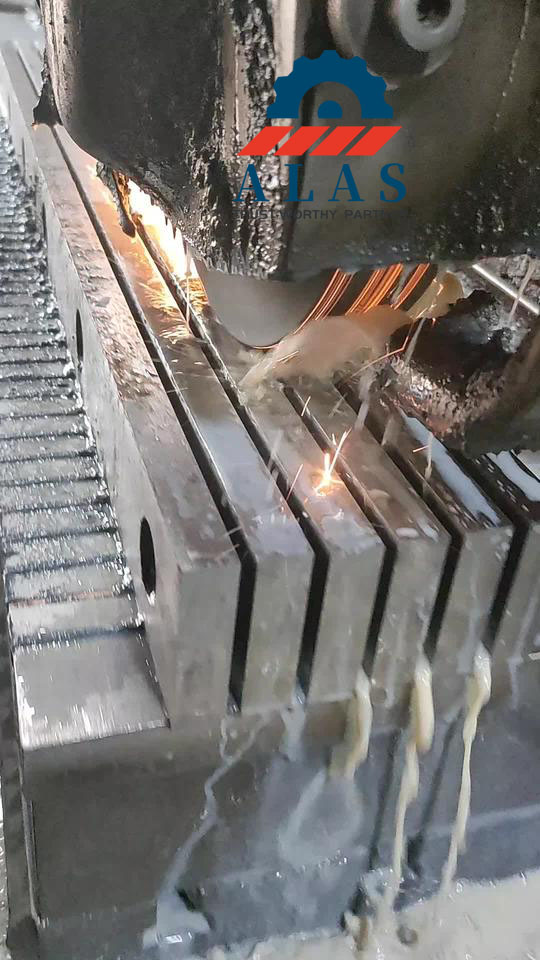
Blades made of the same material may have totally different service life. Heat treatment determines the overall quality of blades, and fine processing will further improve their performance.
All ALAS blades are processed with vacuum heat treatment to achieve uniform hardness across the whole blade without soft areas. We also conduct edge passivation to remove burrs and stress points on cutting edges. This improves impact resistance and slows down wear.
Most low-end blades are treated with salt bath furnace or ordinary air furnace. Only the surface reaches required hardness while the inner part stays soft. Such products have no edge passivation process and will fail after short-time use.
When purchasing blades, you can ask suppliers about heat treatment and processing techniques. Products with vacuum heat treatment and edge passivation are reliable. Every ALAS blade goes through multi-point hardness test and flatness inspection to guarantee traceable quality.
You do not have to chase expensive materials or famous brands when selecting shear blades. Just follow the three rules below:
Select material by workpiece: Use D2 for stainless steel, H13 or H13K for hot cutting, and 9CrSi or Cr12MoV for ordinary carbon steel.
Select material by plate thickness: Follow the thickness limit strictly. Choose Cr12MoV or D2 for 0.3mm to 10mm plates for precision and high-speed cutting. Choose H13 or H13K for plates over 10mm under high-impact conditions. Remember higher hardness does not equal longer service life.
Select material by production volume: Choose high-quality blades for long-term mass production. Do not save small money but suffer big losses.
ALAS provides a full range of blade materials and mature production technology. We can offer customized solutions for your actual working conditions and help you cut total operating cost.
Nanjing Alas International Co., Ltd. is a professional industrial tooling manufacturer focused on shear blades, bending dies, shredder blades, and custom wear parts. We offer full application engineering, material selection, setup guidance, and after-sales support to global customers.
Tell us your requirements, and our engineering team will provide professional solutions for blade specification, tool life optimization, and cost-effective production.