

Phone:
86-15852949220


Views: 115 Author: ALAS-MT Publish Time: 2025-01-07 Origin: Site
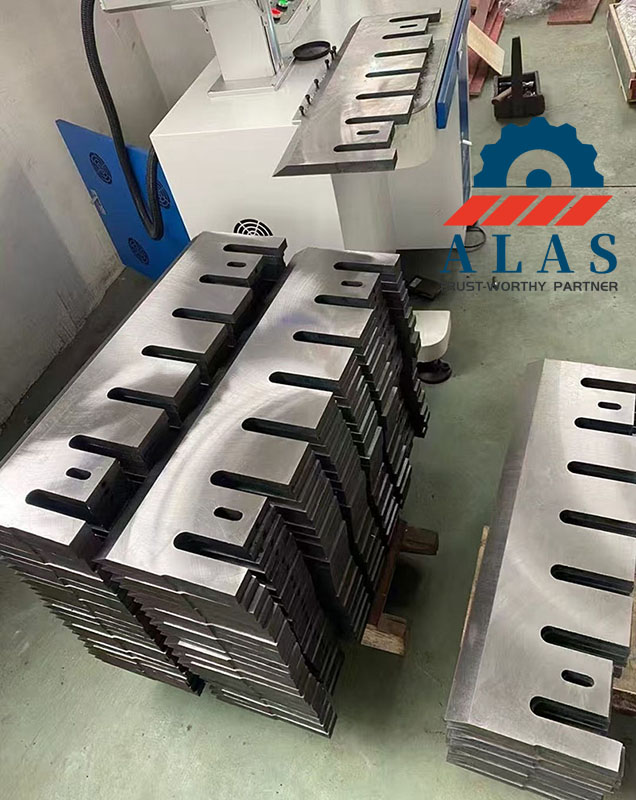
| Comparison Items | A8 | A8B (Modified A8) | D2 |
|---|---|---|---|
| Steel Category | Cold Work Tool Steel | Modified Matrix Steel | High-Carbon High-Chromium Steel |
| Core Characteristics | Maximum impact resistance to stop blade cracking. | Balanced toughness and wear life; stable at high cutting speeds. | Maximum abrasive wear resistance and edge retention. |
| Typical Hardness | HRC 56–58 | HRC 58–60 | HRC 60–62 |
| Toughness | ★★★★★ | ★★★★☆ | ★★☆☆☆ |
| Wear Resistance | ★★★☆☆ | ★★★★☆ | ★★★★★ |
| Thermal Stability | Good | Excellent (Resists high friction heat) | Moderate (Prone to softening under high heat) |
| Corrosion Resistance | Standard | Improved | High (Semi-Stainless, ~12% Cr) |
| Cost Profile | Economical | Mid-Range | Premium |
Engineering Note: Even when custom vacuum heat treatments bring A8B close to D2's working hardness, their wear mechanisms differ. A8B relies on a tough steel matrix to stop micro-chipping under impact. D2 utilizes a dense volume of primary chromium carbides for sliding abrasion resistance, which increases brittleness under shock loads.
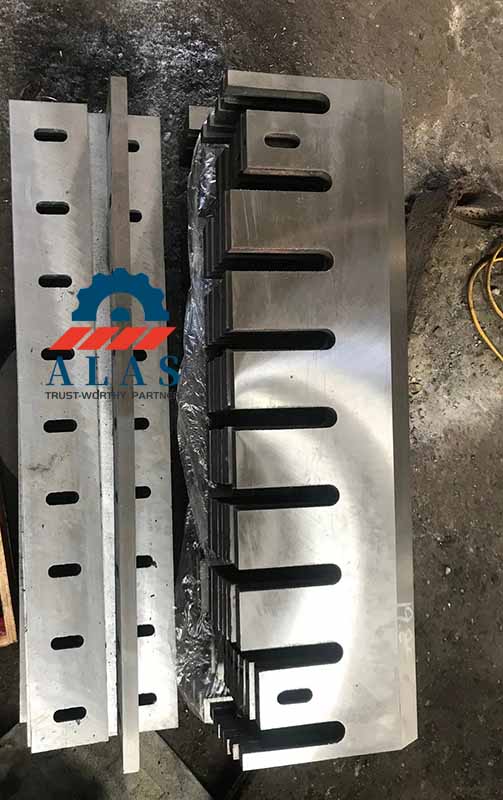
With low carbon and a balanced chromium-molybdenum-vanadium matrix, AISI A8 focuses on mechanical elasticity and notch toughness over absolute hardness. After vacuum tempering, it operates within a stable HRC 56–58 window.
When to use: Use A8 for small-to-medium branch shredders and drum chippers running unpredictable feedstocks. It prevents body splitting and edge cracking when processing dense hardwoods, logs with dirt, knotty wood, or frozen timber.
Instead of traditional high-chromium (8% Cr) design paths, ALAS A8B uses a custom low-carbon, high-vanadium micro-alloying route. This metallurgy maintains high matrix toughness while raising working hardness to HRC 58–60, improving hot-hardness and wear life.
When to use: Specify A8B for high-volume, non-stop industrial operations like pulp mills, paper manufacturing, and biomass pellet plants. It keeps a sharp edge during long runs on tough wood varieties like eucalyptus or rubberwood without softening from frictional heat.
AISI D2 is a high-carbon, high-chromium tool steel engineered for HRC 60–62 hardness. While it delivers the longest running times between maintenance regrinds, its dense volume of chromium carbides makes the blade brittle under sudden shocks.
When to use: Choose D2 for high-capacity chipping of clean, highly abrasive materials such as softwoods, bamboo, sawmill residue, and straw. To prevent macro-cracking, ensure feedstocks are completely free of stones, dirt, or embedded metal fasteners.
High Impact & Mixed Feedstocks (Logs, knots, frozen wood) → Specify A8 to eliminate unexpected blade breakage and splitting.
Continuous Hardwood Processing (Pulp, paper, large-scale biomass) → Specify A8B for the best balance of tool toughness and continuous uptime.
High-Abrasion & Low-Impact (Clean softwood, bamboo, agricultural straw) → Specify D2 to maximize edge retention and minimize grinding frequency.
A blade's performance comes down to its chemical composition (mass percentage, wt%). Understanding how alloy ratios affect wear mechanisms helps procurement teams choose the right tool steel for their operating conditions.
| Element | A8 | A8B (Modified) | D2 | Engineering Function & Impact on Tool Life |
|---|---|---|---|---|
| Carbon (C) | 0.50–0.60% | 0.55–0.65% | 1.40–1.60% | Sets base matrix hardness. Lower levels in A8/A8B protect structural toughness, while D2’s high carbon content triggers massive carbide precipitation for maximum wear life. |
| Chromium (Cr) | 4.75–5.50% | 5.20–6.00% | 11.0–13.0% | Improves hardenability and chromium-carbide formation. At ~12% Cr, D2 acts as a "semi-stainless" steel, resisting corrosion from acidic wood saps. |
| Molybdenum (Mo) | 1.15–1.65% | 1.40–1.80% | 0.70–1.20% | Refines grain structures to prevent temper brittleness. Higher levels in A8B deliver excellent thermal stability during continuous runs. |
| Vanadium (V) | 0.80–1.40% | 1.00–1.50% | 0.50–1.10% | Forms hard vanadium carbides (VC) to resist abrasive wear. The micro-alloyed boost in A8B minimizes micro-chipping under high-speed feeds. |
| Tungsten (W) | 1.00–1.50% | 1.20–1.70% | — | Enhances hot hardness. Working with Mo, the tungsten addition allows A8B blades to resist edge softening from constant friction. |
| Mn & Si | Standard | Standard | Standard | Essential deoxidizers that stabilize melt quality and upgrade tensile strength during custom vacuum heat treatments. |
| P & S | ≤0.030% | ≤0.025% | ≤0.030% | Kept to strict minimums to prevent grain-boundary embrittlement under heavy impact. |
Mismatched tool steel does more than dull your edges quickly. Operating with fractured blades or bad wear profiles creates severe rotor vibration. This dynamic play accelerates structural fatigue and causes premature failure of your expensive machine bearings.
At ALAS Machinery, we focus on lowering your tooling cost per ton by customizing the production lifecycle of your chipper blades based on your specific feedstock types (such as frozen fiber, sand-heavy recycled timber, or high-density eucalyptus):
Custom Alloy Adjustments: Fine-tuning the carbide and matrix balance to match the exact abrasive or impact stress of your wood stream.
Advanced Vacuum Heat Treatment: Achieving a highly stable HRC 58–60 profile for our high-performance A8B series, ensuring consistent, through-hardened performance from the surface to the core.
Application-Specific Cutting Angles: Machining precise 30° or 35° cutting bevels based on your equipment specifications to optimize chip uniformity and reduce main motor load.
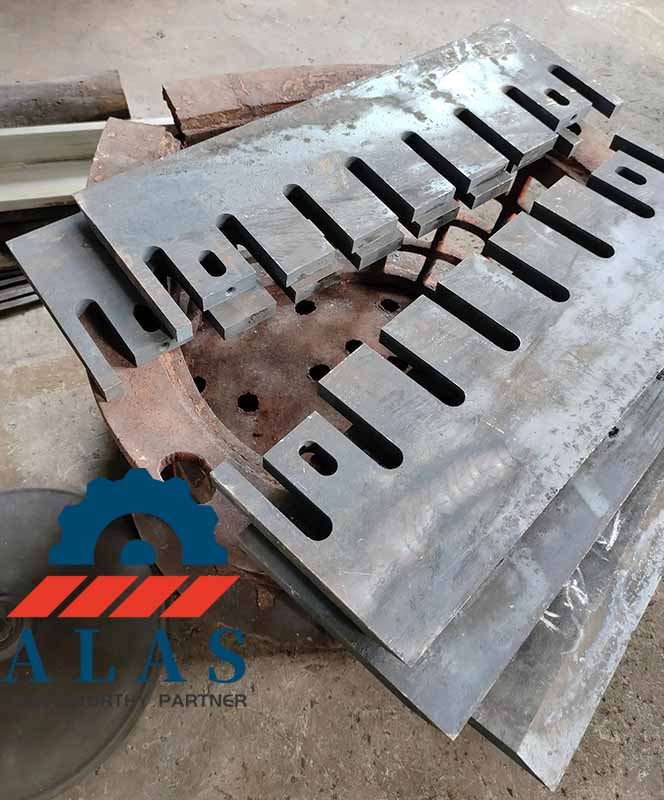
AISI/ASTM A8 | GB ~5Cr5MoSiV1: High impact mitigation and fracture toughness matrix.
ALAS Premium A8B: Proprietary tungsten-vanadium micro-alloyed matrix steel. Specialized for extended-run multi-application continuous logging.
AISI/ASTM D2 | DIN 1.2379 / X153CrMoV12 | JIS SKD11 | GB Cr12Mo1V1: High-carbon, high-chromium cold-work matrix for extreme abrasion resistance.
A8 & Premium A8B Resharpening: Due to refined matrix grain structures and lower chromium thresholds, both grades exhibit excellent grindability. Complete edge restoration is executed via standard vitrified aluminum oxide (Al₂O₃) grinding wheels without localized thermal shock or stress‑induced micro‑cracking risks.
AISI D2 / SKD11 Resharpening: The high volume fraction of primary chromium carbides makes D2 highly resistant to conventional grinding. To eliminate localized thermal annealing (soft-skin degradation down to 40 HRC) and visible grinding cracks, toolrooms must specify premium cubic boron nitride (CBN) or specialized porous silicon carbide wheels, enforcing lighter feed rates under constant, high-volume fluid flood cooling.
Answer: Catastrophic edge failure under sub-zero harvesting is a structural embrittlement failure common with brittle, high-carbon D2 tool steel running against frozen timber or ice knots. Operations must transition to AISI A8 or Premium A8B. Their medium-carbon, molybdenum-tungsten matrix maintains high base structural elasticity at low temperatures, absorbing peak kinetic shock waves elastically rather than micro-shattering.
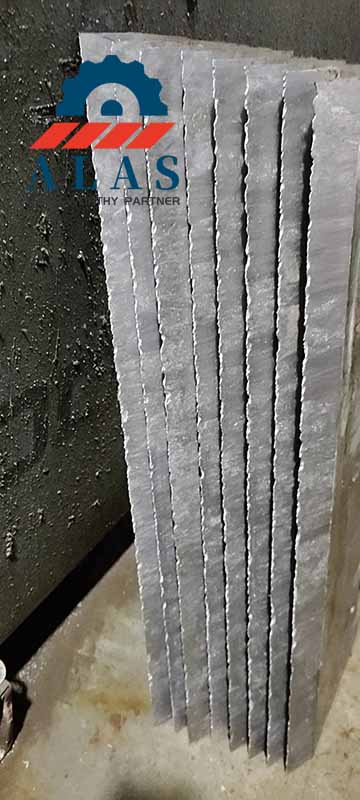
Answer: No. Due to high notch sensitivity and a lower fracture threshold, D2 is prone to macro-cracking or catastrophic splitting when impacting foreign tramp metal. Recycled building formwork, demolition timber, and pallets containing staples or framing nails require an immediate transition to high-toughness tool steels like AISI A8 or thermal-stable AISI H12/H13 hot-work alloys to preserve operational safety limits.
Platform Compatibility: Turnkey fleet maintenance inventory serves as direct-fit alternatives for compatible Bandit, Vermeer, Morbark, Timberwolf, Peterson, Jenz, and Bruks machinery lines.
Legal Disclaimer: ALAS is an independent manufacturer of high-quality aftermarket wear parts. ALAS has no official affiliation with, authorization from, or license from any original equipment manufacturers (OEMs) referenced on this platform. All machinery brand names, specific equipment series, and registered trademark designations are cited strictly for fitment parameters and cross-reference validation only.

Frustrated by Edge Shattering, Thermal Softening, or Tool Steel Mismatch?
Stop increasing your total cost of ownership (TCO) with generic aftermarket parts that edge-roll or fracture under continuous feed loads. Partner with ALAS for verified, data-driven metallurgy tailored to your biomass or pulp-mill waste stream. Ground on automated CNC centers to strict dimensional tolerances, our blades are vacuum heat-treated to grade-specific hardness windows for uniform hardness through the section. Use AISI A8 to greatly reduce the risk of catastrophic body splitting on frozen logs or knots; upgrade to tungsten-modified Premium A8B to resist friction-induced softening during 24/7 continuous hardwood runs; or specify high-chromium AISI D2 for excellent sliding wear resistance on clean softwood. Contact our engineering team today for a factory-direct wholesale quote and custom CAD drawings, with response within 12 hours.
Nanjing Alas International Co., Ltd. is a professional industrial tooling manufacturer focused on shear blades, bending dies, shredder blades, and custom wear parts. We offer full application engineering, material selection, setup guidance, and after-sales support to global customers.
Tell us your requirements, and our engineering team will provide professional solutions for blade specification, tool life optimization, and cost-effective production.